
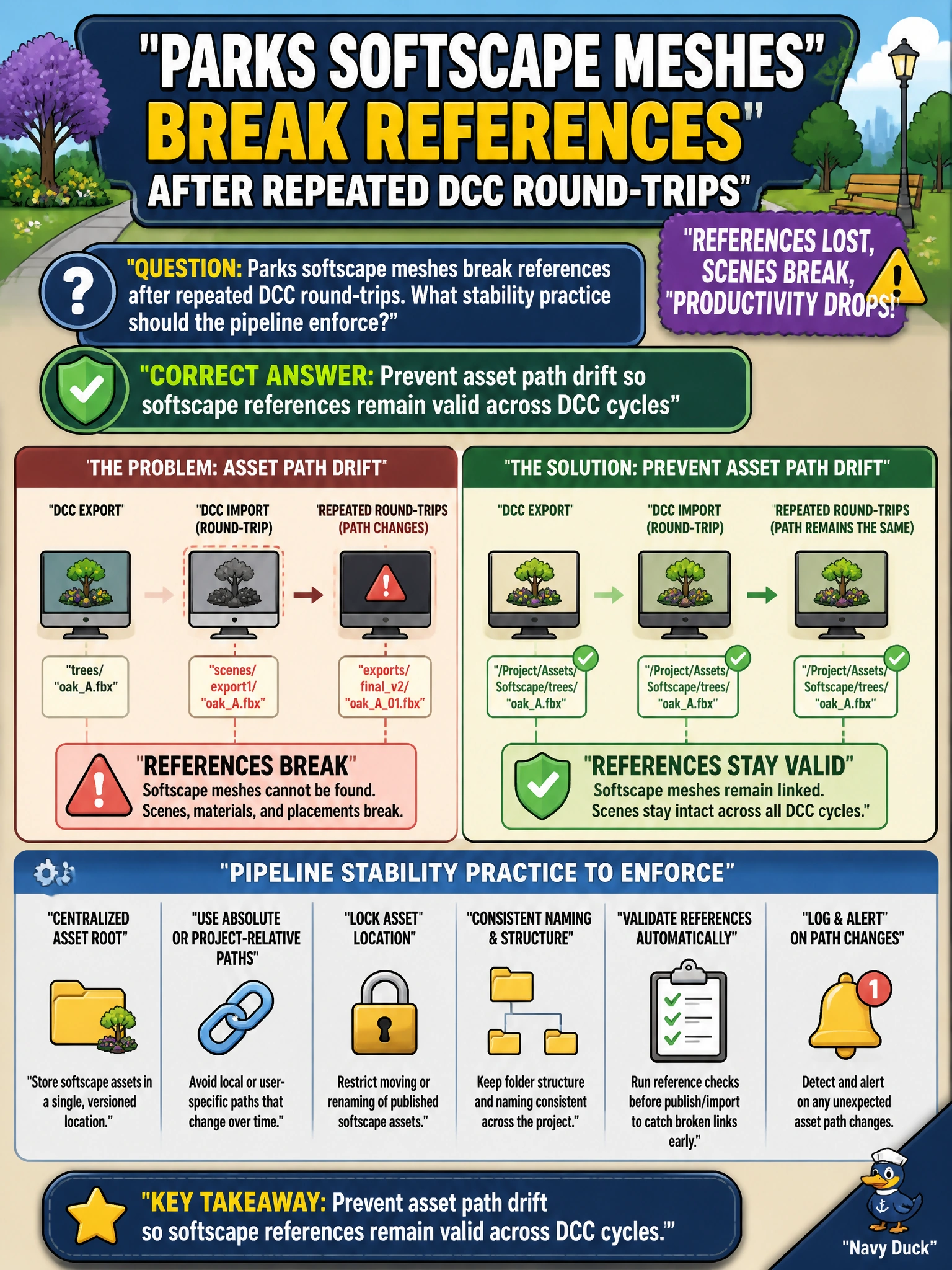
Parks softscape meshes break references after repeated DCC round-trips. What stability practice should the pipeline enforce?
Select an answer to reveal the explanation.
Short Explanation
Softscape dies when paths wander. Lock down path stability across DCC cycles so plaza references keep finding the same bushes.
Full Explanation
Parks softscape meshes that break references after repeated DCC round-trips need a pipeline that prevents asset path drift so softscape references remain valid across DCC cycles. Stable, policy-controlled asset paths keep plaza bushes, trees, and planters resolvable; drifting or regenerating paths on each export orphan references even when geometry files still exist on disk. Path stability is therefore a first-class round-trip requirement for living civic softscape libraries.
Rewriting asset paths to random UUIDs on every export for uniqueness fails by concept: uniqueness-via-randomization guarantees reference breakage for any consumer holding prior paths and destroys cacheability. Deleting unresolved references silently so artists never see breakage fails because silent deletion hides defects and removes softscape from the twin without repair or accountability. Storing softscape only as screenshots outside the USD stage fails because screenshots are not referenceable OpenUSD assets and abandon composition, variants, and shared plaza packaging.
Exam caveat: path drift distractors (random IDs, silent deletes, screenshot-only storage) look convenient but break municipal reuse. Operational check: enforce a stable asset-path policy across DCC export presets, run reference-resolution checks after each round-trip cycle, surface unresolved softscape loudly in CI, repair path mapping rather than deleting arcs, and forbid random UUID rewriting or screenshot-only softscape storage in Parks packages.