
School facilities must edit classroom renovations in a DCC and return them to the campus OpenUSD twin. What pipeline capability is required?
Select an answer to reveal the explanation.
Short Explanation
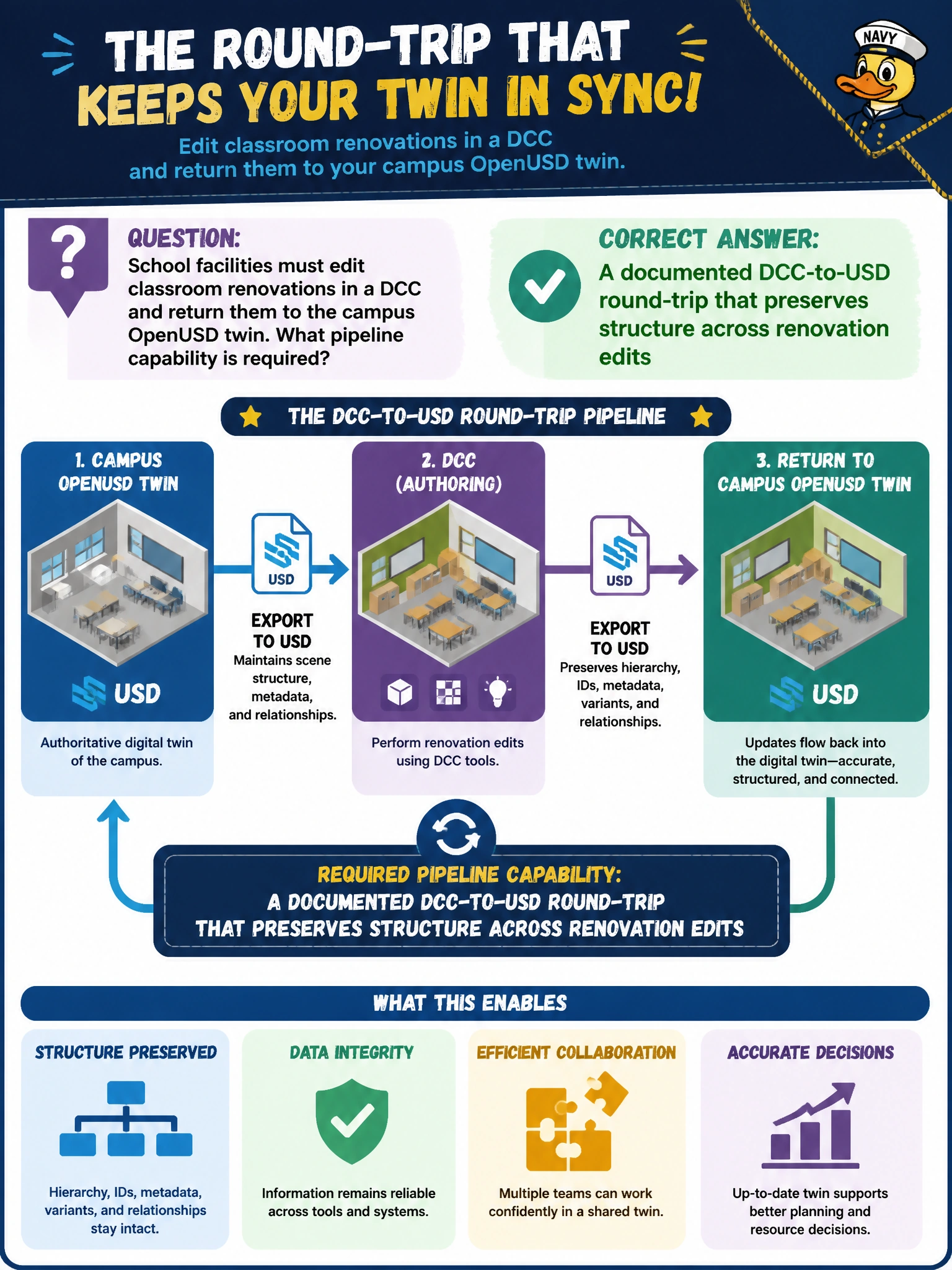
Renovations bounce between DCC and the campus twin—build a real round-trip, not screenshot dead-ends. Structure has to survive the trip home.
Full Explanation
School facilities that edit classroom renovations in a DCC and return them to the campus OpenUSD twin require a documented DCC-to-USD round-trip that preserves structure across renovation edits. Renovations must reintegrate into the living campus twin: prim paths, hierarchy, references, and material bindings should survive export and import so facilities do not rebuild the school from static images after every modeling session. A written round-trip contract is what keeps classroom work reusable in the municipal twin.
One-way screenshots from the DCC with no USD write-back fail by concept: images are not editable twin structure and cannot update composed campus stages, variants, or downstream facility apps. Manual retyping of every prim path after each classroom edit fails because manual path labor does not scale across campuses and invites identity collisions that break references. Discarding the campus twin after every DCC session fails because it destroys the authoritative municipal model instead of merging renovation opinions back into it.
Exam caveat: round-trip items distinguish structure-preserving pipelines from screenshot dead-ends, path retyping theater, or “start over” discards. NCP-OUSD expects documented DCC↔USD preservation, not throwaway visuals. Operational check: document the DCC-to-USD mapping and preserved attributes, edit a classroom in the DCC, write back to USD, confirm prim paths and hierarchy still match the campus twin, validate references still resolve, and reject flows that only produce screenshots or require discarding the twin.