
County archivists must explain OpenUSD delivery encoding to stakeholders. Which articulation is accurate?
Select an answer to reveal the explanation.
Short Explanation
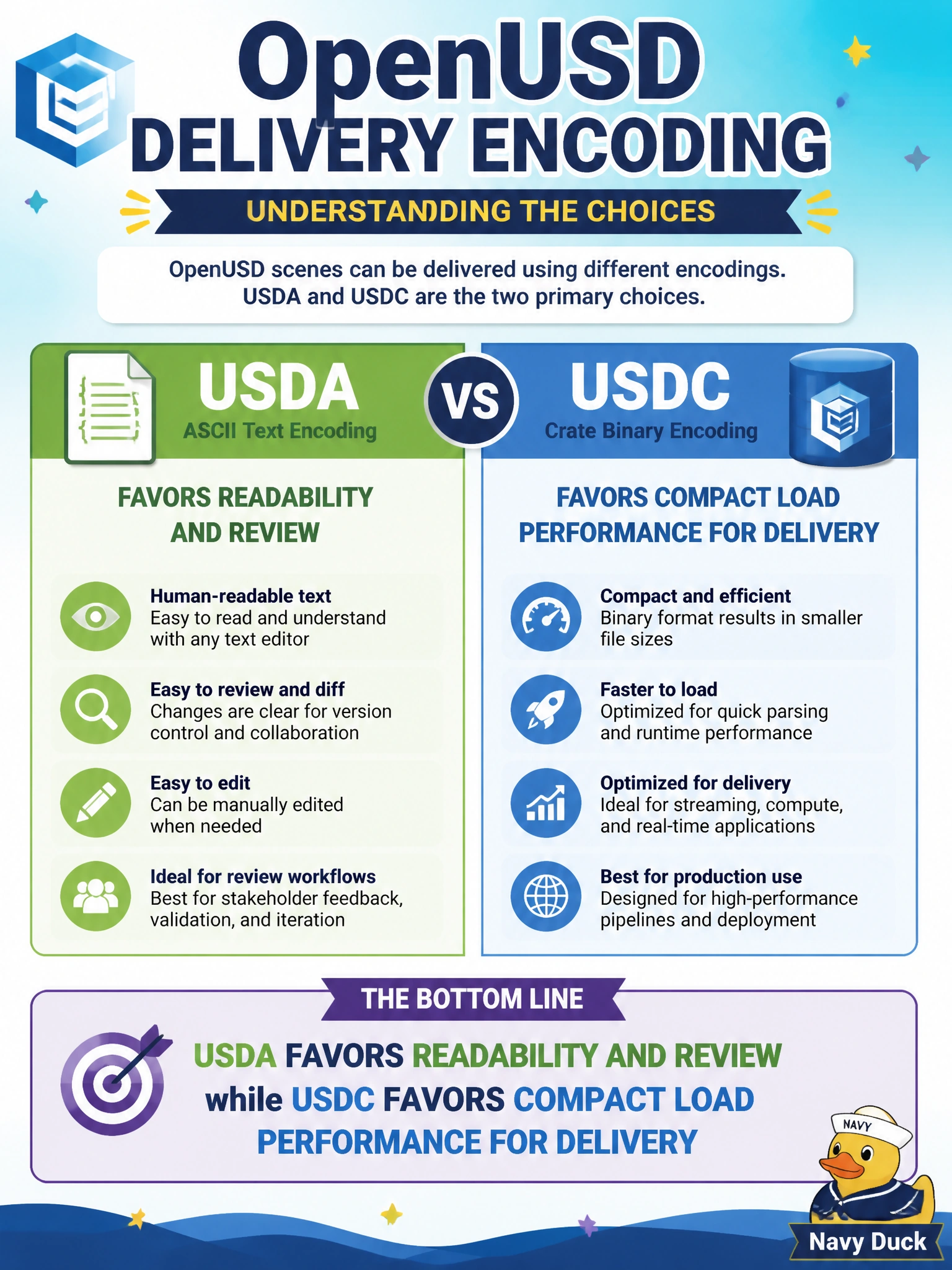
Tell stakeholders the plain truth: USDA is for reading and review, USDC is for compact, fast loads. Same twin, different jackets.
Full Explanation
County archivists explaining OpenUSD delivery encoding to stakeholders should articulate that USDA favors readability and review while USDC favors compact load performance for delivery. Same composed twin content can be serialized either way; the trade-off is human/diff friendliness versus crate compactness and load characteristics. Clear articulation prevents false claims that the formats are identical in every workflow or that one format is universally mandatory.
Claiming USDA and USDC are identical in every workflow with zero trade-offs fails by concept: encoding differences affect readability, diffability, and performance even when semantic content matches. Claiming USDC is always required for one-line metadata comments fails because tiny comment/metadata layers are often better as USDA for human edit/review. Claiming USDA cannot be archived because ASCII is not a file format fails because USDA is a defined OpenUSD text encoding and is routinely archived.
Exam caveat: stakeholder communication items punish absolute “always/never” encoding myths. Operational check: show stakeholders a side-by-side of a policy USDA overlay versus a geometry USDC crate, explain review versus delivery roles, archive both appropriately, and document that choice is purposeful—not that formats are identical or that ASCII is “not a file format.”