
Transit CI reviews station overlays and ships packages to field viewers. How should USDA and USDC be matched to stages?
Select an answer to reveal the explanation.
Short Explanation
CI likes readable USDA overlays; field viewers like compact USDC. Do not push giant ASCII meshes onto handhelds just for purity.
Full Explanation
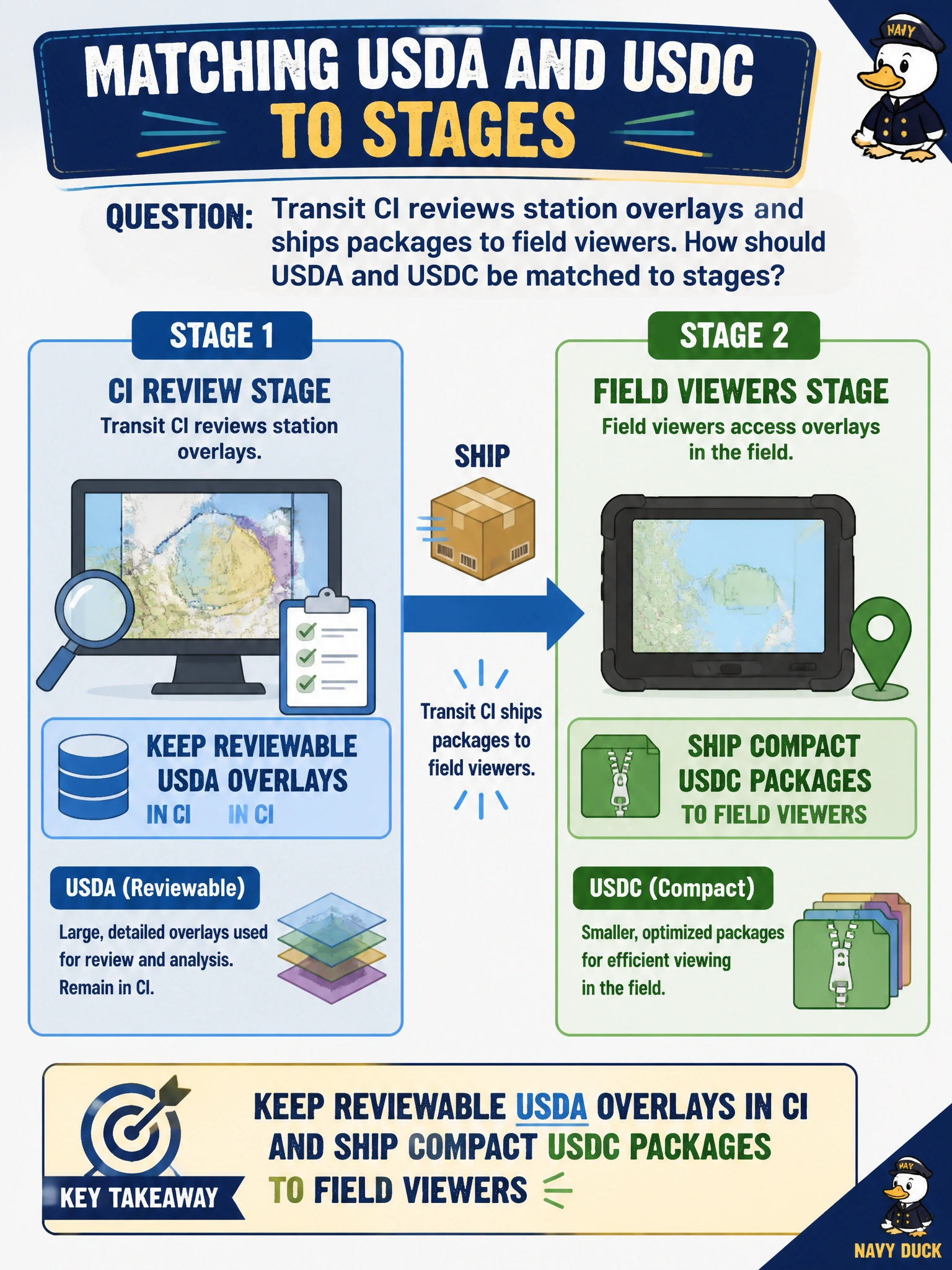
Transit CI that reviews station overlays and ships packages to field viewers should keep reviewable USDA overlays in CI and ship compact USDC packages to field viewers. CI and humans benefit from ASCII overlays they can diff, annotate, and code-review; handheld and field viewers benefit from compact crates that load quickly under constrained I/O. Encoding follows stage purpose across the same twin program rather than forcing one serialization everywhere.
Shipping only USDA multi-gigabyte meshes to handheld field viewers fails by concept: oversized ASCII hurts mobile I/O and parse time and is the wrong delivery jacket for dense station geometry. Banning USDC entirely so every field device parses ASCII only fails because it ignores crate performance advantages that field devices require and turns a format preference into an operational bottleneck. Converting review overlays to opaque screenshots instead of USD fails because screenshots are not composable, queryable twin data and break OpenUSD review, diff, and validation workflows that CI depends on.
Exam caveat: format-choice questions reward matching USDA versus USDC to review versus delivery workloads, not purity bans or screenshot substitutes for living overlays. Candidates who ship “ASCII everywhere” or replace USD review with images miss the municipal performance and audit trade-off. Operational check: store CI overlay opinions as USDA, produce USDC delivery packages for field builds, confirm handheld load budgets against compact crates, keep review artifacts as USD (not screenshots), and document which station package class uses which encoding before release.