
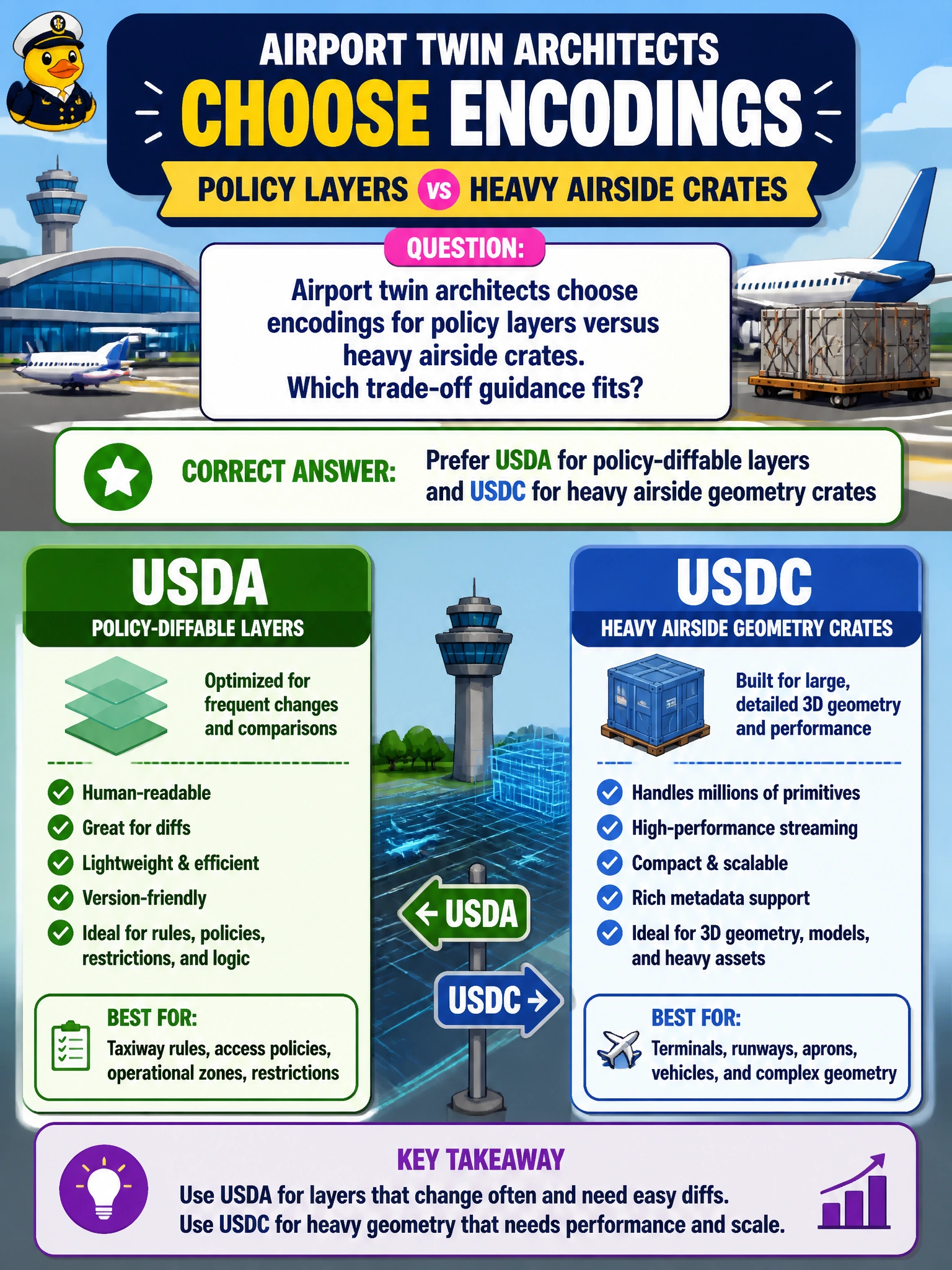
Airport twin architects choose encodings for policy layers versus heavy airside crates. Which trade-off guidance fits?
Select an answer to reveal the explanation.
Short Explanation
Think sticky notes versus shipping crates: USDA for policy you want to diff, USDC for heavy airside geometry. Do not invert that for fun.
Full Explanation
Airport twin architects choosing encodings should prefer USDA for policy-diffable layers and USDC for heavy airside geometry crates. USDA (ASCII) supports readable review and line-oriented diffs for small policy/opinion overlays; USDC (crate) packs dense geometry efficiently for load performance. Matching encoding to layer purpose is the municipal trade-off guidance—not one format for every file.
Always using USDA for multi-gigabyte airside meshes to maximize Git diffs fails by concept: huge ASCII meshes thrash VCS and parsers without improving policy review. Always using USDC for one-line policy overlays so humans can read opinions fails because crates are the wrong default for tiny human-edited opinion layers. Storing both encodings as untitled binary blobs with no extension fails because extensions/format identity guide tools and operators; extension-less blobs break workflow conventions.
Exam caveat: candidates often pick “always USDA” or “always USDC” instead of purpose-matched encoding. Operational check: keep policy overlays as USDA in reviewable repos, crate heavy airside geometry as USDC, verify tools open both, and reject extension-less untitled blobs in the airport twin layout.