
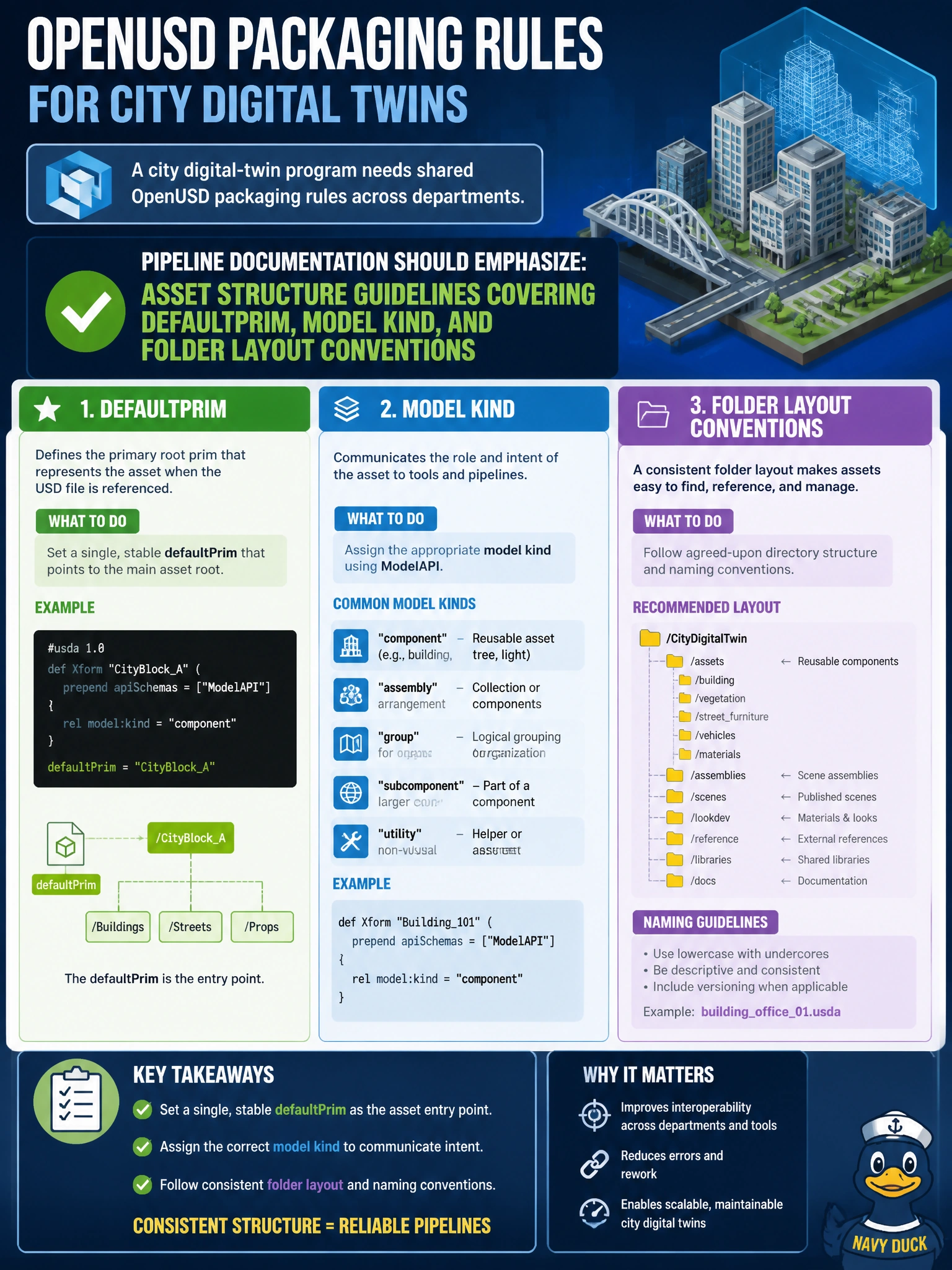
A city digital-twin program needs shared OpenUSD packaging rules across departments. What should pipeline documentation emphasize?
Select an answer to reveal the explanation.
Short Explanation
Shared twins need a map—document defaultPrim, kinds, and folders so departments do not invent private path languages. Guessing the entry prim is how twins go dark.
Full Explanation
A city digital-twin program that needs shared OpenUSD packaging rules across departments should emphasize asset structure guidelines covering defaultPrim, model kind, and folder layout conventions. Shared defaults let any department open another’s package predictably: defaultPrim identifies the entry model, kind communicates assembly/component intent, and folder layout keeps references/payloads resolvable under common roots. Without that map, collaboration collapses into private dialects.
A rule that every department invents private prim path schemes with no shared defaults fails by concept: private schemes maximize collision and onboarding cost across municipal teams. Guidance to omit defaultPrim so consumers guess the entry prim fails because guessing is not interoperable packaging and breaks tools that rely on defaultPrim. Instructions to store all city assets as a single untitled root file forever fails because monolithic untitled roots do not scale, obscure ownership, and defeat modular composition.
Exam caveat: packaging questions reward explicit shared structure over tribal or monolithic shortcuts. Operational check: publish a short asset-structure guide (defaultPrim required, kind usage, folder template), validate sample departmental packages against it in CI, and reject packages that omit defaultPrim or invent incompatible private path schemes without a documented exception.