
Parks contractors receive glTF playground packages derived from the master OpenUSD. What fidelity concern should the delivery pipeline address?
Select an answer to reveal the explanation.
Short Explanation
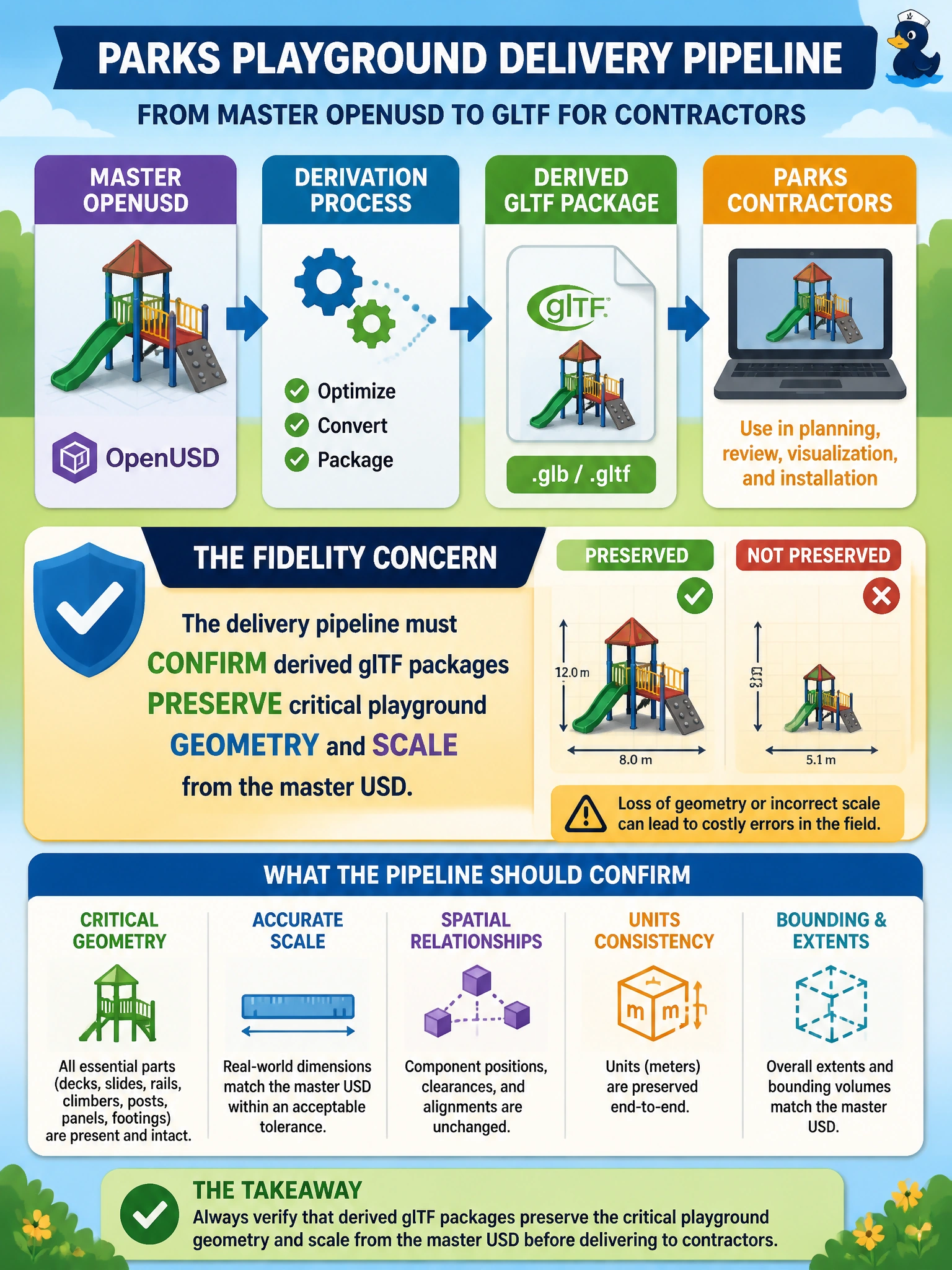
Contractors build from what you ship. Make sure the glTF playground still matches the master USD geometry and scale before it leaves parks.
Full Explanation
When Parks contractors receive glTF playground packages derived from a master OpenUSD, the delivery pipeline must confirm that derived packages preserve critical playground geometry and scale from the master. Contractors fabricate and install from what they receive; if slides, clearances, or site scale drift in conversion, field rework and safety risk follow. Fidelity review against the master USD—extents, units, and key meshes—is the civic control before handoff.
Replacing playground meshes with placeholder cubes labeled TBD fails by concept: placeholders discard the very geometry contractors need and shift modeling risk onto the jobsite. Stripping all units metadata so contractors invent their own scale fails because inventing scale breaks interoperability with surveyed site coordinates and invite dimensional error. Omitting fidelity review because contractors can remodel on site fails because remodeling on site is expensive remediation, not a pipeline quality strategy.
Exam caveat: delivery questions often offer “someone else will fix it later” distractors; NCP-OUSD expects upstream fidelity assurance on derived formats. Operational check: convert master playground USD to glTF, compare critical mesh counts/extents and units to the master, reject packages with TBD placeholders or missing unit metadata, and only then release to contractors with a recorded fidelity checklist.