
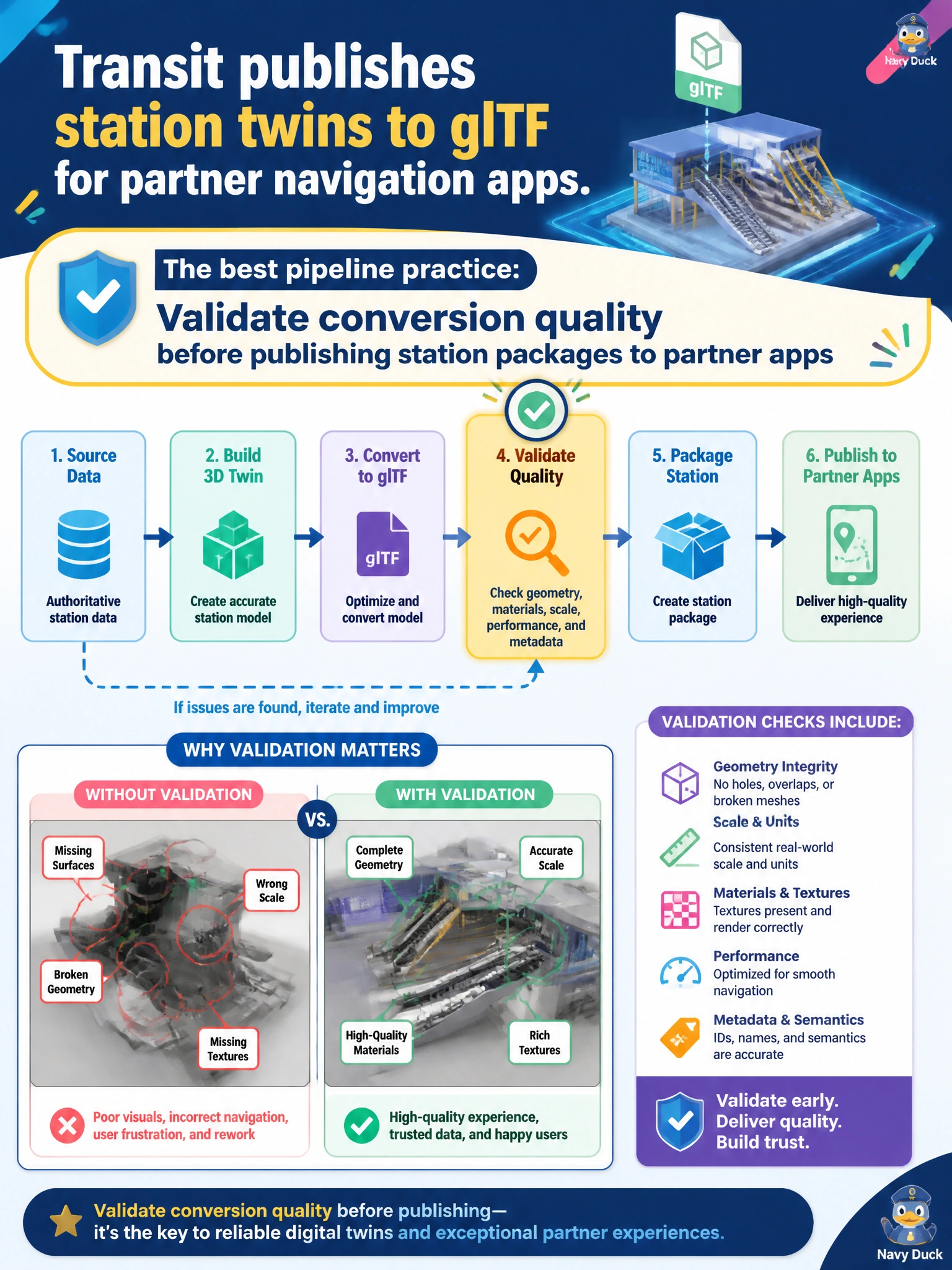
Transit publishes station twins to glTF for partner navigation apps. Which pipeline practice best protects quality?
Select an answer to reveal the explanation.
Short Explanation
Partners hate mystery missing platforms. Validate the USD-to-glTF conversion before the station package leaves the yard.
Full Explanation
Transit publishing station twins to glTF for partner navigation apps best protects quality by validating conversion quality before packages leave for partners. Partners integrate platforms, paths, and clearances; missing or scaled-wrong geometry discovered after go-live becomes a multi-vendor incident. Pre-publish validation of mesh completeness, scale, naming expectations, and critical station features reduces partner defects without baking brittle absolute OS paths into assets.
Publishing first and letting partners report missing platforms after go-live fails by concept: it externalizes QA and turns preventable conversion defects into production outages. Converting only camera prims and omitting station geometry fails because navigation apps need the station fabric, not merely cameras. Renaming every asset path to absolute Windows drive letters before export fails because absolute laptop/server paths do not travel across partner environments and break resolution outside the authoring machine.
Exam caveat: candidates may confuse “export succeeded” with “partner-usable,” or “fix paths with absolute letters” with portable packaging. Operational check: run automated conversion validation (geometry presence, scale/units, critical prims), open the glTF in a partner-like viewer, confirm platforms and wayfinding meshes resolve, then publish only after gates pass—keeping relative or resolver-friendly paths, not Windows drive letters.