
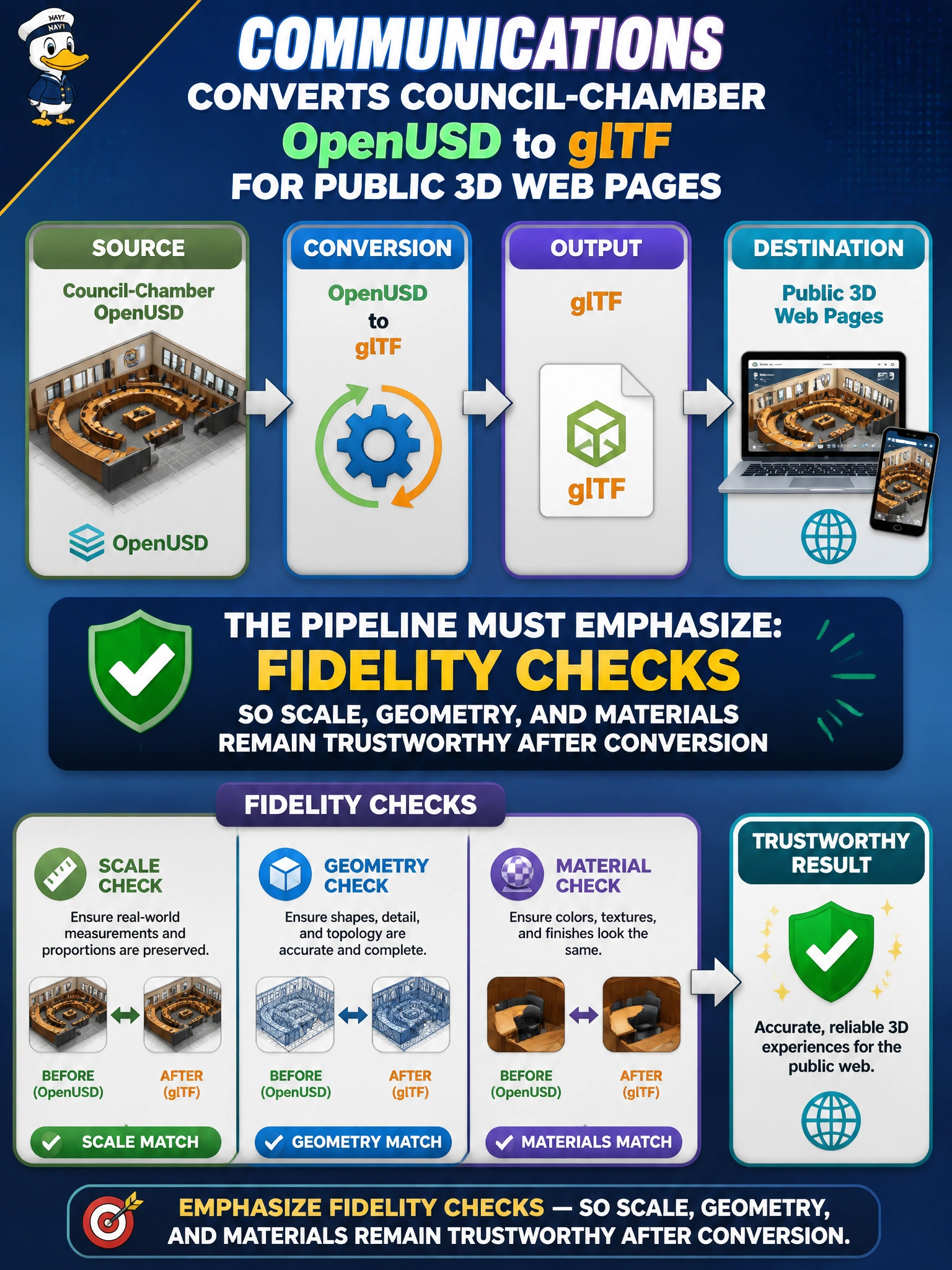
Communications converts council-chamber OpenUSD to glTF for public 3D web pages. What should the pipeline emphasize?
Select an answer to reveal the explanation.
Short Explanation
Public 3D pages must look like the real chamber. Build fidelity checks into the USD-to-glTF hop so scale and materials still tell the truth.
Full Explanation
Communications converting council-chamber OpenUSD to glTF for public 3D web pages must emphasize fidelity checks so scale, geometry, and materials remain trustworthy after conversion. Public viewers treat the page as a truthful civic artifact; unit mismatches, dropped materials, or missing chamber meshes undermine trust. Pipeline gates that compare extents, unit metadata, material coverage, and mesh presence between the USD source and glTF output catch conversion drift before publish.
Dropping all materials so public pages show only untextured boxes fails by concept: it intentionally destroys appearance fidelity citizens expect from chamber visualizations. Skipping validation because glTF always matches USD unit-for-unit fails because converters are not guaranteed lossless on units, normals, or materials—assumption is not assurance. Exporting only empty nodes named PublicView with no meshes fails because empty nodes deliver no chamber geometry and cannot represent the space accurately.
Exam caveat: exam items often tempt “ship something” shortcuts (empty nodes, strip materials, skip checks) that violate public-delivery fidelity. Operational check: convert a representative council-chamber package, assert metersPerUnit/scale against known room dimensions, verify key meshes and materials exist in glTF, spot-check in a web viewer, and block publish on fidelity gate failures.