
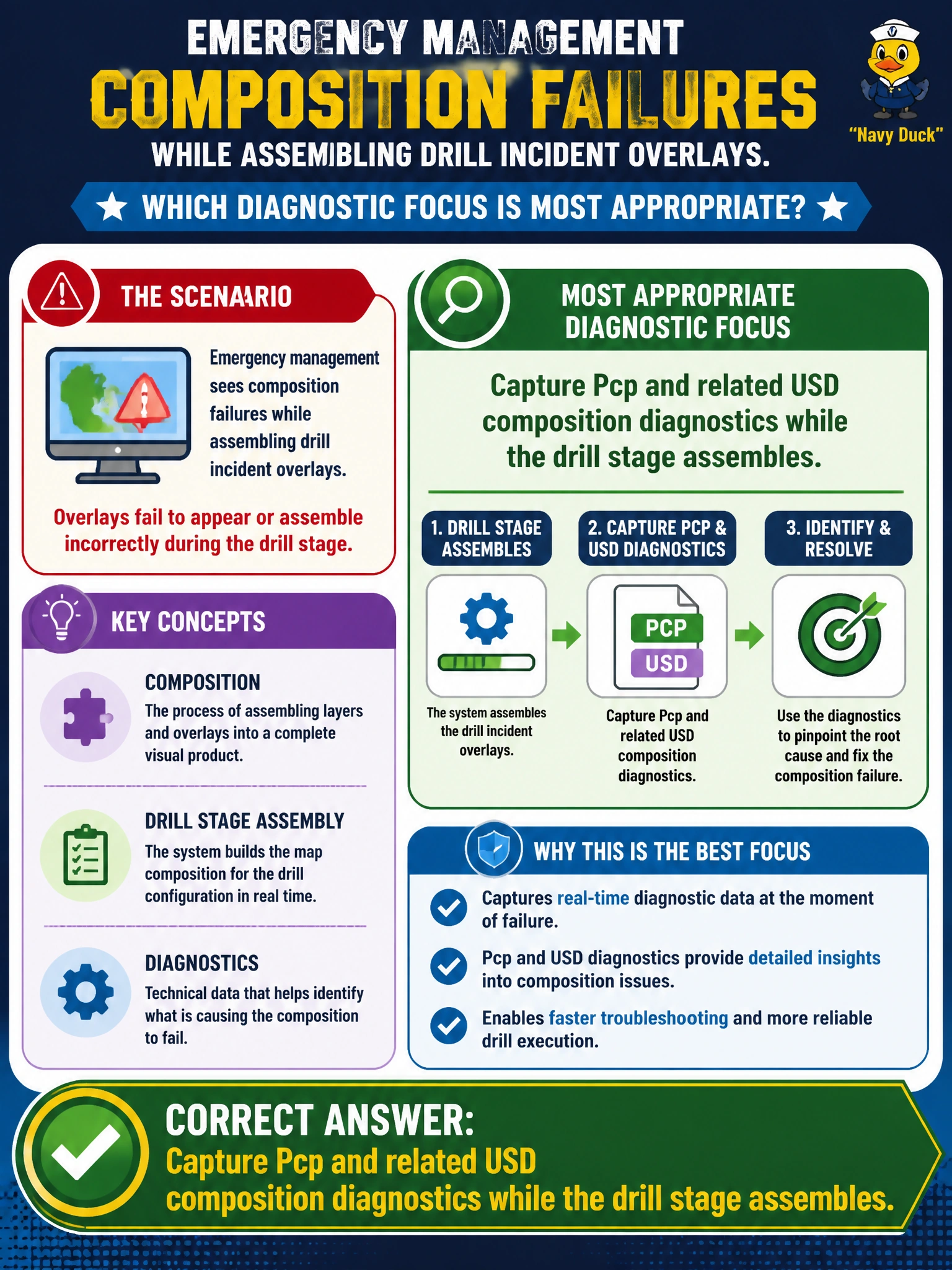
Emergency management sees composition failures while assembling drill incident overlays. Which diagnostic focus is most appropriate?
Select an answer to reveal the explanation.
Short Explanation
Drill overlay blow-ups are often composition talking—capture Pcp and USD diagnostics while the stage builds. Driver strings alone will not explain broken arcs.
Full Explanation
Emergency-management composition failures while assembling drill incident overlays require capturing Pcp and related USD composition diagnostics while the drill stage assembles. Overlay packs typically bring new layers, references, and payloads onto a live municipal stage; failures at that moment are composition/arc/layer-stack issues. Pcp diagnostics expose which arcs fail to resolve, which layers conflict, and where strength or payload deferral breaks the drill narrative—exactly what incident planners need before the exercise starts.
Ignoring composition errors and relying only on GPU driver version strings fails by concept: driver strings describe graphics runtime, not OpenUSD arc resolution or layer stacking for overlays. Treating every drill failure as a material-binding bug without inspecting arcs fails because material bindings affect shading after prims exist; they do not explain missing overlay prims or failed composition. Disabling diagnostic delegates so drill logs stay empty for auditors fails because empty logs remove accountability and hide the composition evidence auditors and operators need.
Exam caveat: under time pressure, candidates may blame GPU, materials, or “quiet logs” instead of composition diagnostics. Operational check: enable Pcp/composition diagnostics for a dry-run assemble of the incident overlay, note failing arcs or unresolved assets, fix those package paths or layer includes, reassemble with diagnostics still on, and only then evaluate materials or GPU if the composed overlay prims exist but shade incorrectly.