
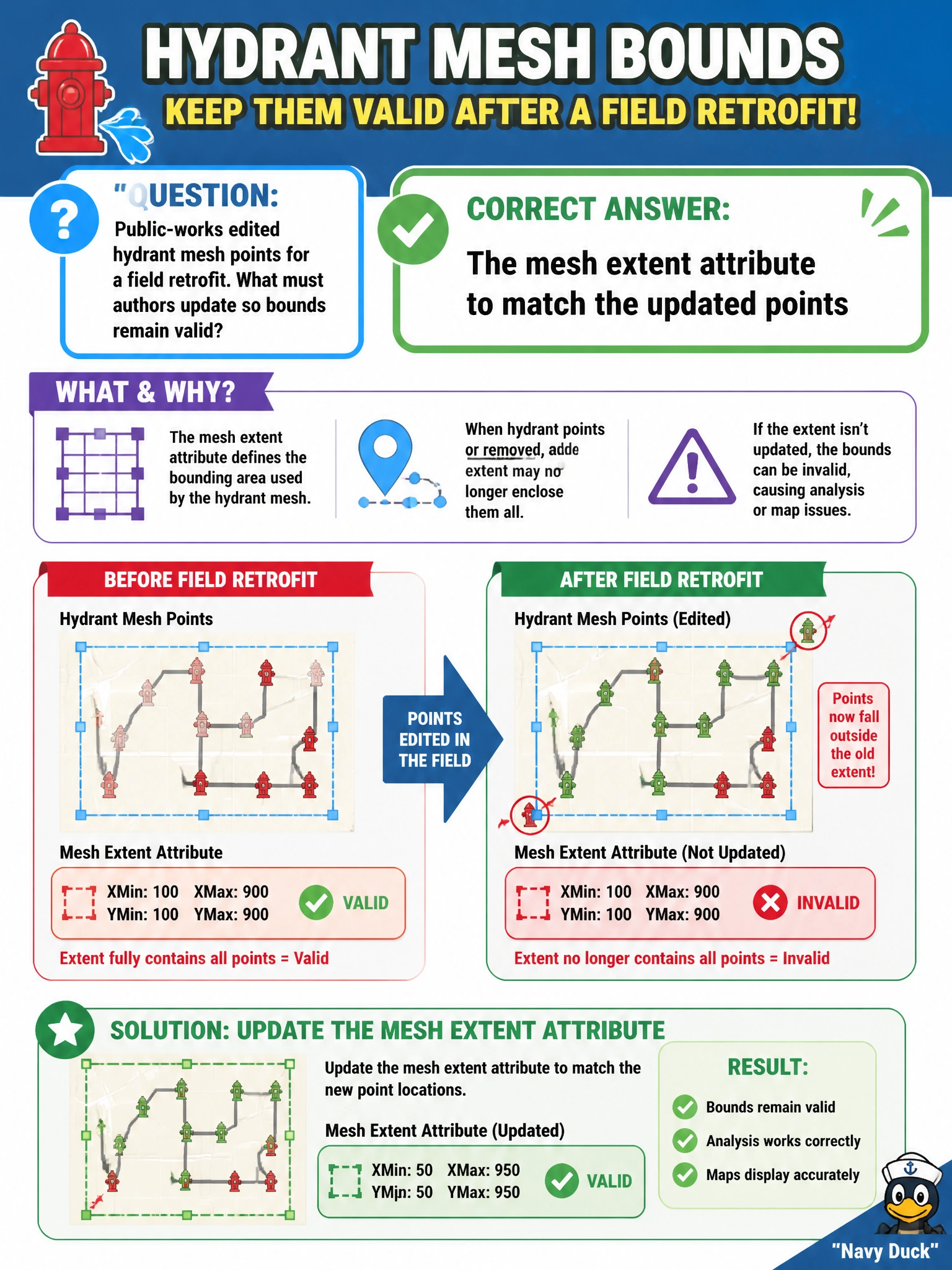
Public-works edited hydrant mesh points for a field retrofit. What must authors update so bounds remain valid?
Select an answer to reveal the explanation.
Short Explanation
Moved hydrant points? Refresh extent so bounds still hug the mesh. Renaming the hydrant or flipping upAxis will not fix stale bounding boxes. Keep extent in sync with the new points.
Full Explanation
After public-works edits hydrant mesh points for a field retrofit, authors must update the mesh extent attribute so bounds remain valid. Extent is the authored axis-aligned bound consumers use for selection, culling, framing, and many visualization overlays; stale extent after point moves leaves bounding boxes floating away from the hydrant or clipping incorrectly even though the new points are correct. Recomputing and authoring extent that matches the updated points keeps the civic asset honest for inspectors and twin tooling.
Updating only the hydrant's display name string changes a label, not geometric bounds. Changing only the stage upAxis token reorients the whole stage contract and does not recompute a single hydrant's extent. Toggling only TfDebug flags on the authoring machine affects diagnostics, not authored mesh bounds.
Exam caveat: Some pipelines can recompute extents on load, but authored extent is still the portable contract across tools; do not rely on a single DCC's transient bounds. Multi-sample geometry may need extent that covers the relevant time range.
Operational check: After point edits, run the team's extent-recompute utility (or author extent explicitly), verify bounding-box visualization hugs the hydrant in usdview, and fail QA if extent and points disagree beyond the municipal tolerance before publishing the retrofit.