
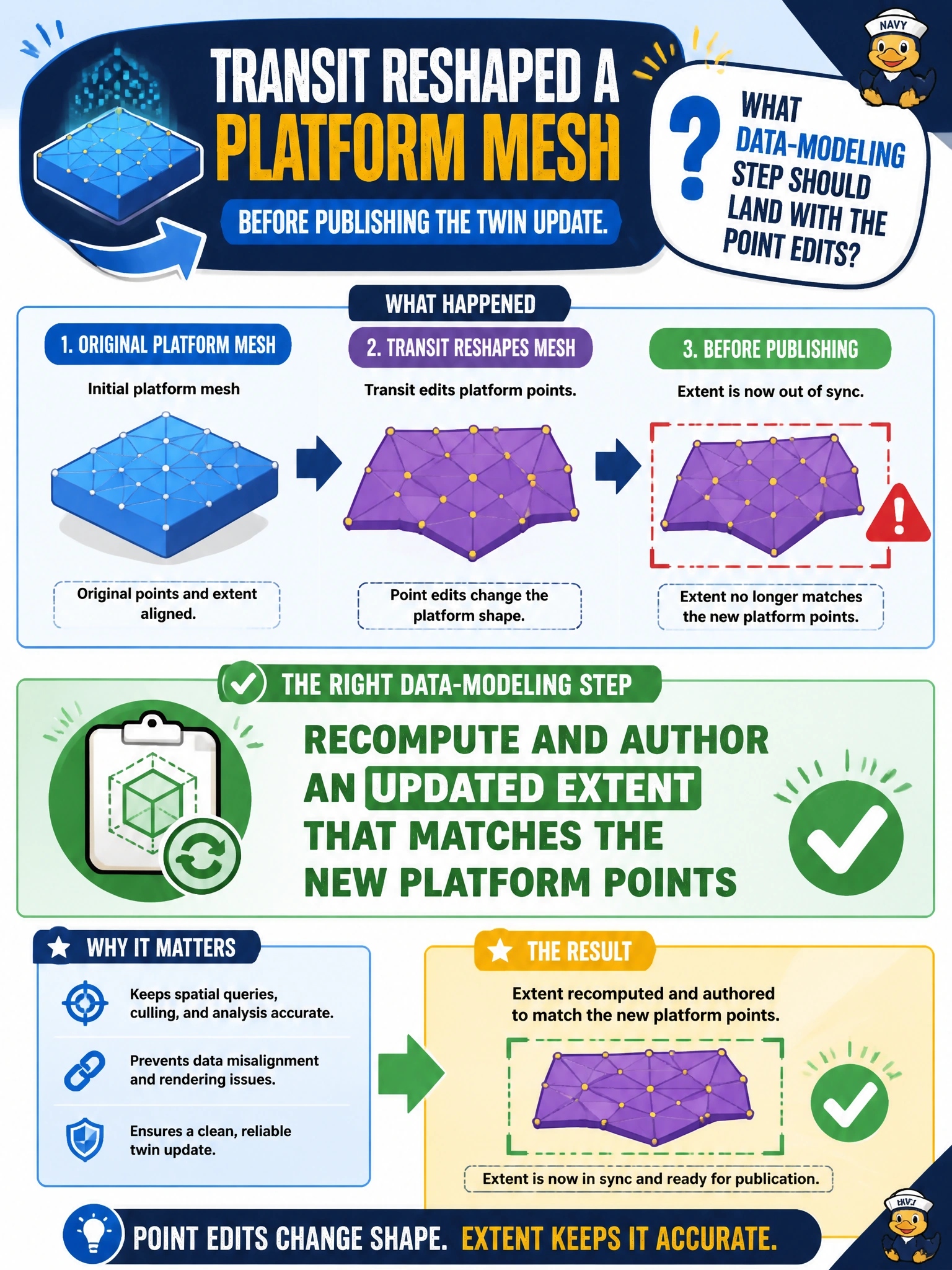
Transit reshaped a platform mesh before publishing the twin update. What data-modeling step should land with the point edits?
Select an answer to reveal the explanation.
Short Explanation
Reshape the platform, then recompute extent so the published bounds match the new points. Deleting materials or muting layers is not how extents stay honest. Publish geometry and extents together.
Full Explanation
When transit reshapes a platform mesh before publishing a twin update, the matching data-modeling step is to recompute and author an updated extent that matches the new platform points. Publishing deformed points with stale extents ships incorrect bounds into the city twin, breaking selection, LOD/culling heuristics, and any civic QA that compares footprint envelopes to GIS. Geometry edits and extent updates must land together as one publishable unit.
Deleting all materials so extents supposedly regenerate from shaders confuses shading with bounds; materials do not author mesh extent. Converting the platform exclusively to a string attribute destroys geometric modeling rather than refreshing bounds. Muting every layer that references the platform hides the asset from composition and does not synchronize extent with points.
Exam caveat: Extent is not a substitute for correct xformOps or metersPerUnit; fix transforms and units separately if scale is wrong. Still, for point reshapes, extent refresh is the required companion edit.
Operational check: Diff the pre/post platform points, recompute extent, include both in the transit publish package, and validate in the composed twin that platform bounds align with the reshaped mesh and adjacent curb references before operations sign-off.