
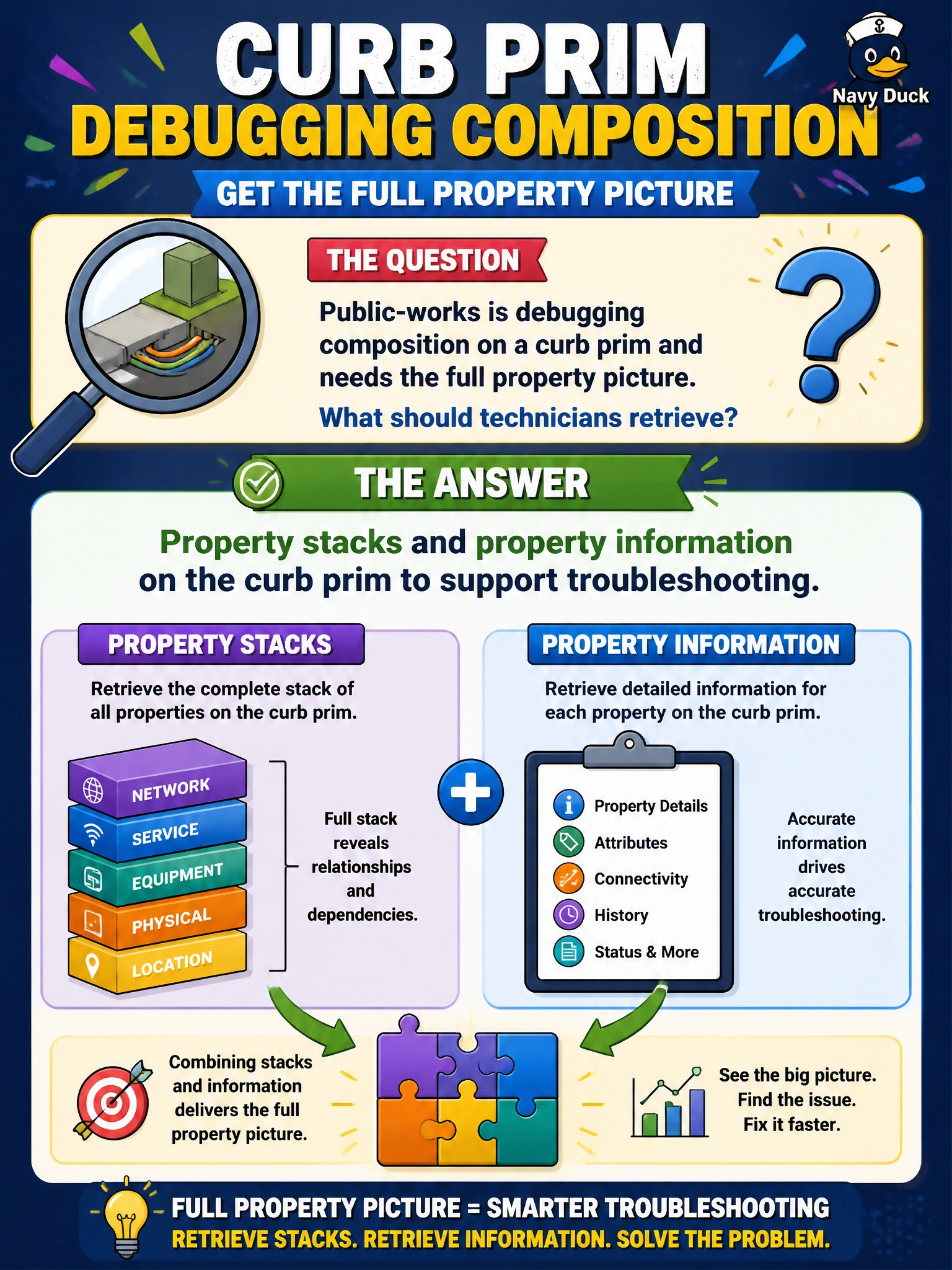
Public-works is debugging composition on a curb prim and needs the full property picture. What should technicians retrieve?
Select an answer to reveal the explanation.
Short Explanation
When a curb opinion looks wrong, pull the property stack on that prim—not laptop clocks or random fountain shots. The stack shows what authored values and relationships are actually in play. Debug the curb with its own properties.
Full Explanation
When public-works technicians debug composition on a municipal curb prim, the actionable evidence is the property stack and property information for that prim—not laptop hardware counters or unrelated park screenshots. Property stacks expose which layers and arcs authored values, how stronger and weaker opinions resolve under LIVERPS, and which attributes, relationships, and metadata are actually present after composition. Retrieving that picture lets teams see whether a curb height, material binding, visibility token, or reference path is missing, blocked, or overridden before they rewrite assets blindly.
GPU clock speed on a review laptop is a host-performance metric; it never describes authored curb properties or composition strength. Filename length of the twin root is packaging trivia and does not encode property stacks or value resolution. A screenshot of an unrelated park fountain captures different geometry and lighting and cannot substitute for inspecting the curb prim's composed property state.
Exam caveat: Inspecting property information does not by itself change the stage; it is a diagnostic step. Empty opinions, muted layers, and edit-target mistakes can still make expected curb values absent even when you know which property to check. Distinguish reading the stack from fixing LayerStack membership or authoring a stronger opinion.
Operational check: Open the curb prim in usdview or an equivalent inspector, list property stacks for the contested attributes, note which layer wins, and compare against the intended department source layer. Confirm the edit target and LayerStack include that source before re-authoring, then recompose and verify the curb values match the public-works specification.