
Housing QA must confirm which prims unit door relationships target. What should inspectors retrieve?
Select an answer to reveal the explanation.
Short Explanation
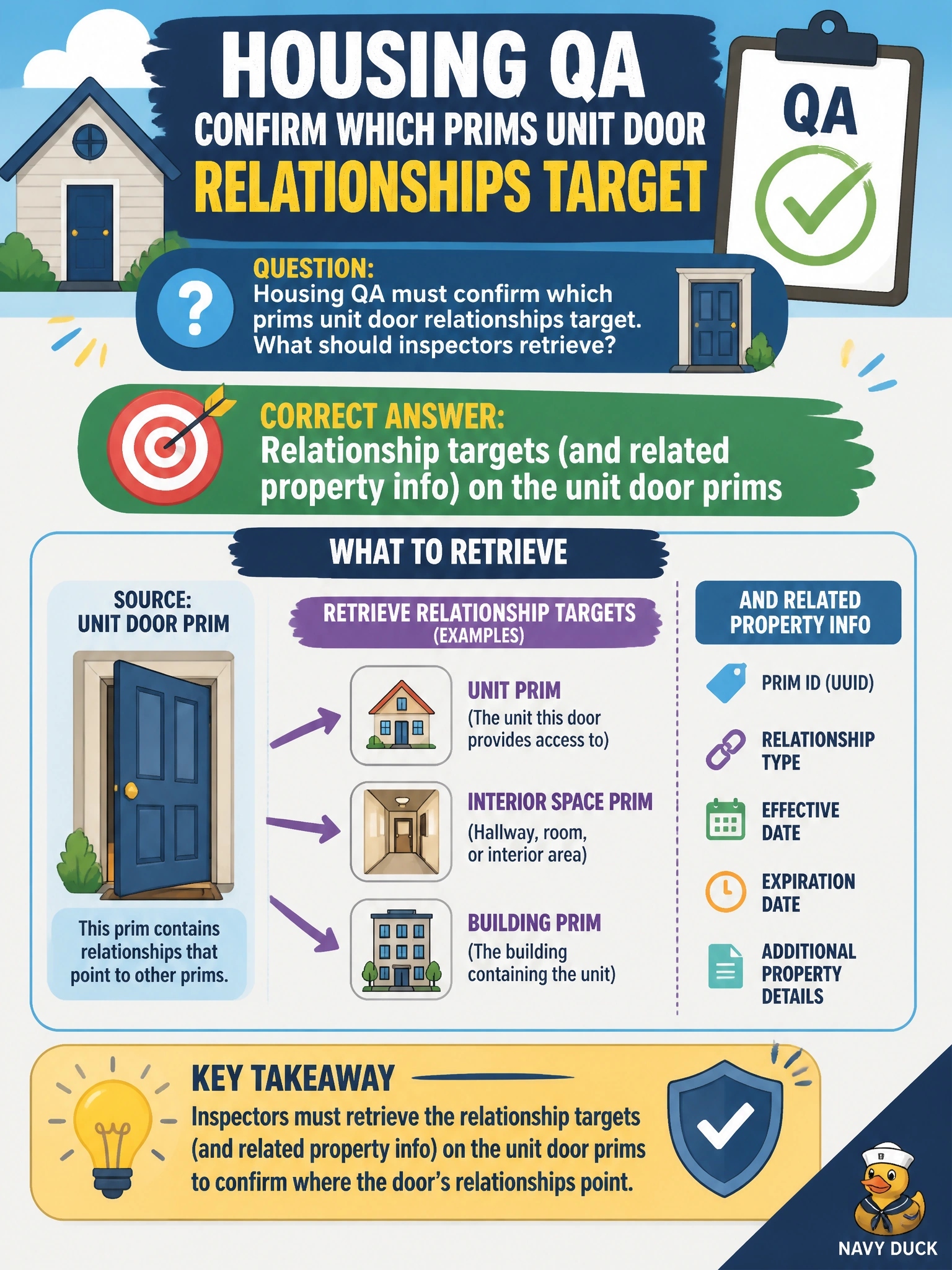
Door links are relationships—pull the targets on the door prims to see what they point at. Face counts and GPU drivers will not tell you the connected unit. Follow the arrows in the scenegraph.
Full Explanation
Housing QA confirming which prims unit door relationships target must retrieve relationship targets (and related property info) on the unit door prims. Relationships are OpenUSD properties that point at other prim paths; inspecting targets is how validators prove a door connects to the correct unit, hardware set, or access-control node before occupancy handoff. Mesh metrics and workstation environment data cannot answer linkage questions.
Retrieving only door mesh face counts speaks to topology density, not connectivity. Checking only the defaultPrim token on an unrelated root ignores the door prim’s relationships entirely. Inspecting only GPU driver versions on artist workstations is environmental noise with no bearing on authored USD relationships.
Exam caveat: relationship targets can be lists; validate emptiness, dangling targets, and unexpected multiple targets per pipeline rules. Forwarding vs resolving relationships across references may matter in composed stages—inspect in the composition context QA actually ships.
Operational check: for a sample unit, get the door prim’s relationship targets, confirm each target prim exists and matches the unit ID map, run a dangling-target report across the building package, and block publish while any required door relationship is empty or points outside the allowed namespace.