
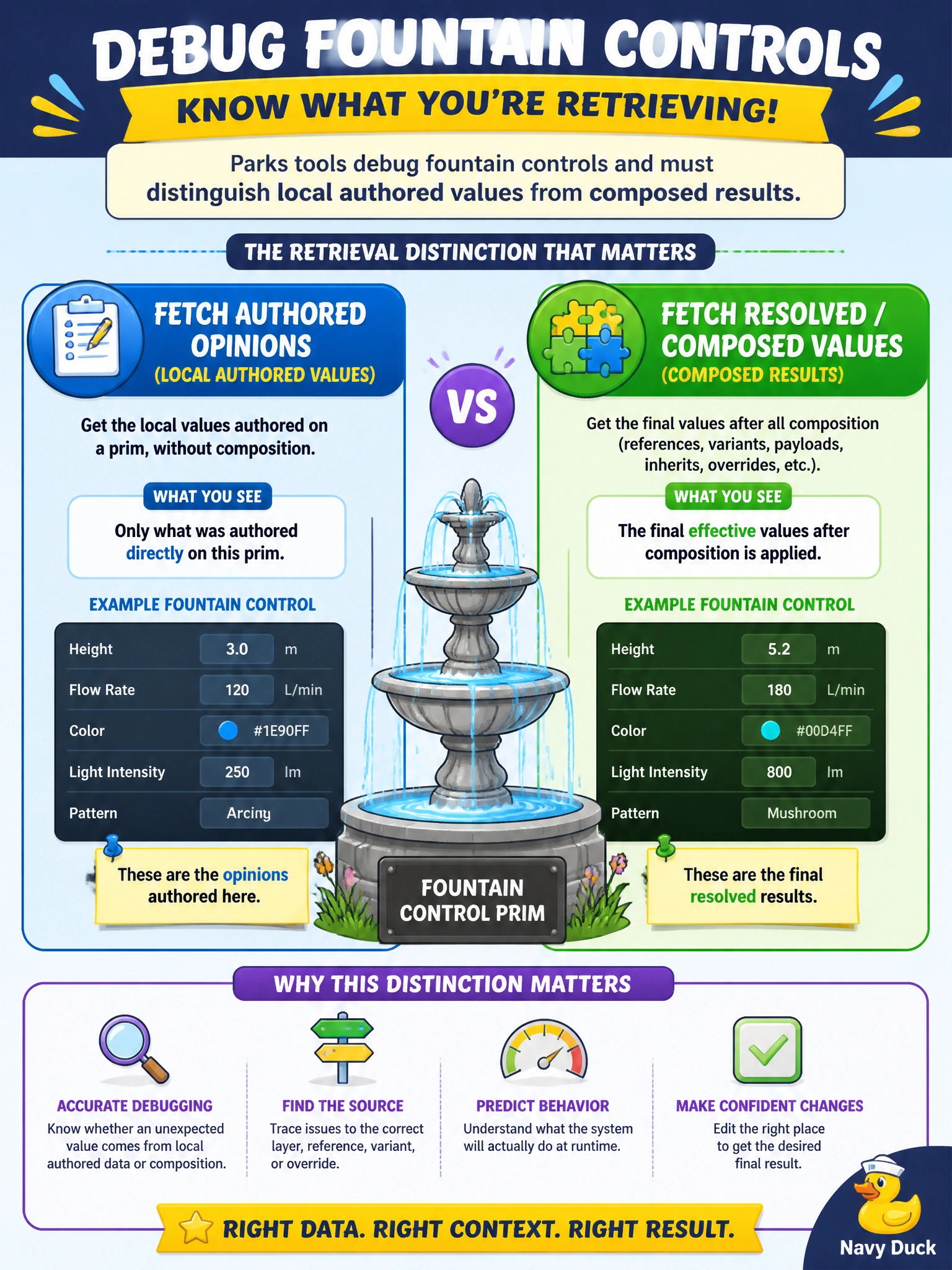
Parks tools debug fountain controls and must distinguish local authored values from composed results. What retrieval distinction matters?
Select an answer to reveal the explanation.
Short Explanation
Fountain bugs often hide in the gap between what a layer authored and what the stage resolves. Fetch both when debugging. File mtimes and deleting layers are blunt instruments next to property retrieval.
Full Explanation
Parks tools debugging fountain controls must distinguish local authored opinions from resolved/composed property values. Fetching authored versus composed values on the fountain control prims—as needed—reveals whether a bug comes from a weak layer, a reference, a session opinion, or the final composed result operators see. That distinction is central to OpenUSD property retrieval during debugging.
Treating filesystem mtime as the only property value confuses file timestamps with scene data and cannot explain composition. Reading only TfDebug symbols while ignoring prim properties may help engine logging but does not show attribute values. Always deleting weaker layers instead of retrieving values is destructive troubleshooting that can discard legitimate municipal contributions.
Exam caveat: authored queries answer “what did this layer/edit target write?”; composed/resolved queries answer “what does the stage compute now?” Use both when debugging strength and arc issues. Do not assume USDA text order equals composition strength.
Operational check: on a misbehaving fountain control, print authored values at the suspected layer and composed values at the stage, identify the winning opinion via layer stack/arcs, fix the correct layer, and re-query to confirm authored and composed views align with intent.