
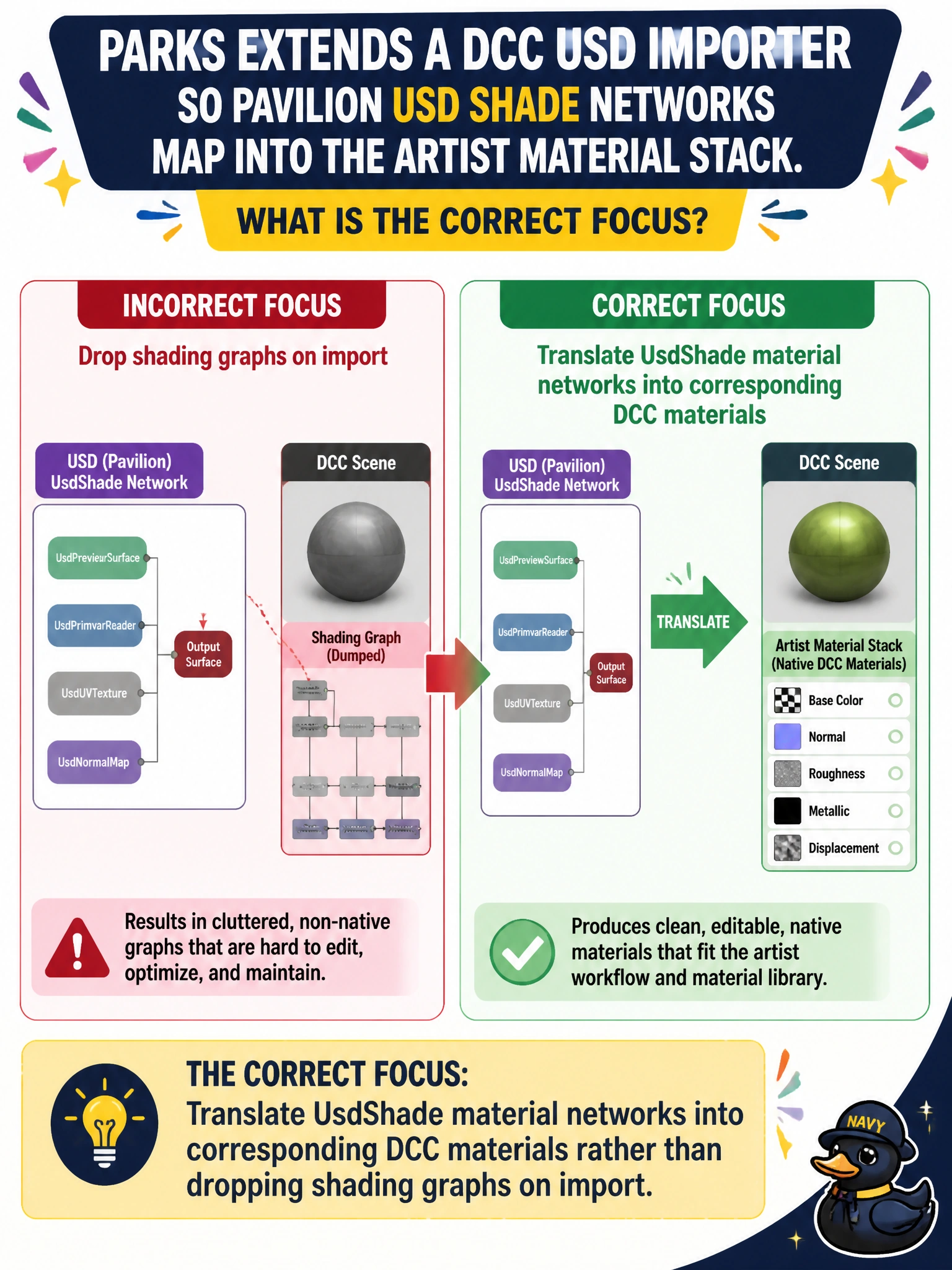
Parks extends a DCC USD importer so pavilion UsdShade networks map into the artist material stack. What is the correct focus?
Select an answer to reveal the explanation.
Short Explanation
Pavilion looks matter: map UsdShade networks into the DCC material stack instead of tossing them. Gray-Lambert defaults and header comments do not preserve parks shading intent.
Full Explanation
Parks pavilion assets typically author look via UsdShade material networks and bindings. Extending a DCC USD importer correctly means translating those UsdShade networks into corresponding DCC materials so shading graphs and texture connections survive into the artist material stack. Without that mapping, pavilion previews lose wood, glass, and branded wayfinding looks that stakeholders expect, and artists must rebuild materials from scratch—breaking the exchange loop.
Replacing every material with a single untextured gray Lambert discards authored networks and is only acceptable as an explicit debug fallback, not as the importer’s design focus. Storing shade networks only as comments in the USDA header is not executable shading and will not drive the DCC viewport. Deleting bindings so artists reassign materials from memory guarantees visual drift and non-reproducible civic assets.
Exam caveat: full fidelity of every UsdShade node in every DCC is not always possible; the correct focus remains mapping networks and bindings as faithfully as the host allows, with documented fallbacks—not abandoning shade graphs.
Operational check: import a pavilion with textured UsdShade materials, confirm DCC materials appear with connected maps, render or viewport-shade a known camera, then re-export and compare bindings. Treat missing networks or forced gray Lambert (absent an intentional fallback flag) as importer defects.