
Airport tools import gate USD that uses custom model kinds into a DCC. What importer behavior keeps civic structure intact?
Select an answer to reveal the explanation.
Short Explanation
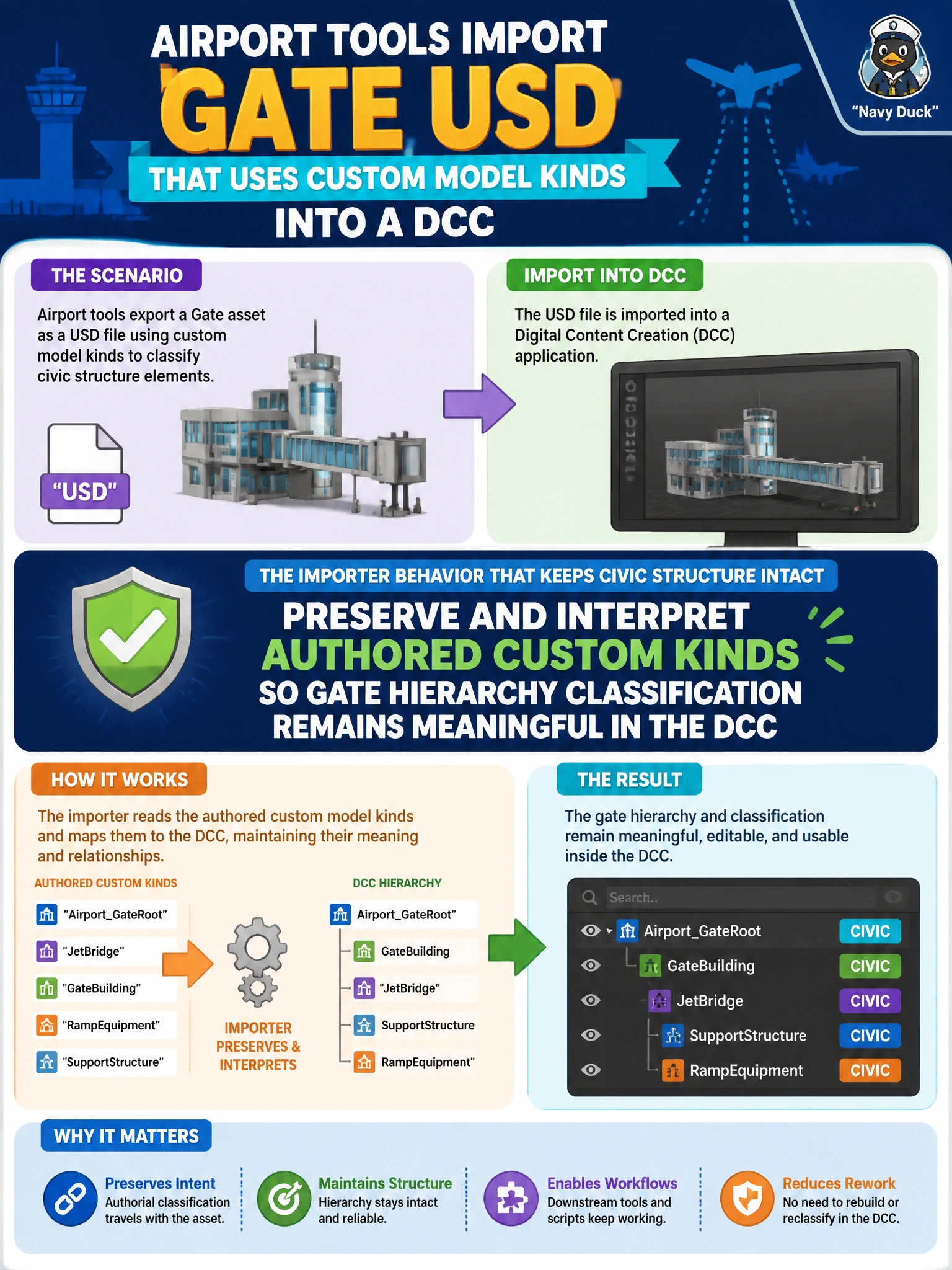
Custom kinds tell the airport what is a gate assembly versus a bolt. The importer should keep and honor those kinds, not smash everything to Mesh. Classification is how the twin stays navigable.
Full Explanation
Airport gate USD that uses custom model kinds encodes asset classification—assembly versus component versus group—so tooling can traverse hierarchy, apply LODs, and run selection filters correctly. A DCC importer should preserve and interpret authored custom kinds so gate hierarchy classification remains meaningful inside the artist environment. Kind is part of OpenUSD’s model/asset vocabulary; ignoring it collapses the civic structure that airside planners and maintenance scripts rely on.
Flattening kinds to Mesh for every prim regardless of authored kind erases assembly boundaries and makes gate packages look like undifferentiated geometry. Ignoring kind metadata because “DCCs never need asset classification” is false for production pipelines that drive outliners, exporters, and validation from kind. Rewriting all kinds to component even when authored as assembly or group falsifies the model hierarchy and can break consumers that key behavior off assembly roots.
Exam caveat: custom kinds should be registered/understood by the pipeline; preserving an unknown token without a fallback policy can still confuse some tools—but rewriting or discarding kinds is worse than documenting an unknown-kind handling rule.
Operational check: import a gate package with mixed assembly/component kinds, verify the DCC outliner or metadata panel still shows the authored kinds, run a kind-based selection (assemblies only), and re-export to confirm kinds survive. Reject importer changes that normalize everything to Mesh or component.