
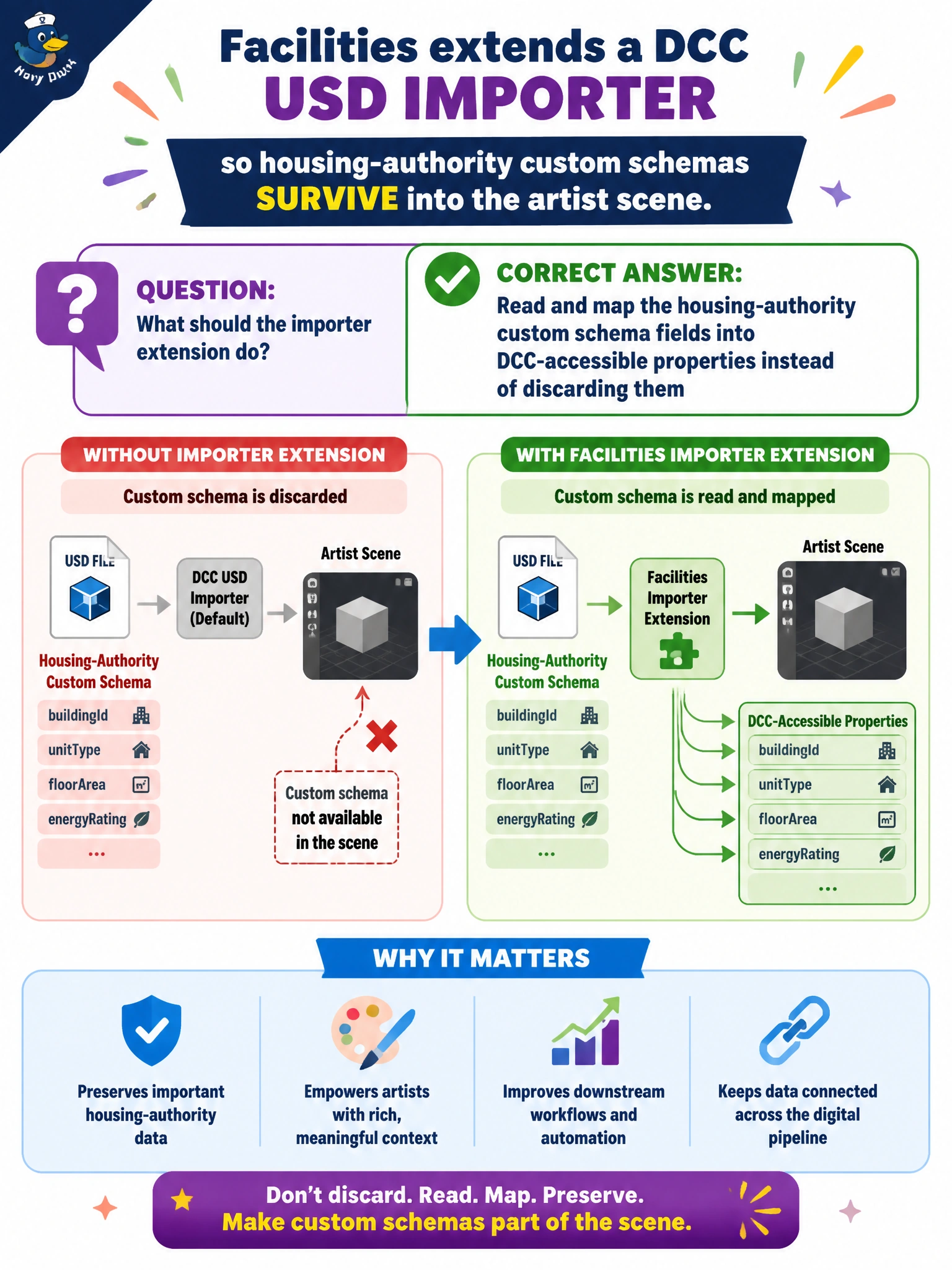
Facilities extends a DCC USD importer so housing-authority custom schemas survive into the artist scene. What should the importer extension do?
Select an answer to reveal the explanation.
Short Explanation
You’re right to preserve housing-authority data as schema fields that artists and tools can access. Map those fields into DCC properties so they survive the artist workflow; sticky notes and random point colors won’t preserve their meaning.
Full Explanation
To keep housing-authority custom schemas available in the artist scene, extend the DCC USD importer to read and map schema-backed fields into DCC-accessible properties rather than discard them. Custom attributes may carry unit counts, accessibility flags, funding program codes, or inspection status that operations and compliance tools need after an artist round-trip. Preserving these fields maintains the municipal twin’s semantic contract through DCC edits and re-exports. Ignoring unknown fields and relying on sticky notes loses machine-readable data and invites transcription errors. Converting every custom attribute into random mesh point colors destroys typed meaning and may pollute geometry channels already used for shading or analytics. Disabling schema plugins to keep import schema-free guarantees the loss of housing-authority semantics, the opposite of carrying custom data into the scene. Exam caveat: mapping may require registering the custom schema plugin; preservation is not a display-only workaround. If the DCC cannot represent a type directly, document a lossless sidecar or typed custom-attribute strategy rather than silently dropping it. Practical check: import a housing package with known values, inspect their DCC properties, edit one field, re-export to USD, and verify that the authored schema value round-trips. Fail the importer change if fields vanish or become unrelated geometric attributes.