
Transit scripts an exporter from signal-plan CAD into the city USD library. Which design best matches OpenUSD exchange practice?
Select an answer to reveal the explanation.
Short Explanation
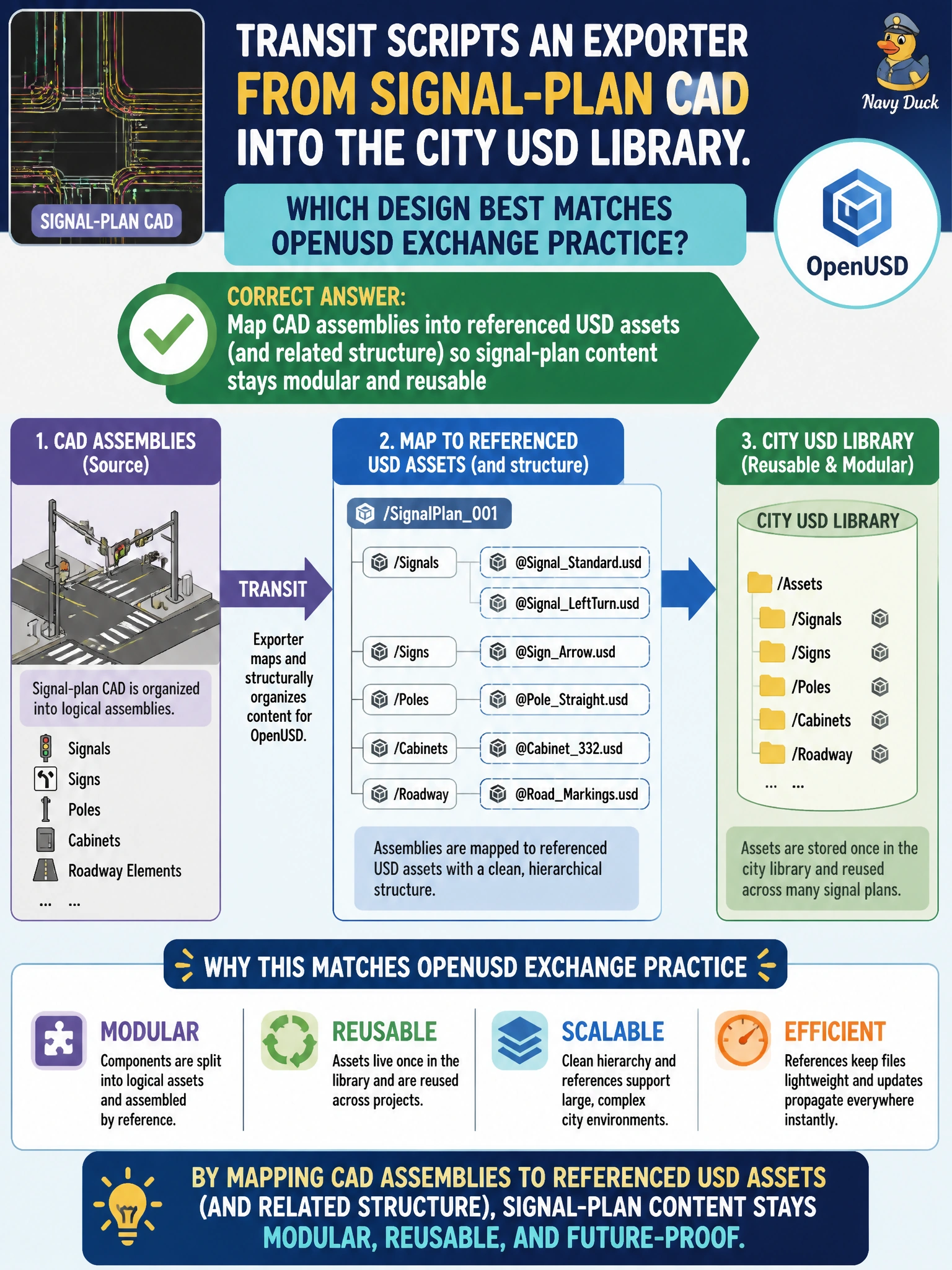
Signal-plan CAD should become modular USD you can reference, not one giant anonymous mashup. Map assemblies into referenced assets so corridors stay reusable. Treat it like stacking standard traffic-cabinet kits, not pouring concrete once.
Full Explanation
Transit exporters that move signal-plan CAD into the city USD library should map CAD assemblies into referenced USD assets and related structure so corridor content stays modular and reusable. OpenUSD exchange practice favors asset boundaries, references/payloads, and stable prim hierarchies over dumping an entire intersection into one anonymous mesh. Referenced signal heads, cabinets, and mast assemblies can then be versioned, instanced, and swapped without re-exporting every corridor mile—matching how municipal libraries manage reusable civic components.
Dumping every CAD entity into one anonymous mesh with no references destroys assembly identity, prevents selective updates, and bloats corridor stages with non-modular geometry. Exporting only layer names as TfTokens without geometry produces labels with no visual or spatial content for operations or simulation. Baking signal plans exclusively into material displayColor misuses shading channels for plan data and cannot represent hierarchy, kinematics, or maintainable asset versions.
Exam caveat: modular referenced assets do not forbid flattening for a specific delivery LOD, but the library-facing exchange should preserve referenceable structure. Do not confuse CAD layer names with USD model kinds or assetInfo; map structure deliberately.
Operational check: export a sample intersection, confirm assemblies appear as referenced assets with resolvable paths, open the corridor stage and verify selective mute/unload of a signal assembly works, and re-publish one updated mast asset to confirm consumers pick up the change without a full corridor re-export.