
Stormwater engineering wants flood-plain meshes from a proprietary engineering format available as municipal USD. What is the right converter outcome?
Select an answer to reveal the explanation.
Short Explanation
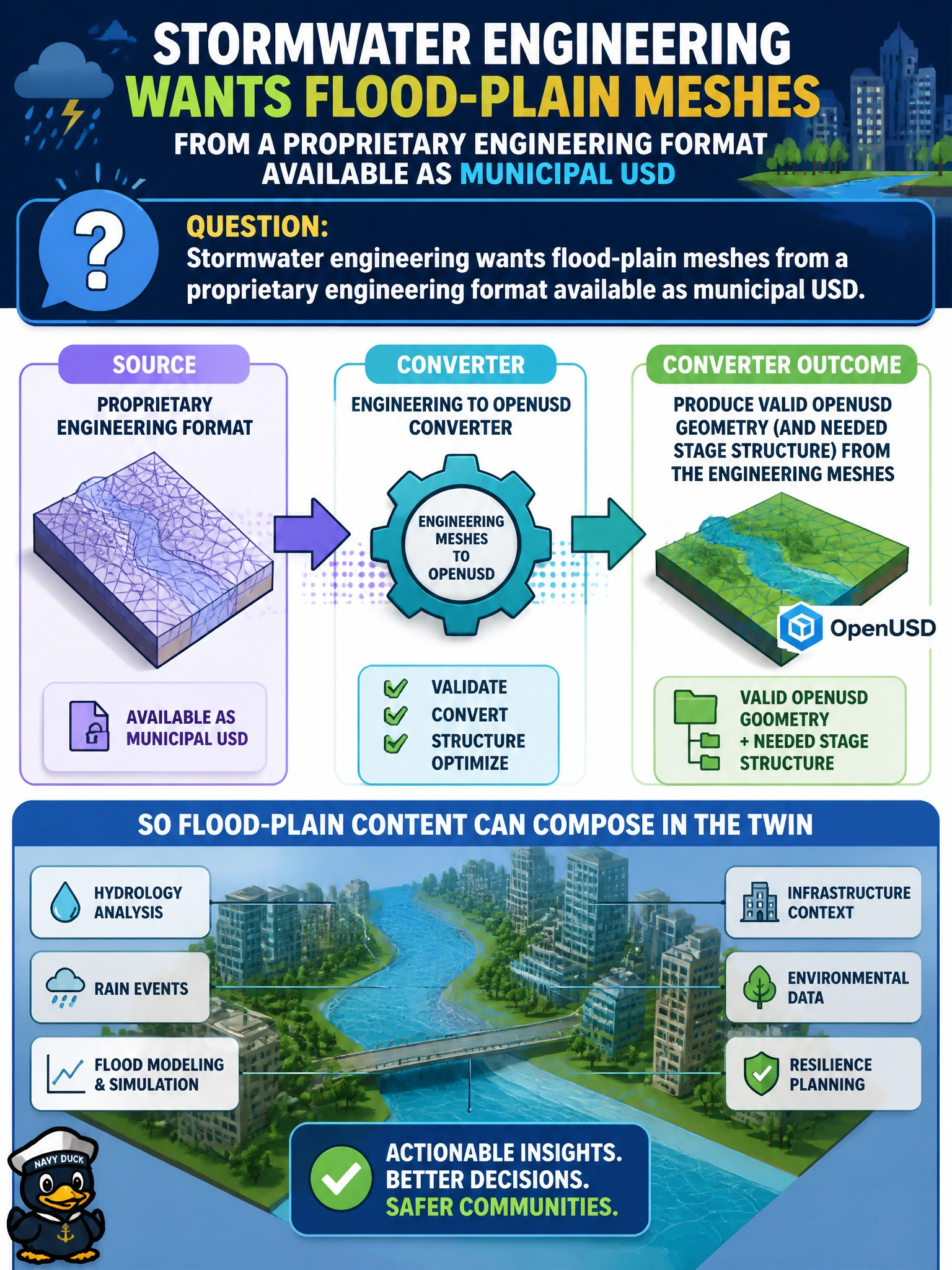
Flood-plain meshes only help the twin when they become real USD geometry others can compose. Convert the engineering format into valid OpenUSD structure. Screenshots and CSV-in-tokens are dead ends for stormwater viz.
Full Explanation
Stormwater flood-plain meshes authored in a proprietary engineering format only become useful to the municipal twin when a converter produces valid OpenUSD geometry and the needed stage structure so those meshes can compose with other civic layers. The right outcome is typed geometry prims, sensible transforms, extents, and stage metadata (upAxis, metersPerUnit) that flood visualization, hydrology overlays, and emergency planning tools can load without a proprietary plug-in. That conversion is the data-exchange bridge from engineering silos into shared OpenUSD libraries.
Embedding the proprietary files as JPEG screenshots on a single quad abandons mesh topology, elevations, and analytic depth—reviewers see a picture, not flood geometry. Storing flood meshes only as CSV coordinate lists inside tokens is not valid USD geometry; tokens are labels, not meshes, and CSV-in-tokens cannot drive extents, normals, or subdivision. Skipping conversion and permanently muting engineering layers hides the flood content entirely and leaves the twin without the hazard surface operations needs.
Exam caveat: conversion quality includes both geometric fidelity and stage hygiene. Emitting triangles without correct units or upAxis still fails municipal integrity gates even if the mesh “opens.” Prefer preserving engineering elevations in a documented unit system rather than baking arbitrary DCC defaults.
Operational check: convert a known flood-plain sample, validate with usdchecker-style integrity checks, confirm mesh prims and stage metadata, compose under the stormwater root, and spot-check elevations against the engineering source at control points before accepting the converter into the production pipeline.