
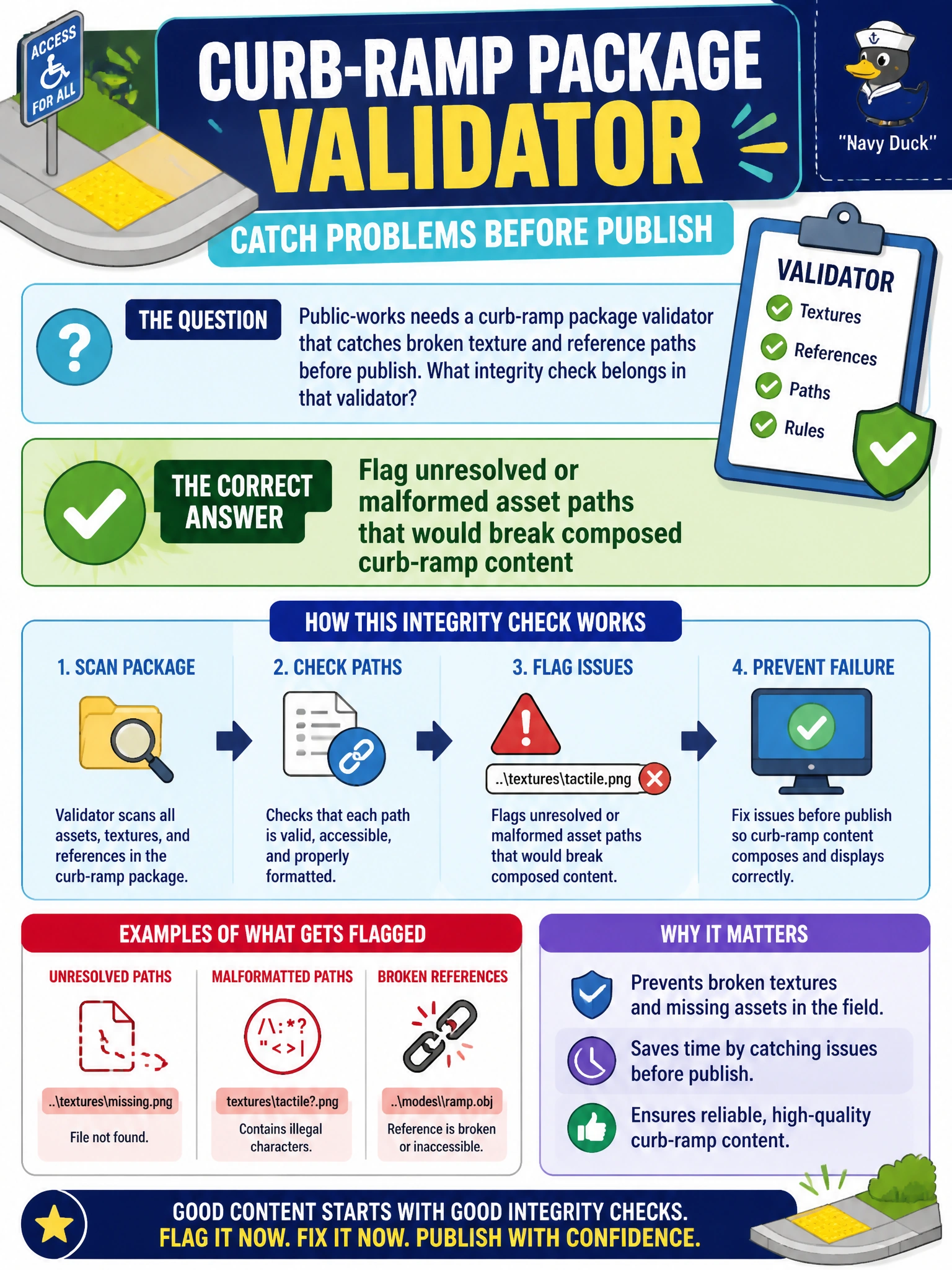
Public-works needs a curb-ramp package validator that catches broken texture and reference paths before publish. What integrity check belongs in that validator?
Select an answer to reveal the explanation.
Short Explanation
Broken curb-ramp paths are like a map with streets that lead nowhere. The validator should flag unresolved or malformed asset paths before publish. Screenshots and drive-letter hacks do not prove the package will compose cleanly.
Full Explanation
Public-works curb-ramp packages depend on textures, materials, and referenced USD assets resolving correctly when composed into the municipal twin. A package integrity validator should therefore flag unresolved or malformed asset paths that would break curb-ramp content at publish time—missing texture files, broken payload/reference URIs, Windows-only absolute paths that fail on Linux CI, or relative paths that leave the package root incorrectly. Catching those defects in the validator is a core usdchecker-class structural integrity check: it prevents field crews and accessibility reviewers from opening a ramp package that shows pink materials, empty references, or silent geometry gaps.
Forcing every path to an absolute Windows drive letter on all workstations creates non-portable packages that fail on build agents, macOS artist boxes, and Linux twin servers; path hygiene favors relocatable, package-relative resolution—not locking to one OS. Stripping all asset paths so packages never resolve externally removes the very links textures and sublayers need; empty paths are still broken content. Replacing path validation with a single screenshot comparison only proves one rendered view and cannot detect alternate LODs, muted layers, or assets that fail under a different camera or time sample.
Exam caveat: path validation is about structural resolvability of asset and reference paths in the exported civic USD, not about artistic quality of the curb texture itself. A green path check does not replace material review, but a red path check is sufficient grounds to block publish.
Operational check: run the curb-ramp package through the integrity validator with the same search paths the twin will use, list unresolved asset and reference paths, fix or repackage until the report is clean, then open the composed stage in a viewer and confirm textures and referenced assemblies load without fallback placeholders before releasing to public-works.