
Permitting QA must reject hearing-exhibit USD exports that omit stage upAxis or metersPerUnit. What should the integrity validator enforce?
Select an answer to reveal the explanation.
Short Explanation
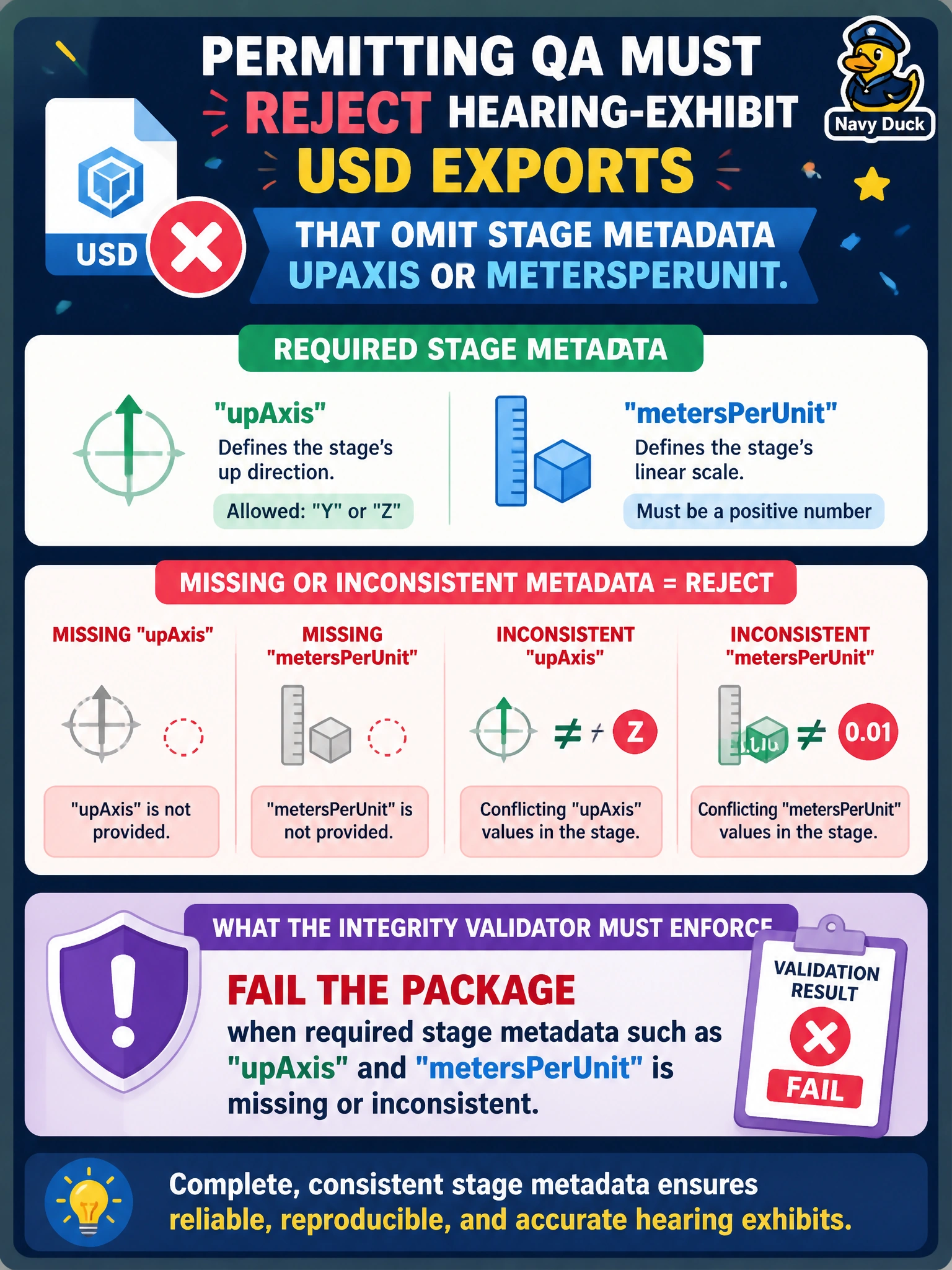
Hearing exhibits need a shared sense of up and scale, or the twin looks sideways and tiny. The validator should fail packages missing upAxis or metersPerUnit instead of hoping viewers guess. Treat that stage metadata like the title block on a permit drawing.
Full Explanation
Hearing-exhibit USD packages for municipal permitting must carry unambiguous stage orientation and scale metadata so commission viewers, third-party reviewers, and digital-twin composers all interpret the same up direction and meters-per-unit. An integrity validator should therefore fail the export when required stage metadata such as upAxis and metersPerUnit is missing or inconsistent across the composed package. That gate is the OpenUSD equivalent of rejecting a permit drawing that lacks a title block and scale bar: without those fields, curb lines, building envelopes, and accessibility clearances can appear sideways, mirrored, or orders of magnitude wrong when layers from different DCC tools are composed.
Muting every sublayer so scale metadata becomes irrelevant does not fix the defect; it only hides authored civic content and still leaves the consumer without a declared coordinate contract. Converting all meshes to points so orientation checks seem unnecessary destroys the geometric fidelity required for hearing exhibits and does not encode upAxis or metersPerUnit. Deleting TfDebug symbols before publish is unrelated hygiene—diagnostics are not stage metadata and clearing them does nothing for orientation or scale integrity.
Exam caveat: OpenUSD does not invent a single mandatory municipal schema for every city, but stage-level upAxis and metersPerUnit are foundational authored metadata that usdchecker-style and custom QA gates routinely treat as required for cross-tool exchange. Do not confuse them with prim-level displayColor, kind, or customData APNs.
Operational check: before accepting a hearing-exhibit package into the permitting library, run the integrity validator (or equivalent scripted asserts) against the composed stage, confirm upAxis and metersPerUnit resolve to expected values, and reject or quarantine packages that omit or contradict those fields. Spot-load a known reference curb or parcel overlay in a viewer and verify north/up and real-world scale match the GIS source before public posting.