
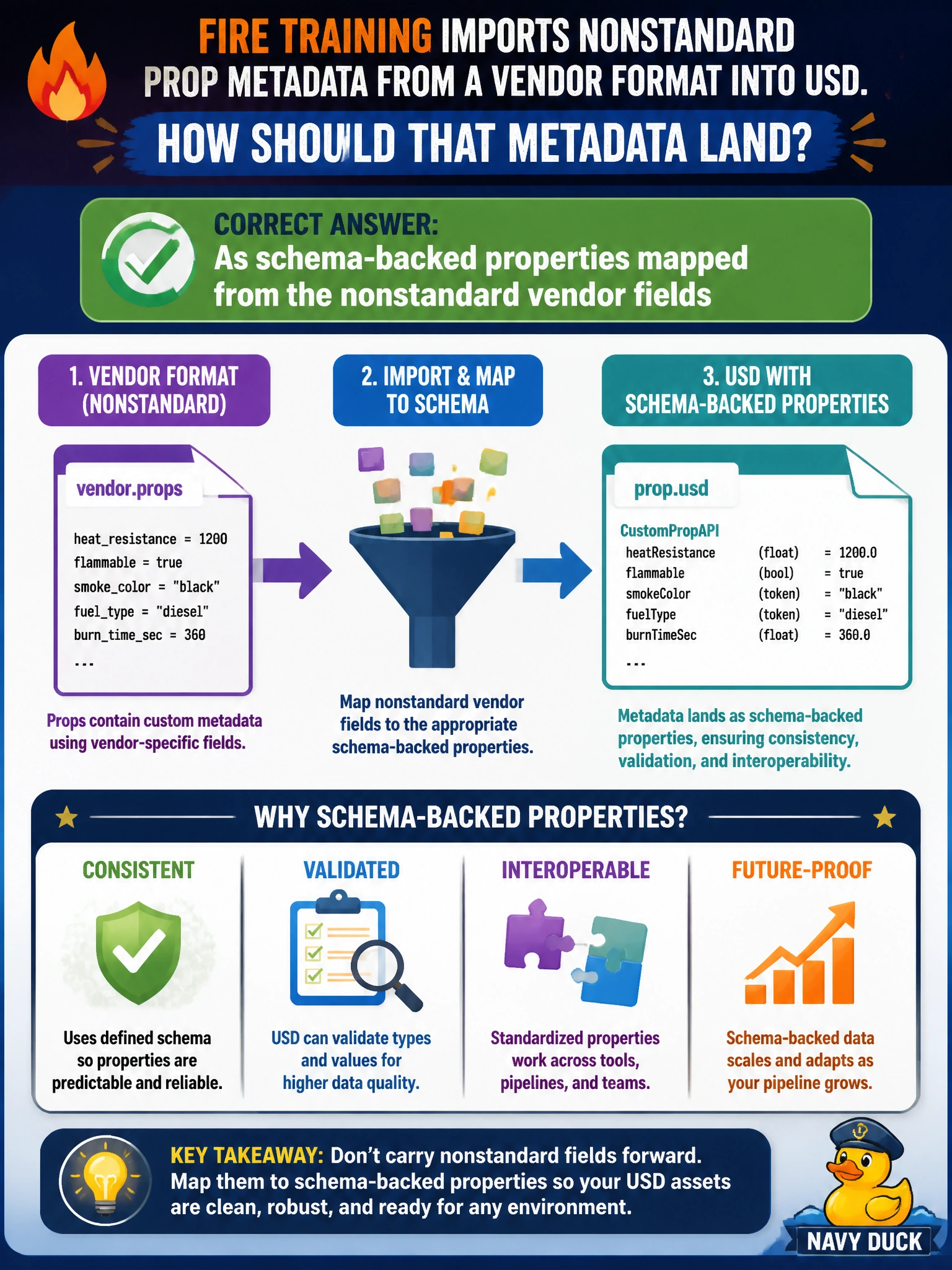
Fire training imports nonstandard prop metadata from a vendor format into USD. How should that metadata land?
Select an answer to reveal the explanation.
Short Explanation
You’ll get dependable prop metadata when you map vendor fields into schema-backed properties on USD prims. That gives your training tools usable data, unlike scattered comments, overloaded texture filenames, or deleted attributes that trainers must retype.
Full Explanation
Nonstandard vendor prop metadata should be mapped into schema-backed properties on USD prims. This gives you consistent, typed data—such as hazard class, mass, and drill role—that trainers and tools can use. Unstructured comments scattered across random layers are not reliable metadata interfaces, so validators, filters, and training UIs may not be able to use them. Encoding the entire metadata blob in texture filenames overloads asset paths and can make the data unreliable when textures are shared, compressed, or renamed. Deleting attributes leaves no imported metadata for trainers to use and forces them to retype details for each drill, disrupting continuity and increasing the chance of human error during scenario setup. Exam caveat: vendor fields may require normalization of units, enums, or ID formats; document those rules in the schema and importer specification rather than relying on ad hoc post-edits after each delivery. Practical check: import a vendor prop pack, verify that every required field appears as a schema-backed USD property on the expected prims, and run a training-stage checklist that rejects incomplete prop metadata before the drill package is approved.