
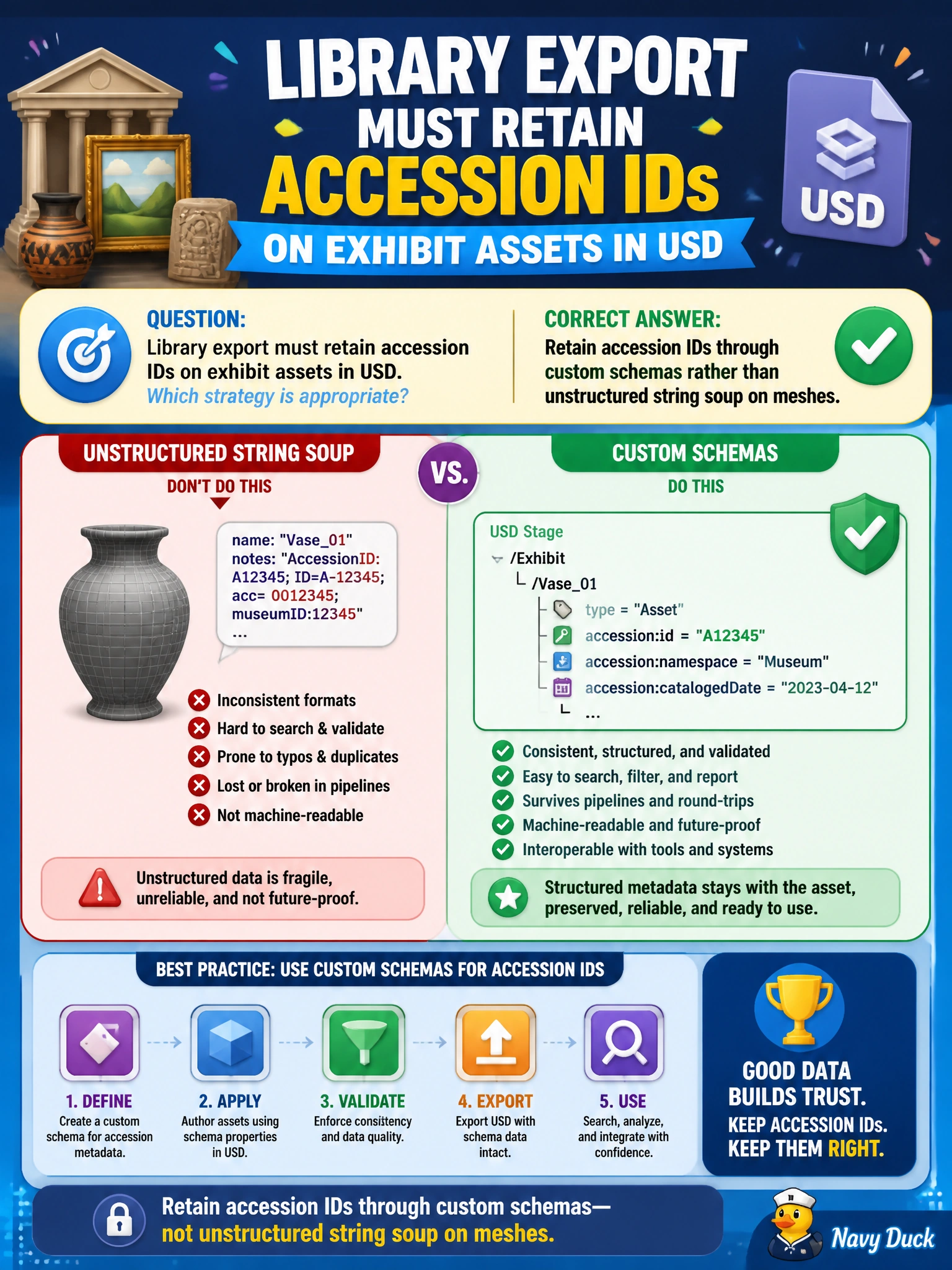
Library export must retain accession IDs on exhibit assets in USD. Which strategy is appropriate?
Select an answer to reveal the explanation.
Short Explanation
Accession IDs deserve a proper schema seat, not a blender of random mesh strings. Custom schemas keep the catalog IDs clean through export.
Full Explanation
Library export must keep accession IDs on exhibit assets so catalog identity survives in the USD package shared with partners and public viewers. Retaining accession IDs through custom schemas—rather than unstructured string soup on meshes—gives a stable, typed place for catalog keys that inventory systems, exhibit tools, and auditors can trust across revisions.
Concatenating accession IDs into mesh faceVarying normals corrupts shading and geometry channels and invents a non-queryable pseudo-database. Dropping accession IDs because “OpenUSD cannot store custom fields” is false; custom properties and schemas exist specifically for domain identity like catalog numbers. Printing accession IDs only on paper labels taped to workstations fails digital continuity and does not travel with the exported stage.
Exam caveat: Enforce uniqueness and format rules for accession IDs in schema validation so duplicate or malformed IDs cannot publish silently into the library’s exhibit corpus.
Operational check: Export a gallery subset, confirm each exhibit prim carries its schema-backed accession ID matching the catalog system, and reject packages with missing, colliding, or mistyped IDs before release.