
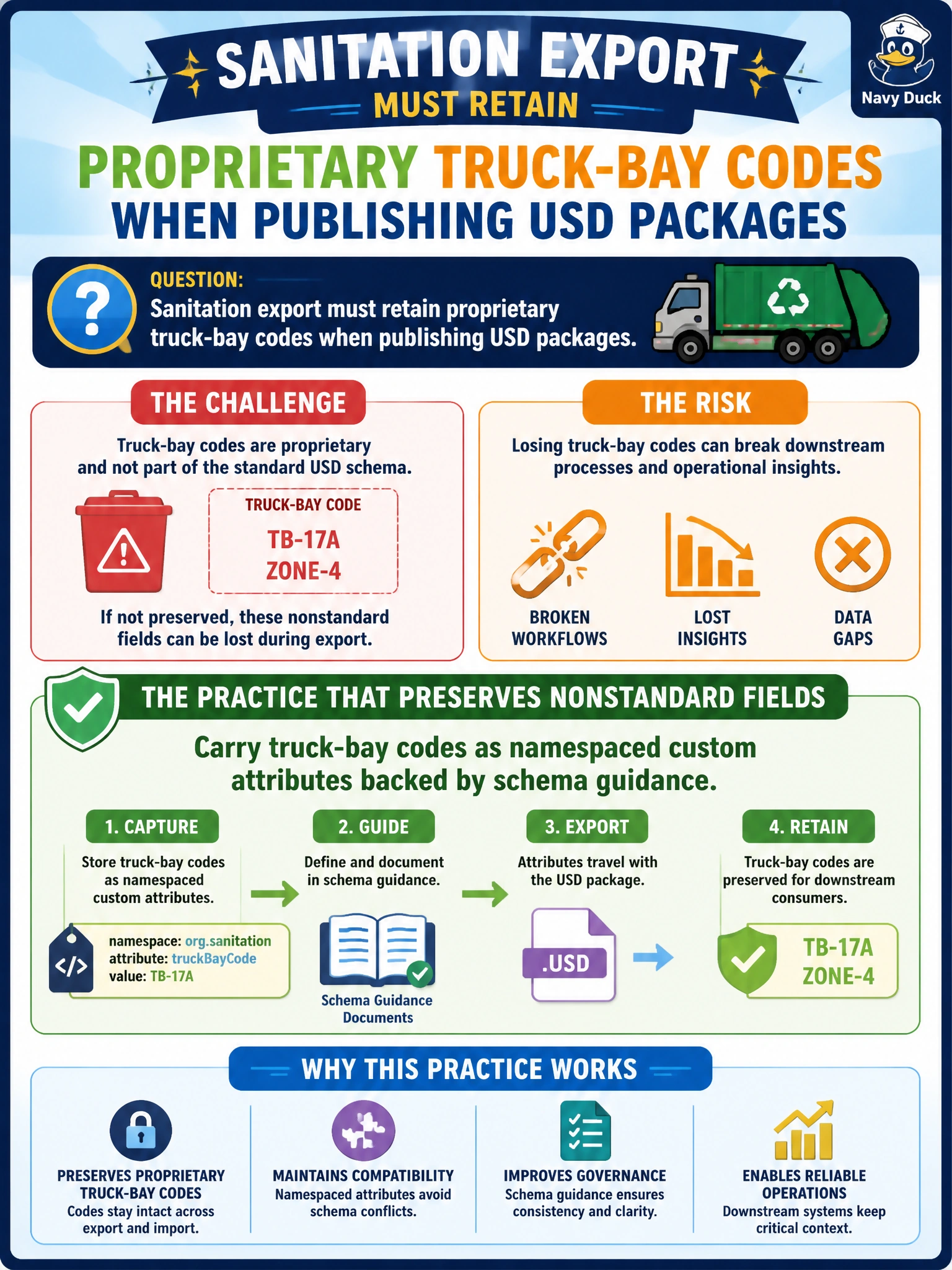
Sanitation export must retain proprietary truck-bay codes when publishing USD packages. What practice preserves those nonstandard fields?
Select an answer to reveal the explanation.
Short Explanation
Truck-bay codes are inventory truth—give them namespaced custom attributes with schema backing. Do not hide them in colors or filenames and hope.
Full Explanation
Sanitation export that must retain proprietary truck-bay codes should carry them as namespaced custom attributes backed by schema guidance. Namespacing avoids collisions with core USD property names, and schema guidance keeps bay codes typed, documented, and consistent across published packages that depot operations and inventory systems consume.
Appending bay codes into every prim’s displayColor as free text abuses a shading attribute, breaks color meaning for lookdev, and is hostile to queries. Omitting bay codes and relying on staff memory at the depot discards digital-twin value and fails auditability when packages move between sites. Renaming meshes so the filename is the only place a bay code appears couples identity to brittle file naming and fails once assets are referenced, renamed, or composed inside the stage.
Exam caveat: Proprietary codes may be sensitive—confirm packaging and access controls for published USD still meet agency data-handling rules while preserving the attributes for authorized consumers.
Operational check: After export, query namespaced bay-code attributes on truck-bay prims, verify schema validation passes, and confirm codes match the sanitation inventory system for a sample package before wide publish.