
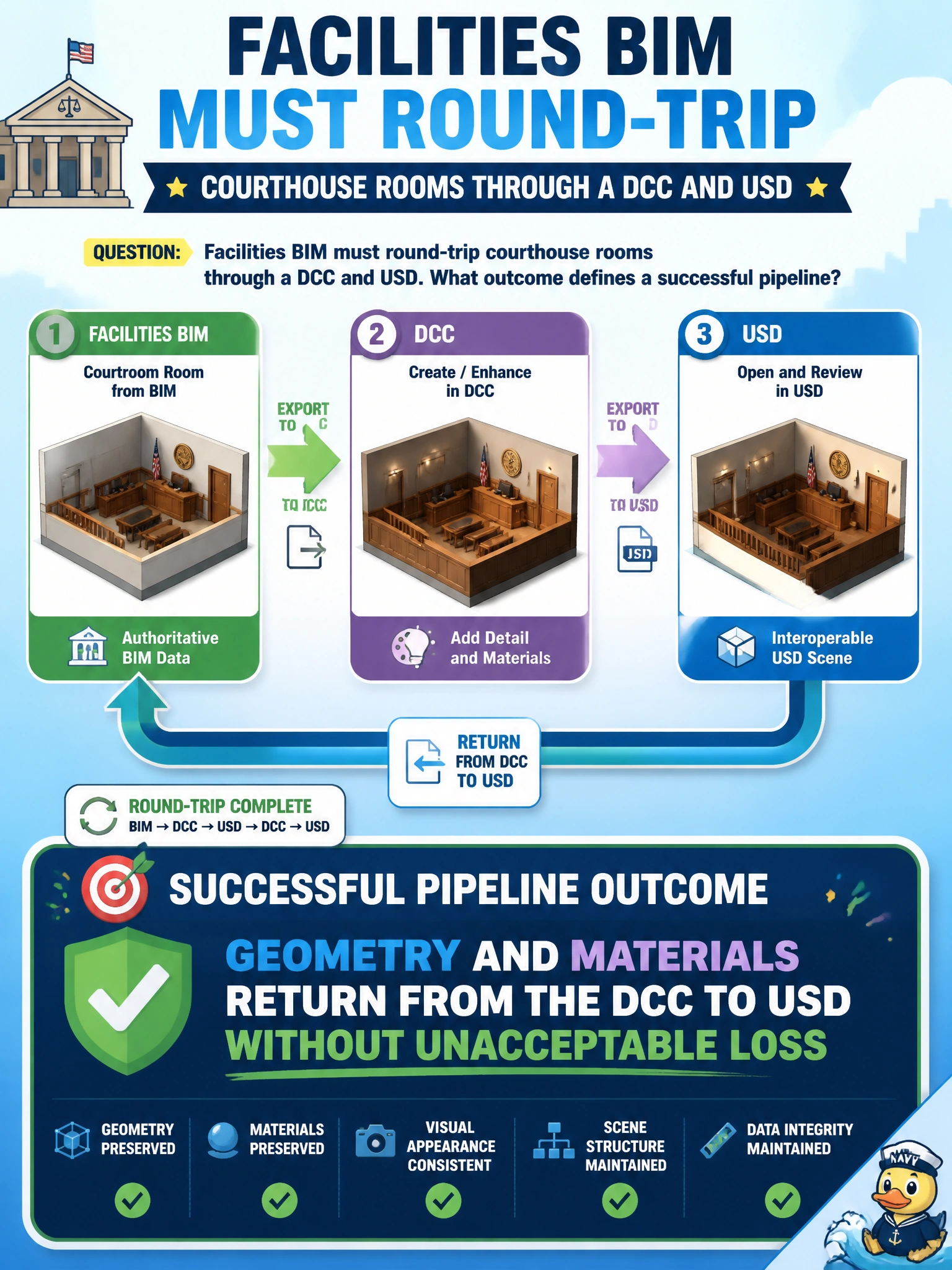
Facilities BIM must round-trip courthouse rooms through a DCC and USD. What outcome defines a successful pipeline?
Select an answer to reveal the explanation.
Short Explanation
A round-trip is like sending rooms through a revolving door—they should come back looking like themselves. Geometry and materials need to survive without ugly losses.
Full Explanation
Facilities BIM round-tripping courthouse rooms through a DCC and back to USD succeeds when geometry and materials return without unacceptable loss. That outcome preserves the digital twin as a trustworthy facilities record for space planning and maintenance rather than a one-way export sink that degrades each cycle.
Discarding materials on every re-import to keep files small fails lookdev, finish schedules, and occupant-facing visualizations. Randomizing prim paths on each export to avoid cache hits intentionally breaks references, overrides, and facility asset identity across the courthouse stage. Allowing only cameras to survive while replacing meshes with permanent proxies abandons the room geometry the twin exists to carry and blocks measurement from the USD record.
Exam caveat: “Unacceptable loss” must be quantified—tolerances for triangulation changes, material approximation, UV drift, and metadata dropouts—before declaring the BIM↔USD pipeline production-ready.
Operational check: Export a representative courtroom, round-trip through the DCC, re-import to USD, and compare mesh metrics, material bindings, and key facility attributes against the pre-round-trip baseline; gate promotion of the pipeline on those measured deltas.