
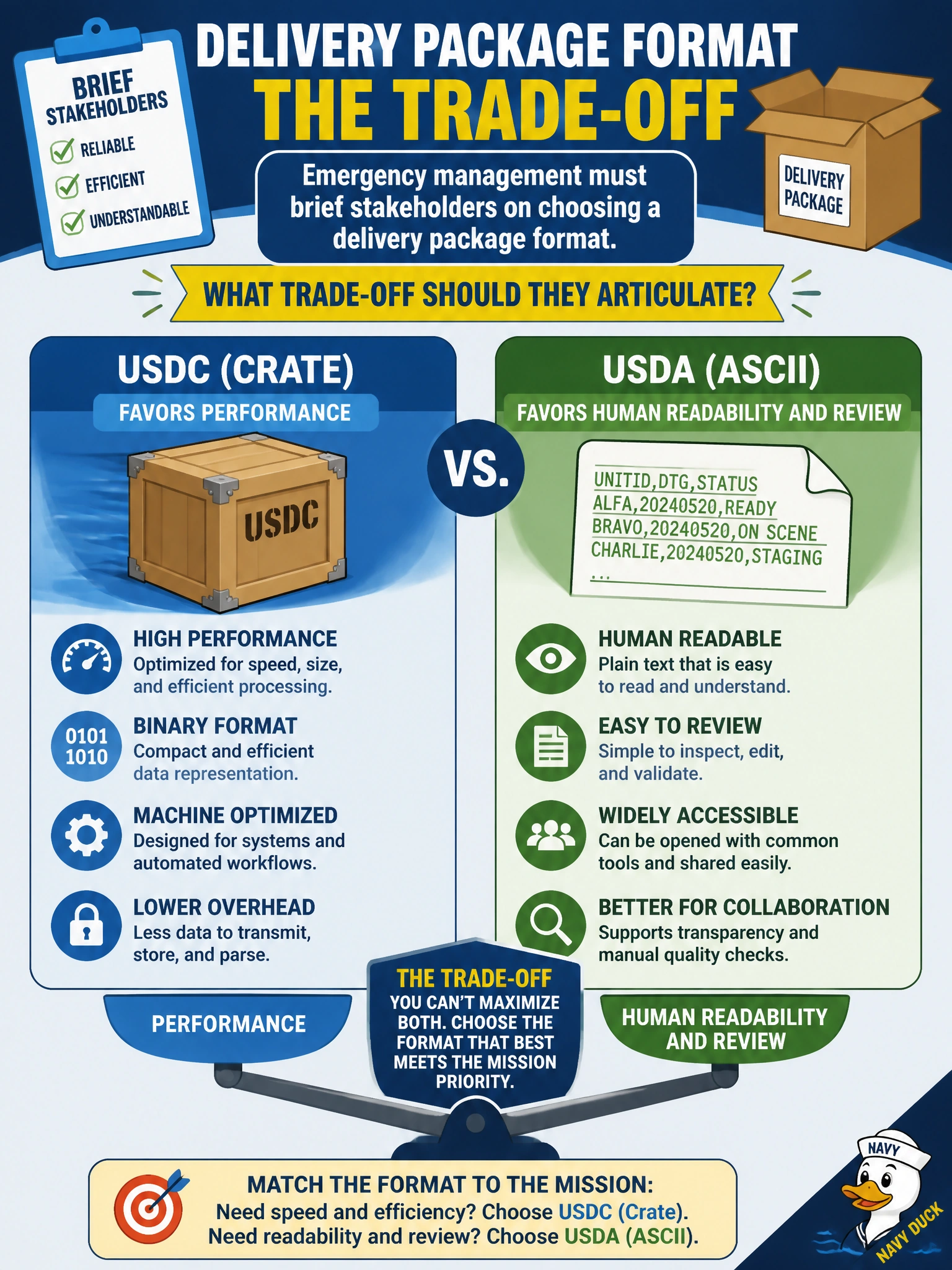
Emergency management must brief stakeholders on choosing a delivery package format. What trade-off should they articulate?
Select an answer to reveal the explanation.
Short Explanation
Tell stakeholders the simple fork in the road: crates (USDC) run leaner; ASCII (USDA) reads clearer. That is the delivery trade-off, not a MIME-type myth.
Full Explanation
Emergency-management stakeholders choosing a delivery package format need a clear trade-off statement: USDC (crate) favors performance—faster loads and denser binary packaging for large stages—while USDA (ASCII) favors human readability, review, and textual diffing. That framing guides whether a briefing package prioritizes inspection by planners or runtime efficiency for operators in the field.
Claiming USDA and USDC are interchangeable MIME types with identical tooling behavior is wrong; codecs, diffability, and load characteristics differ by encoding. Saying USDC is ASCII and USDA is the only binary crate reverses the facts and mis-trains the decision. Choosing PNG storyboards instead because “neither format can leave the authoring machine” abandons USD delivery entirely and is not an OpenUSD packaging trade-off.
Exam caveat: Many programs deliver both—an USDA review package and a USDC runtime package—rather than forcing a single file to optimize opposite goals for every audience.
Operational check: In the stakeholder brief, show the same civic stage as USDA and USDC with size and load metrics plus a sample textual diff; record which audiences receive which encoding before locking the emergency-management delivery SOP.