
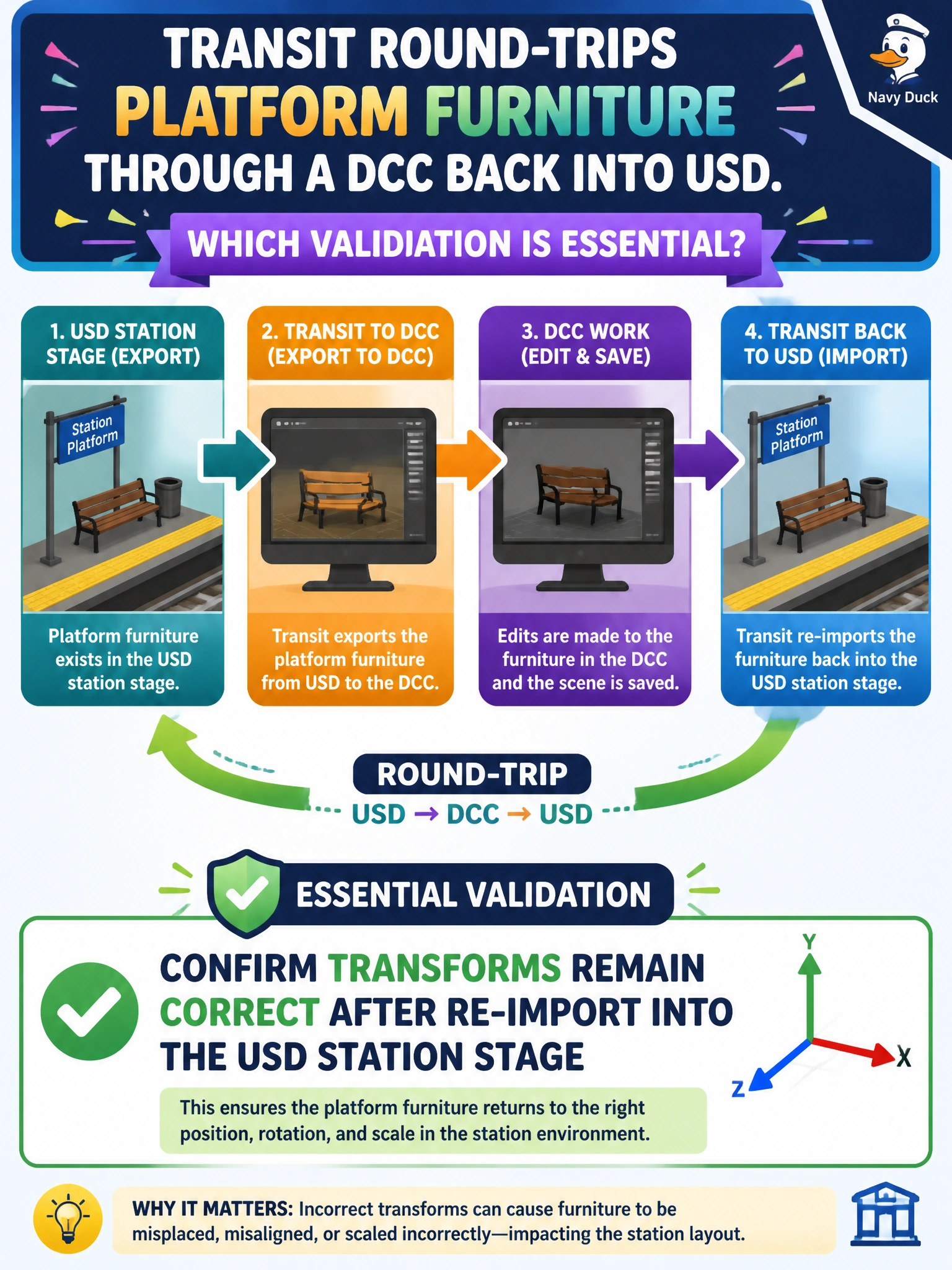
Transit round-trips platform furniture through a DCC back into USD. Which validation is essential?
Select an answer to reveal the explanation.
Short Explanation
If a bench comes back floating above the platform, the round-trip lied. Check transforms after re-import before you call the pipeline done.
Full Explanation
Transit platform furniture that round-trips through a DCC must land back in the USD station stage with correct transforms. Placement is operational: a bench, sign, or gate device in the wrong location is a bad twin even if the mesh looks fine in isolation, and clearance errors can mislead construction and safety reviews.
Zeroing all transforms on re-import so furniture collapses to the origin destroys station layout by design and is not a validation strategy. Deleting relationships so furniture cannot parent under platforms removes structure needed for modular station composition and selective updates. Converting furniture to cameras to skip transform checks changes schema identity and avoids the very validation the pipeline requires.
Exam caveat: Watch for centimeters versus meters, up-axis conventions, and parent-space versus world-space bake differences between DCC and USD—transform values that are “almost right” still fail platform clearance and wayfinding checks.
Operational check: After re-import, sample furniture xformOps or local-to-world matrices against known station anchors and as-built dimensions; reject the package if any asset exceeds the transit placement tolerance and log which exporter options produced a clean round-trip.