
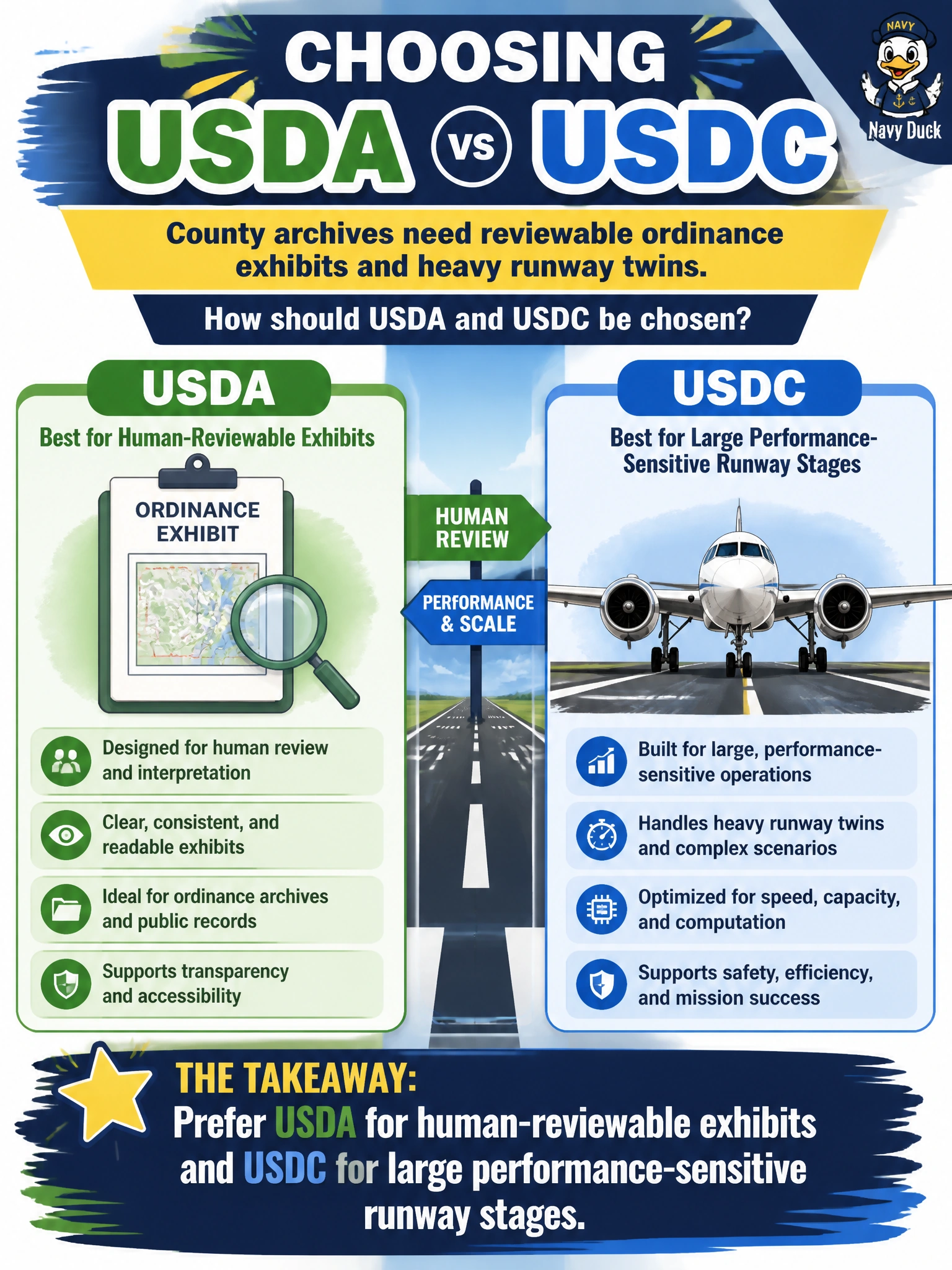
County archives need reviewable ordinance exhibits and heavy runway twins. How should USDA and USDC be chosen?
Select an answer to reveal the explanation.
Short Explanation
USDA is the readable binder for ordinance review; USDC is the packed crate for heavy runway geometry. Pick the format that matches the job, not a one-size myth.
Full Explanation
County archives that handle both reviewable ordinance exhibits and heavy runway twins should choose USD encodings by workflow, not ideology. Prefer USDA for human-reviewable exhibits where legal and planning staff need readable diffs and inspectable text, and USDC for large performance-sensitive runway stages where load time and file size dominate interactive review and simulation.
Always using USDA for every runway mesh ignores performance realities of large geometry and slows stakeholders who only need to view the twin. Always using USDC for ordinance text review fights human readability and audit workflows that depend on textual inspection. Storing both formats as identical byte streams so tools cannot tell them apart is impossible by design—USDA is ASCII layer text and USDC is crate binary—and would break format-specific tooling and validators.
Exam caveat: Teams often keep USDA as the editable source of truth and publish USDC derivatives; do not assume one on-disk file must optimize review and runtime equally for every county asset class.
Operational check: For ordinance packages, confirm reviewers can open and diff USDA meaningfully in the archive toolchain; for runway packages, confirm USDC meets load-time budgets and that USDA or other sources remain available for change control and legal hold.