
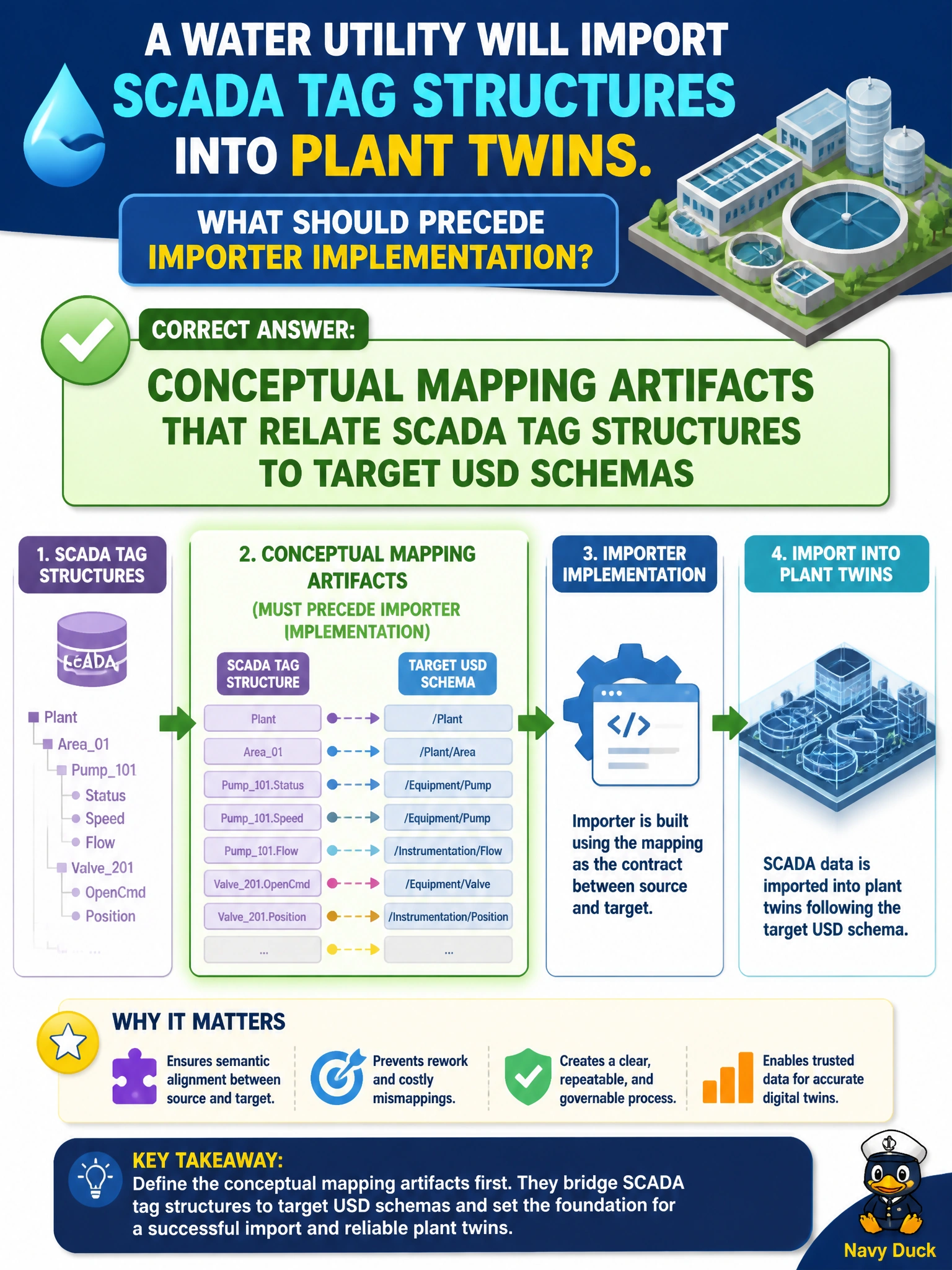
A water utility will import SCADA tag structures into plant twins. What should precede importer implementation?
Select an answer to reveal the explanation.
Short Explanation
Do not weld SCADA into USDC blind. Produce the conceptual mapping from tags to USD schemas first—then the importer has a blueprint.
Full Explanation
A water utility importing SCADA tag structures into plant twins should not start with ad-hoc binary merges. Conceptual mapping artifacts that relate SCADA tags to target USD schemas give engineers a blueprint for types, namespaces, units, update frequency assumptions, and which plant prims own which tags—essential before importer implementation locks in a brittle path.
Immediate binary concatenation of SCADA dumps into USDC without a schema plan produces opaque, non-portable blobs that USD consumers cannot interpret as tags or validate. Removing all typed schemas so tags become free-form strings only throws away validation, discovery, and tooling support. Banning documentation until after production cutover guarantees expensive rework when plant operators discover mis-mapped tags during incident response.
Exam caveat: SCADA naming collisions and unit conventions vary by vendor and site—mappings must include normalization and conflict rules, not only naïve one-to-one field copies from the historian export.
Operational check: Approve mapping artifacts with operations and digital-twin owners, prototype a narrow tag subset into schema-backed properties, validate with usdchecker-style rules and a plant-specific required-tag list, then scale the importer.