
Public-works lookdev uses agency MaterialX graphs that must land as UsdShade networks. What should the team produce first?
Select an answer to reveal the explanation.
Short Explanation
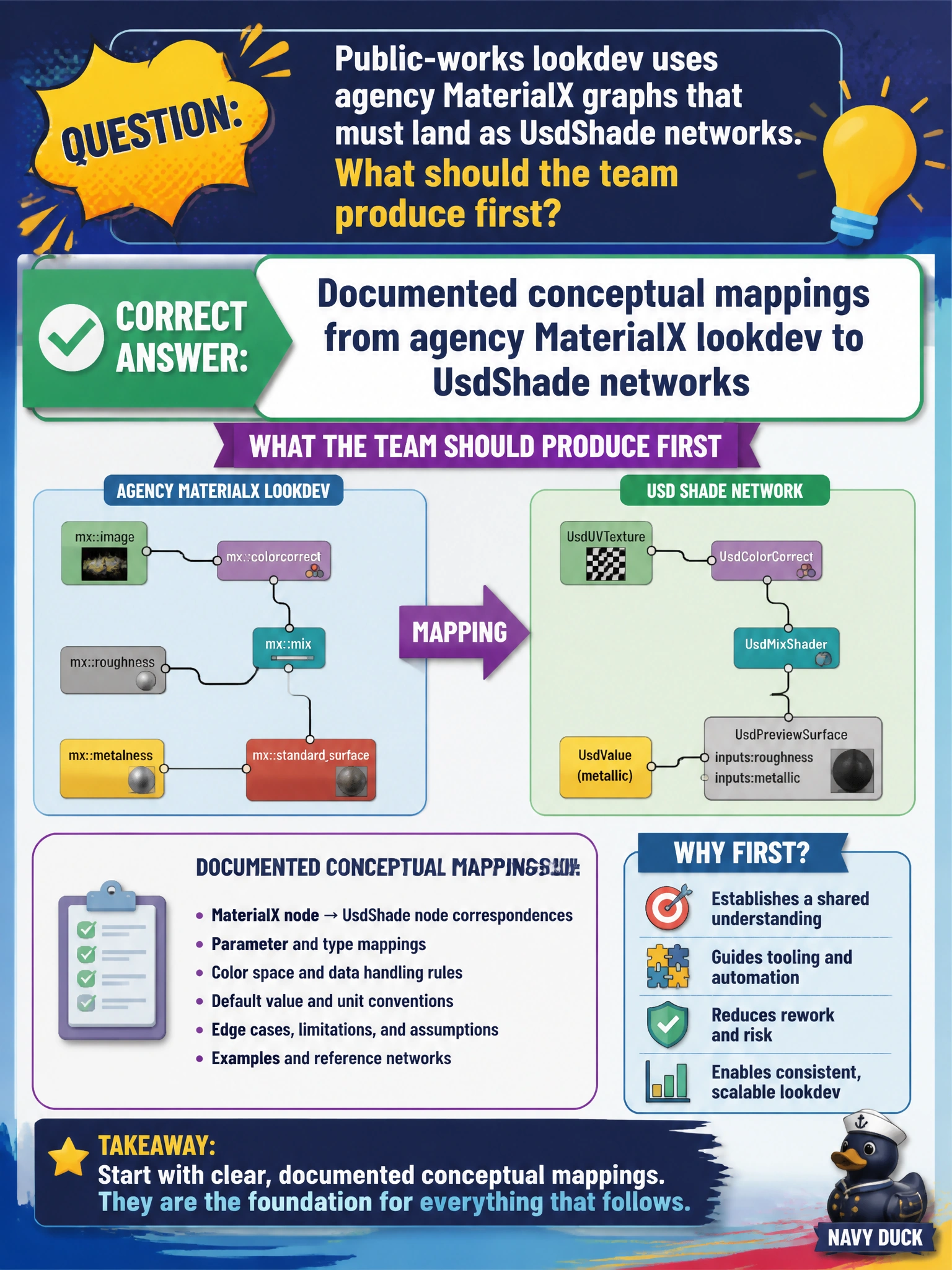
Before you build the importer, draw the map. Document how agency MaterialX lookdev concepts land on UsdShade so nobody guesses during conversion night.
Full Explanation
Public-works lookdev that begins in agency MaterialX graphs must eventually bind as UsdShade networks on municipal assets. The first deliverable should be documented conceptual mappings from MaterialX lookdev concepts to UsdShade constructs—nodes, parameters, texture connections, and material binding patterns—so importer authors and lookdev artists share one agreed translation before production conversion begins.
A mute list that deletes all UsdShade bindings citywide removes shading rather than mapping MaterialX into USD and leaves assets unbound. Renaming MaterialX files with a .usdc extension does not convert graphs; it mislabels content and breaks both MaterialX tooling and USD crate expectations. A single displayColor override that replaces every material network flattens lookdev into a trivial color opinion and abandons network fidelity the agency already invested in.
Exam caveat: Not every MaterialX node has a one-to-one UsdShade equivalent—document approximations, unsupported nodes, and bake-down strategies explicitly so reviewers know where lookdev may diverge after import.
Operational check: Maintain the mapping document with a small golden set of agency materials; convert them, compare shade networks and renders in the public-works viewer, and refuse production importer rollout until the documented mappings cover the agency’s required lookdev patterns.