
Parks delivers a playground twin as glTF for a contractor tablet app. What fidelity concern should lead the handoff checklist?
Select an answer to reveal the explanation.
Short Explanation
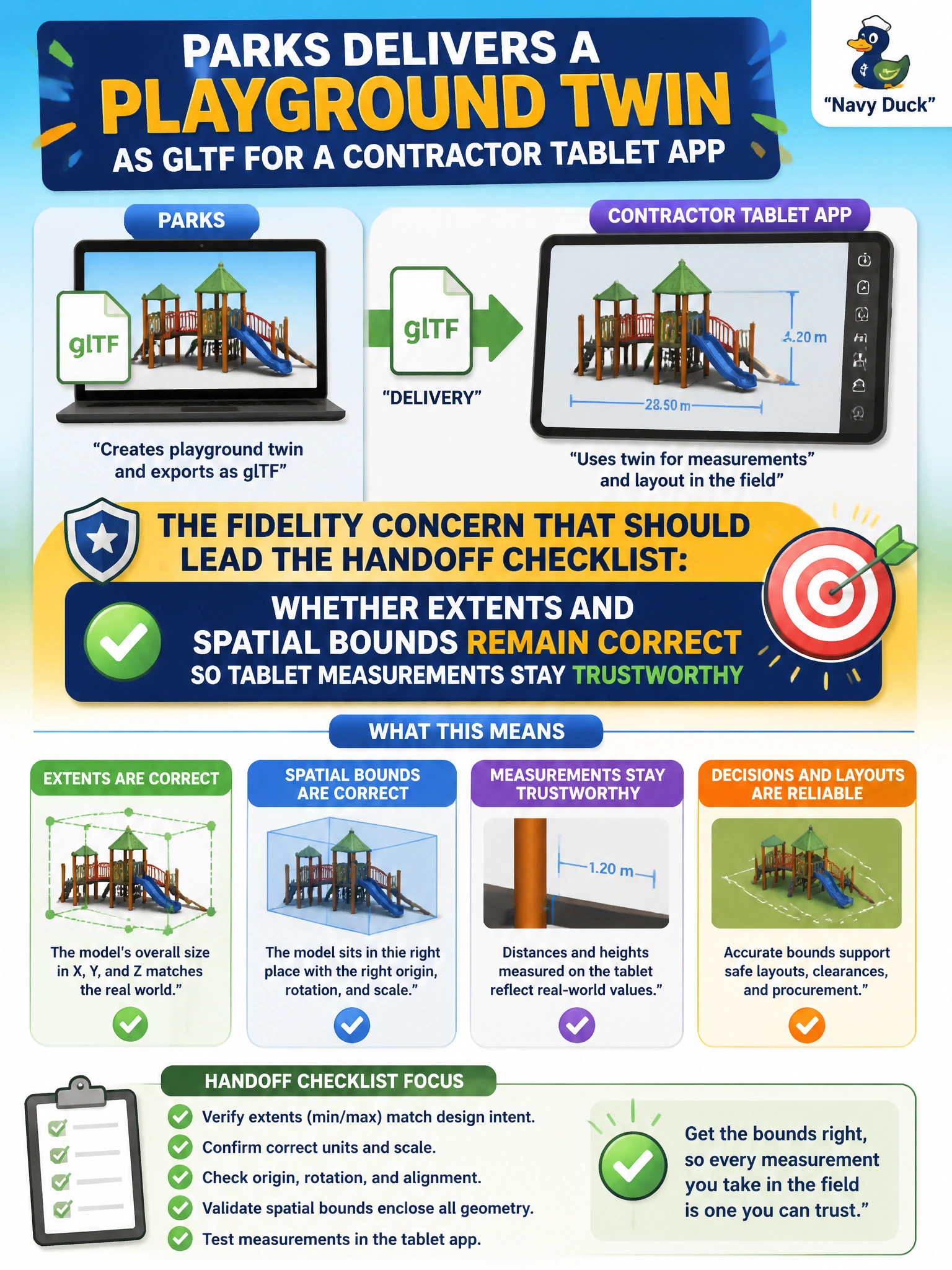
Contractors measure from what they see on the tablet. If extents and bounds drift in glTF, the playground twin becomes a bad tape measure—so check spatial fidelity first.
Full Explanation
Parks playground twins delivered as glTF to contractor tablets are used for layout and measurement decisions in the field. Extents and spatial bounds that remain correct after conversion keep those tablet measurements trustworthy relative to the authored USD twin. If axis conversion, unit scaling, or exporter packing shifts bounds, contractors inherit a false tape measure and may mis-place equipment relative to fall zones and paths.
Whether USDA layer comments survive as glTF extras with identical whitespace is irrelevant to measurement fidelity and over-constrains a delivery format that does not exist to preserve USD comment formatting. Encoding every swing set as a payload arc inside glTF misuses packaging concepts and does not validate spatial correctness of playground geometry. Embedding KindRegistry entries as PNG chunks invents an unsupported transport and ignores the actual fidelity risk: wrong extents and world bounds after export.
Exam caveat: Bounds checks should include both local mesh extents and world-space placement under the playground root after any up-axis or meters-versus-other-unit conversion the glTF path applies.
Operational check: Compare authored USD extents and a few surveyed anchor points (for example, fence corners or pour edges) against the glTF on the tablet app; fail the handoff if spatial bounds or placements disagree beyond the parks measurement tolerance, and record the exporter unit settings that produced a clean package.