
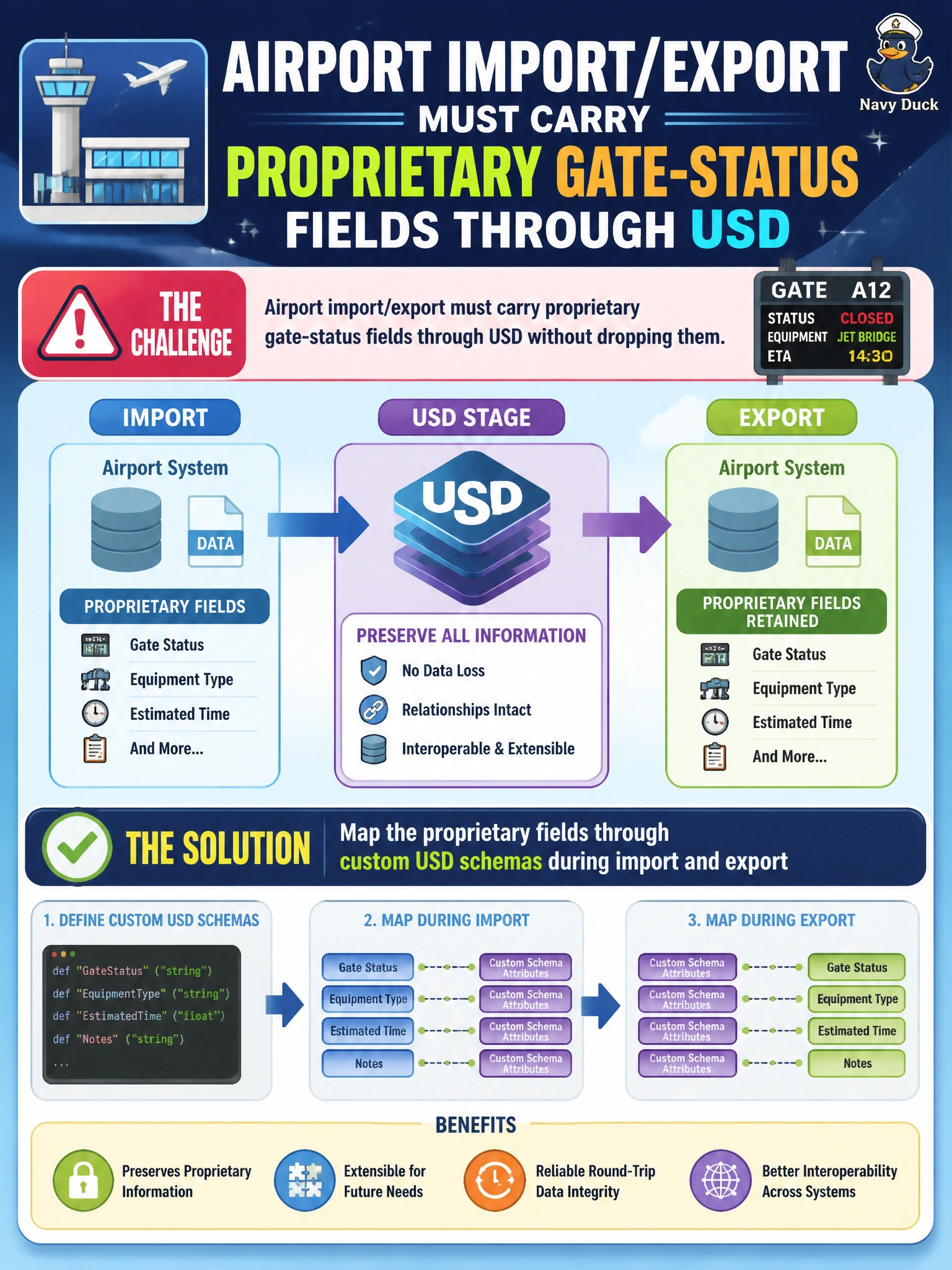
Airport import/export must carry proprietary gate-status fields through USD without dropping them. Which approach supports nonstandard attributes?
Select an answer to reveal the explanation.
Short Explanation
Gate status is real operational data—do not shove it into texture names and hope. Map it through custom schemas so import and export keep it intact.
Full Explanation
Airport import/export must carry proprietary gate-status fields through USD by mapping those fields through custom USD schemas during import and export. Custom schemas provide a stable, typed home for nonstandard attributes so round-trips do not drop operational gate status. Importers write schema attributes; exporters read them back into the airport system of record; viewers with the schema plug-in display and validate the data consistently.
Stripping all custom fields on import and recreating them from memory later guarantees data loss and nondeterministic rebuilds—unacceptable for gate operations. Storing gate-status only inside texture filenames abuses image assets as a side channel, breaks with renames/compression, and is not queryable as typed USD data. Relying on undocumented binary blobs attached to mesh points is non-interoperable, invisible to standard tooling, and fragile under geometry edits.
Exam caveat: proprietary operational fields survive USD pipelines through custom schemas, not steganography in textures or undocumented blobs. Pair schemas with the pinned runtime/plugins used by airport import/export services.
Operational check: import a gate with status fields into USD using the schema mapping, confirm attributes exist and type-check on the stage, export back to the airport system, diff status fields for fidelity, and open the stage in a viewer that loads the custom schema to ensure nothing is silently ignored as unknown fluff.