
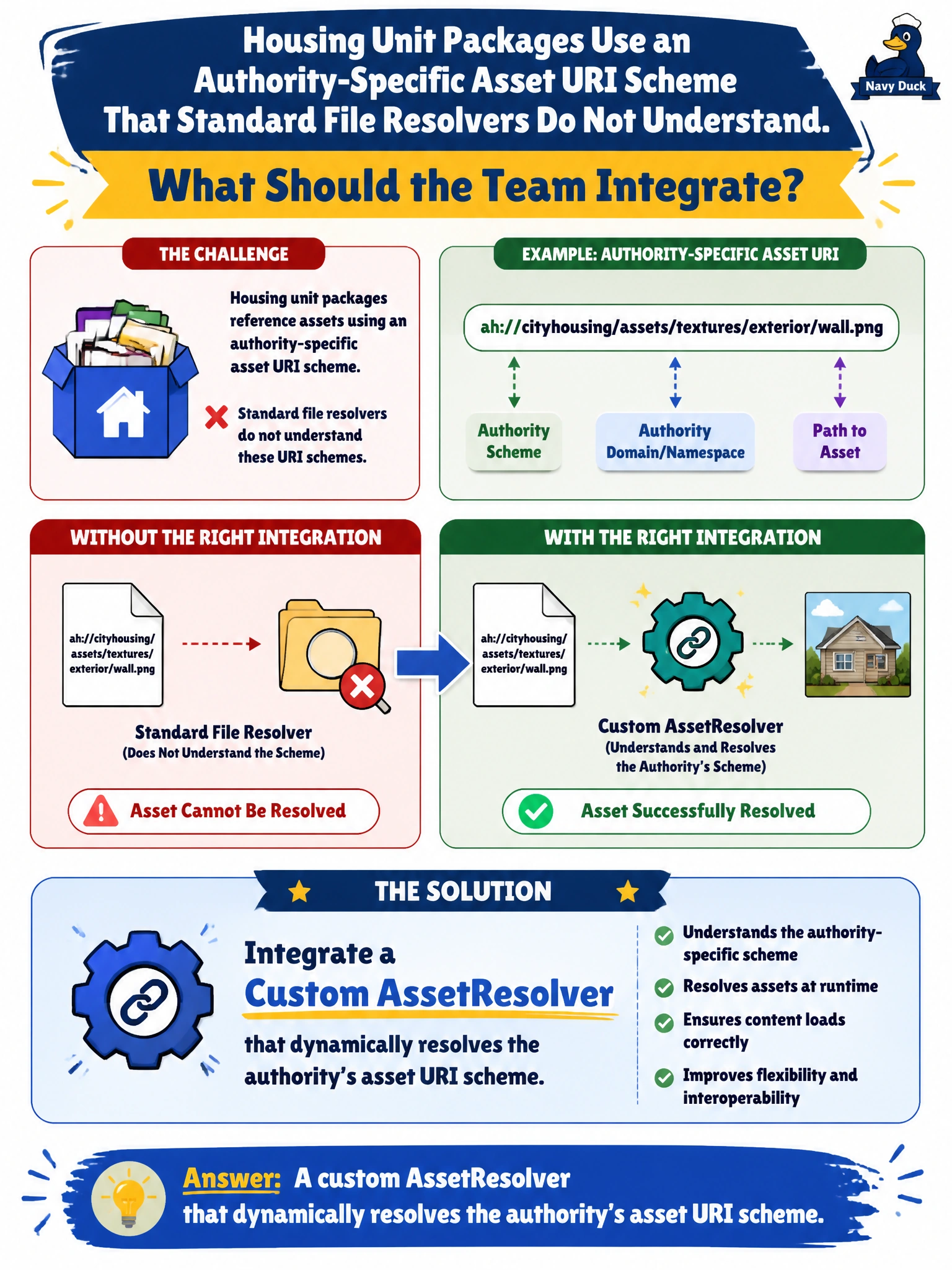
Housing unit packages use an authority-specific asset URI scheme that standard file resolvers do not understand. What should the team integrate?
Select an answer to reveal the explanation.
Short Explanation
If the housing authority speaks a special address dialect, teach USD that dialect with a custom AssetResolver—do not tattoo absolute paths on every unit.
Full Explanation
Housing unit packages that use an authority-specific asset URI scheme require integrating a custom AssetResolver that dynamically resolves that scheme. OpenUSD asset resolution is pluggable precisely so enterprises can map proprietary URI dialects to real storage locations without baking environment-specific absolute paths into every reference. A custom AssetResolver keeps unit packages portable across authority environments while still composing correctly in housing twins.
Adding a new LIVERPS letter that outranks Local for URI strings invents composition mythology; LIVERPS is not extended ad hoc for path strings. Hard-coded absolute NFS paths pasted into every reference brittle-break across machines, air-gapped enclaves, and cloud mirrors. Replacing all references with inline anonymous layers only abandons asset identity and scalable packaging for housing libraries.
Exam caveat: proprietary URI scheme ⇒ custom AssetResolver. This is a frequent customization-domain answer and should not be confused with composition strength or anonymizing layers.
Operational check: install/register the resolver via plugInfo, open a unit package that uses the authority URI scheme, confirm references resolve to the expected files, test on a second environment with different physical roots but the same URI scheme, and ensure failure modes produce clear unresolved-asset diagnostics.