
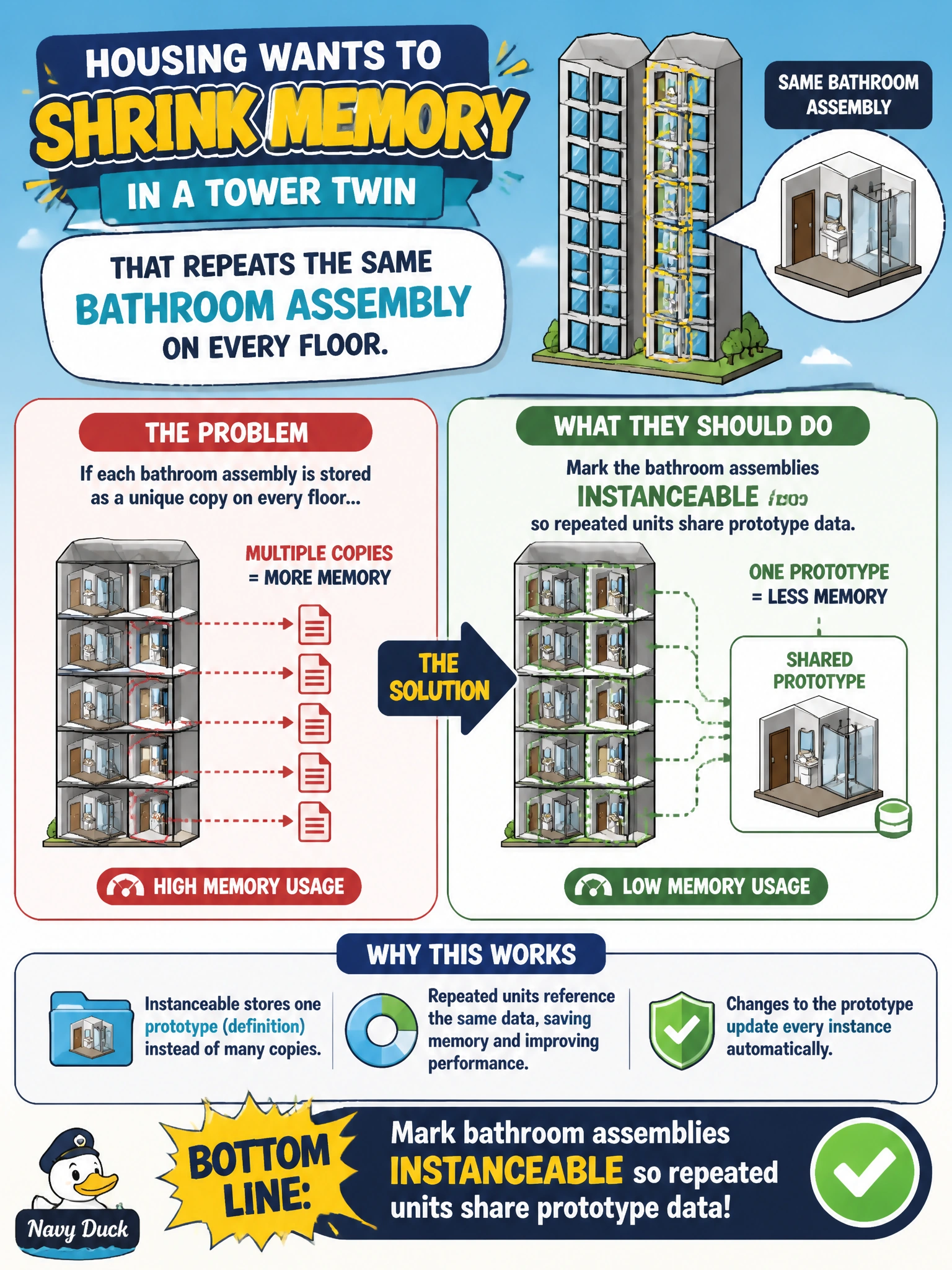
Housing wants to shrink memory in a tower twin that repeats the same bathroom assembly on every floor. What should they do?
Select an answer to reveal the explanation.
Short Explanation
Hundreds of identical bathrooms should share one recipe card. Make the assembly instanceable and let the tower twin breathe again.
Full Explanation
Housing tower twins that repeat the same bathroom assembly on every floor should mark those bathroom assemblies instanceable so repeated units share prototype data. Instancing shrinks memory by sharing meshes, materials, and hierarchical structure across floors while preserving per-unit placement. For authority-scale residential packages, this is the difference between a workable tower stage and an unmanageable unique-prim explosion.
Payloading each bathroom as a unique unshared USDA with full materials may help load deferral per unit but does not share prototype data across units the way instancing does; unique unshared payloads still multiply composed unique content when opened. Deleting bathroom geometry and replacing it with annotation spheres removes the twin's spatial truth for clearances, renovations, and resident services planning. Specializing every bathroom under a different LIVERPS strength tier misunderstands composition: LIVERPS ordering is not a memory-optimization tool and 'different strength tiers' per bathroom does not create sharing.
Exam caveat: payloads and instances solve different problems—deferral vs sharing. The exam often pairs them as distractors. Choose instancing when the assembly is identical and memory/sharing is the goal; choose payloads when working-set load control is the goal (and you can still instance inside payloads).
Operational check: enable instanceable on the bathroom assembly, instance per floor/unit, inspect instance sharing in your USD diagnostics, compare memory before/after on a multi-floor stage, and confirm a prototype plumbing fix propagates to all units that still share it.