
An airport twin reuses the same jet-bridge wheel assemblies across many gates. How should staff organize them for scale?
Select an answer to reveal the explanation.
Short Explanation
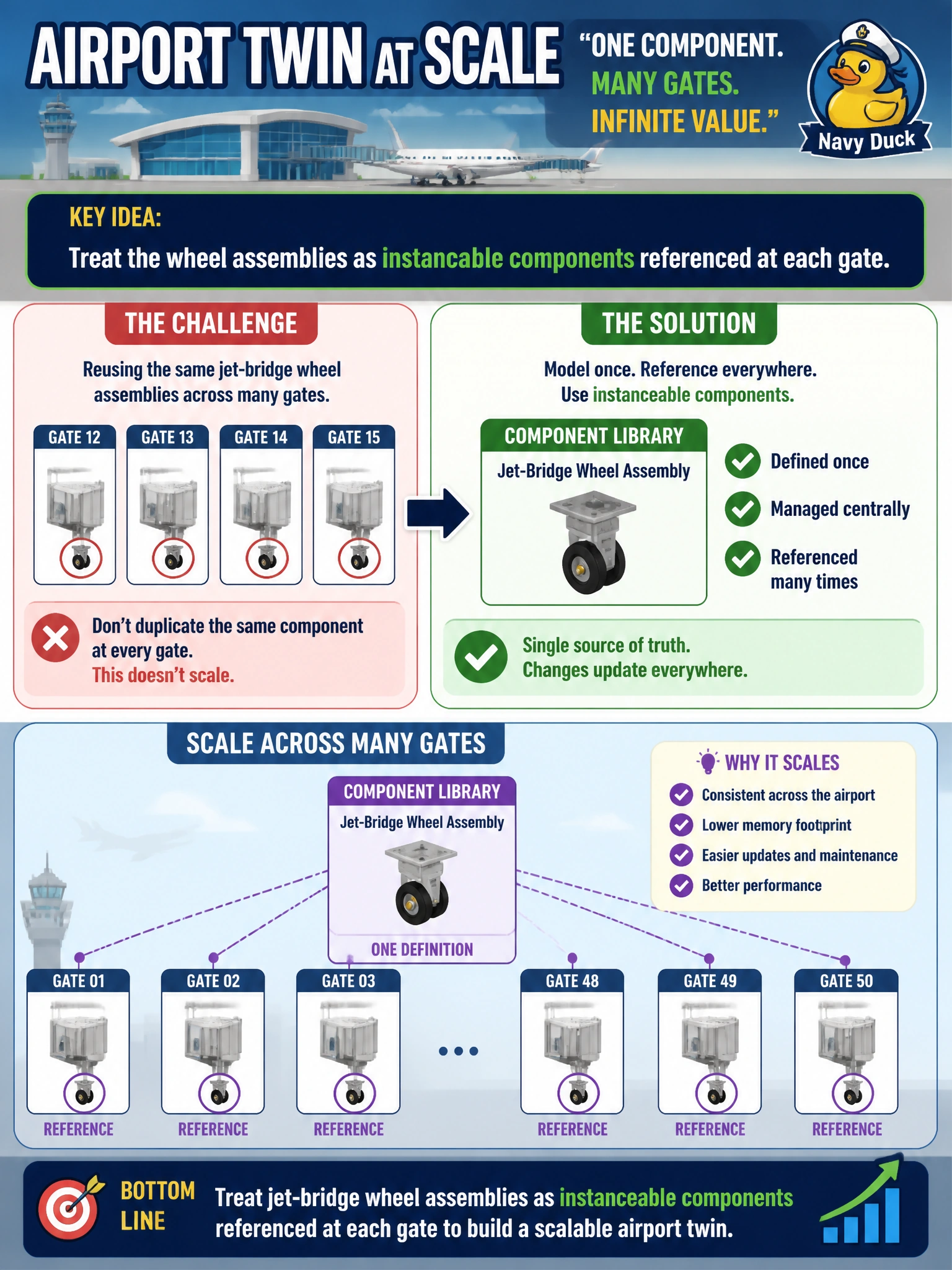
Gate after gate, the same wheels—no need to reinvent the tire. Treat the wheel assembly as an instanceable component and reference it at each jet bridge.
Full Explanation
Airport twins that reuse the same jet-bridge wheel assemblies across many gates should treat those assemblies as instanceable components referenced at each gate. This gives you a scalable organization: one validated mechanical assembly, many gate placements, shared updates for tire or hub revisions, and predictable memory behavior as gate count grows.
Creating a separate, uniquely authored wheel asset and root layer for every gate multiplies roots and identities, complicates asset resolution, and prevents sharing. Embedding wheel meshes as anonymous prims with no asset identity blocks catalog governance, reuse, and resolver-friendly packaging; anonymous geometry is hostile to municipal asset management. Storing wheels only as timesampled camera moves without geometry fails a twin that needs physical gate-interface visualization, clash checks, or training.
Exam caveat: componentization plus instancing is the aggregation pattern. A component without instanceable may still be referenced uniquely everywhere; the key distinction is that identical assemblies should use instanceable reuse. Do not confuse authoring a separate wheel asset and root layer for every gate with referencing a shared component. Practical check: publish the wheel assembly as an instanceable component asset, reference it under each jet bridge, confirm instances share the prototype, move one gate’s bridge without breaking others, and verify a hub-material update on the component appears at all gates that still instance it.