
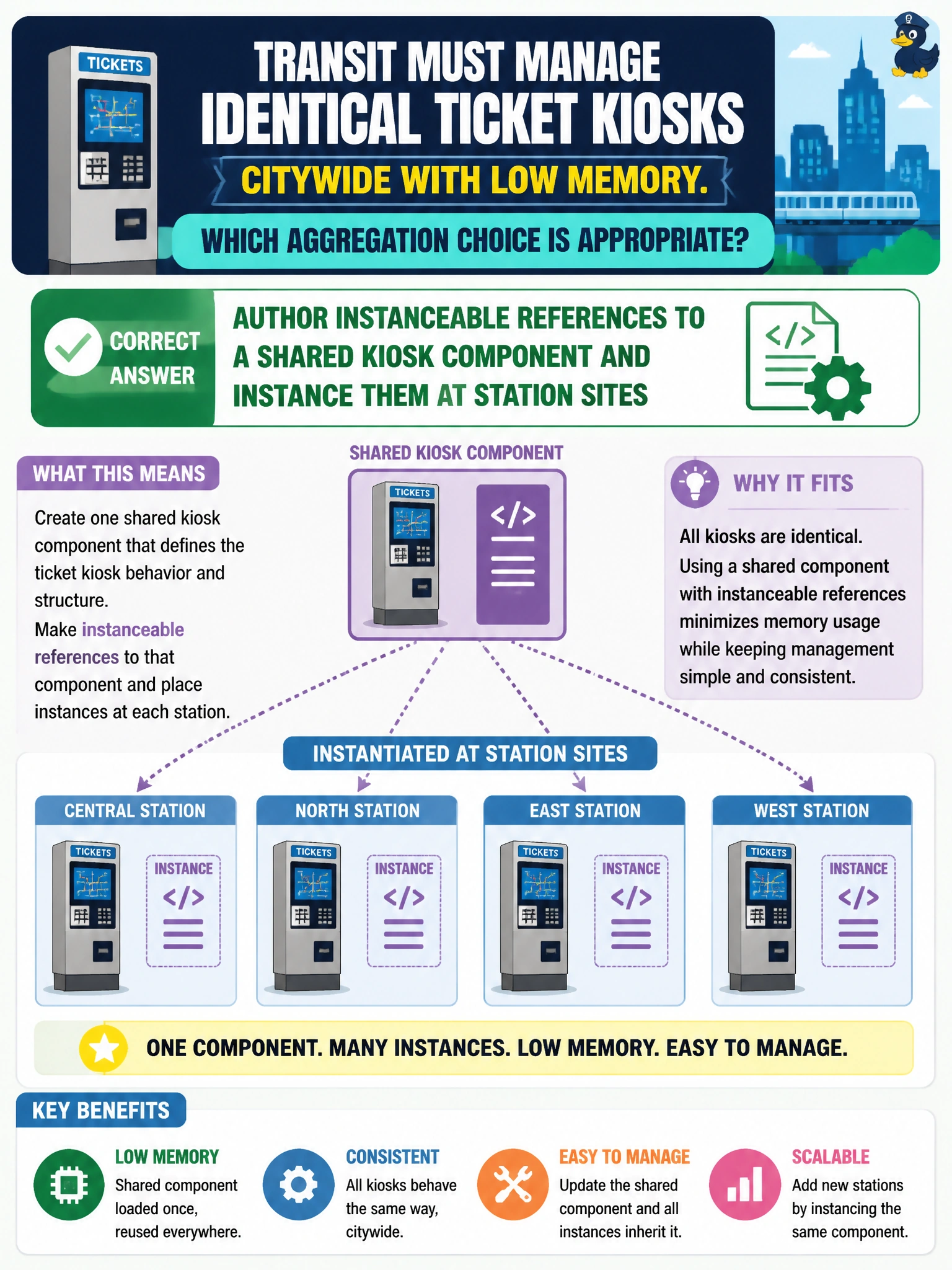
Transit must manage identical ticket kiosks citywide with low memory. Which aggregation choice is appropriate?
Select an answer to reveal the explanation.
Short Explanation
One kiosk blueprint, many stations—that is classic instancing. Mark the component instanceable and reference it everywhere it appears.
Full Explanation
Transit ticket kiosks repeated citywide should be authored as instanceable references to a shared kiosk component and then instanced at station sites. This aggregation choice keeps memory low, preserves a single source of truth for kiosk geometry and materials, and lets stations differ only by placement (and allowed per-instance overrides). Municipal operations benefit when a kiosk hardware refresh updates the shared component rather than dozens of duplicated station folders.
Duplicating the kiosk asset into each station folder with unique absolute paths creates fork drift, multiplies storage, and invites path breakage across environments. Merging every kiosk into the station root mesh during a nightly flatten destroys component identity, blocks selective updates, and turns a maintainable twin into baked soup. Representing kiosks only as camera bookmarks with no geometry fails any twin use case that needs visual, spatial, or clearance-accurate kiosks for planning and public exhibit stages.
Exam caveat: instanceable references are not the same as payloads alone. Payloads defer loading; instancing shares prototype data among loaded instances. Municipal packages often use both—payload for working sets, instancing for repetition—but this question targets instancing for identical kiosks.
Operational check: confirm the kiosk component is instanceable, place instances at multiple stations, measure that unique prototype data does not multiply per station, update a material on the shared component, and verify all station instances pick up the change unless intentionally overridden.