
A city twin repeats identical ADA ramp components across many downtown blocks and needs efficient reuse. What should the aggregation lead implement?
Select an answer to reveal the explanation.
Short Explanation
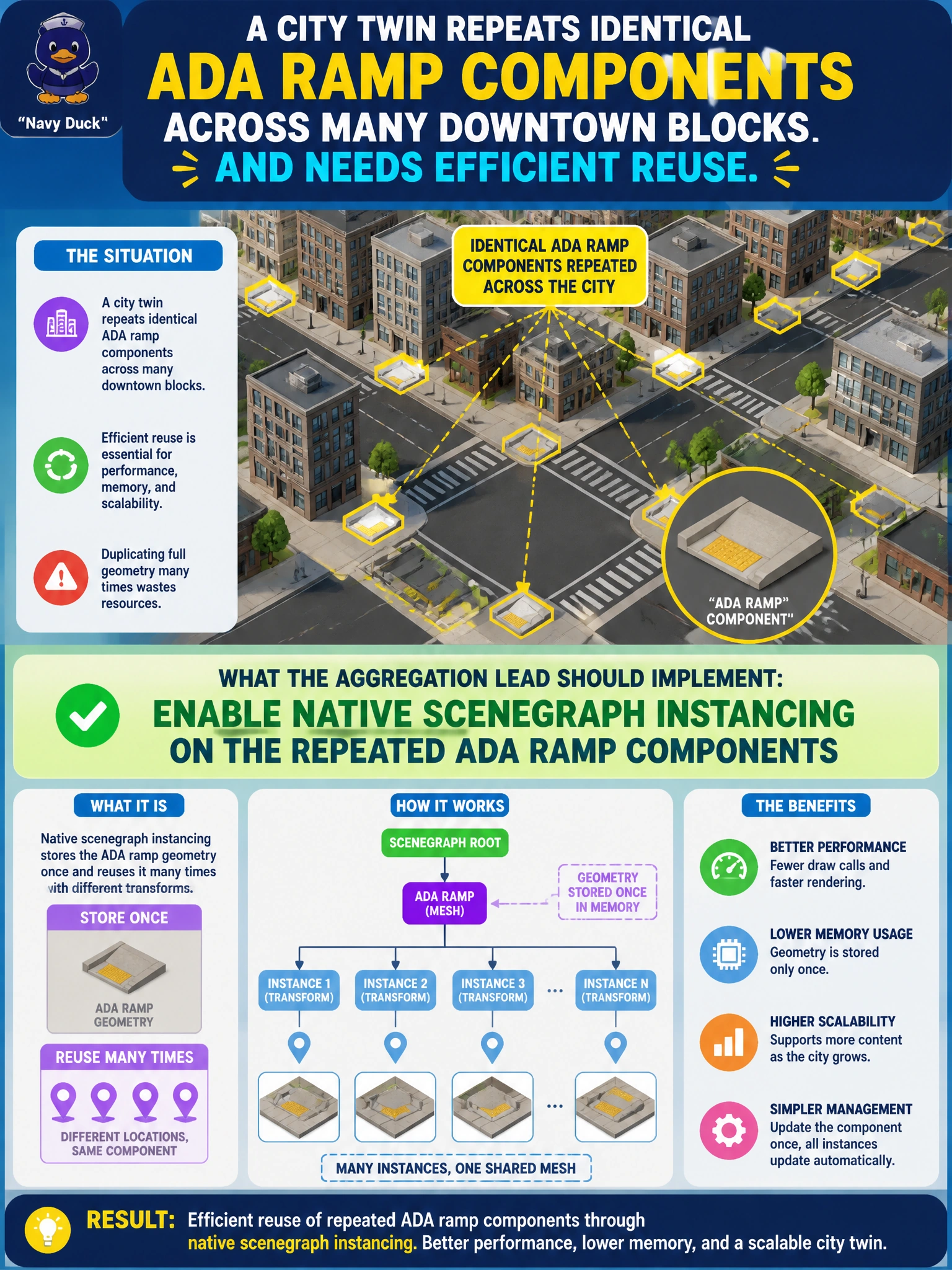
You’ve got identical ramps repeated across downtown, so they’re ideal for reuse. Enable native scenegraph instancing to place them efficiently without duplicating the same components.
Full Explanation
For identical ADA ramp components repeated across downtown blocks, enable native scenegraph instancing. This lets you share prototype geometry, materials, and structure while placing many ramp instanceProxies at curb locations. You get one approved ramp design with many compliant placements, lower memory use, and centralized catalog updates when the ADA detail changes. Storing each ramp as an independent flattened USDC with duplicated materials maximizes uniqueness and storage cost; flattening also hardens copies, so catalog updates do not propagate cleanly. Inlining ramp meshes under every curb prim without sharing repeats topology everywhere and defeats aggregation discipline. Baking ramps into street textures removes real geometry needed for clearance checks, simulation, and accessibility review; textures cannot replace model hierarchy in a digital twin. Exam caveat: “identical” is the key condition. If ramps differ by corner, selective unique references or variants may be needed; for identical components, native instancing is the expected approach. Practical check: mark the ramp component instanceable, reference it across blocks, confirm instance counts in the aggregator, edit the prototype once and verify that all downtown instances update, then spot-check that accessibility metadata on the shared component composes onto each placement.