
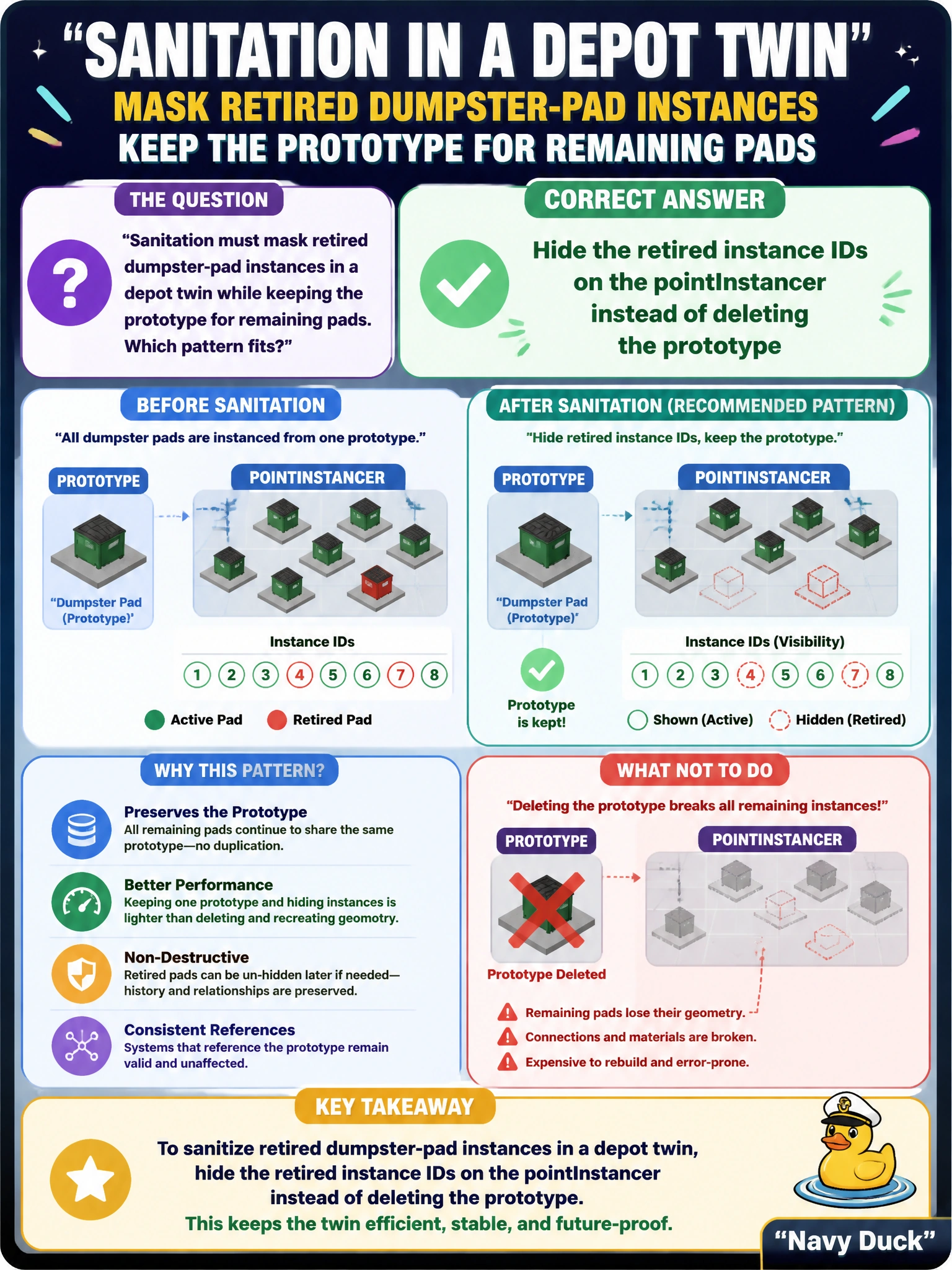
Sanitation must mask retired dumpster-pad instances in a depot twin while keeping the prototype for remaining pads. Which pattern fits?
Select an answer to reveal the explanation.
Short Explanation
Retired pads are like closed checkout lanes—tape them off, do not demolish the store. Hide those instance IDs and keep the dumpster-pad prototype.
Full Explanation
Sanitation depot twins often retain a dumpster-pad prototype even when some pads are retired from service. The fitting pattern is to hide the retired instance IDs on the pointInstancer instead of deleting the prototype. Active pads keep sharing the prototype; retired pads disappear from visualization and planning views; and the depot can reopen a pad later without re-ingesting geometry. This matches municipal reality: infrastructure can be mothballed without demolishing the standard pad design.
Removing the pointInstancer schema API from the depot root prim is unrelated and harmful—it can invalidate the population prim itself rather than masking a subset of instances. Collapsing all pads into a single extent box so retired ones 'disappear' destroys pad identity, spatial accuracy, and any per-pad metadata needed for operations. Replacing each pad with a payload that loads an empty USDA stub may hide geometry but replaces a clean instance mask with payload churn, empty-asset sprawl, and weaker intent signaling than inactive/hidden instance IDs.
Exam caveat: retired ≠ deleted. OpenUSD aggregation questions reward reversible population control over destructive prototype or schema removal. Also avoid confusing schema API removal with instance masking—two different failure modes.
Operational check: list active vs retired instance indices, confirm only retired IDs are hidden, validate remaining pads still instance the shared prototype, and document the mask in the depot overlay so future staff do not 'fix' by deleting the prototype.