
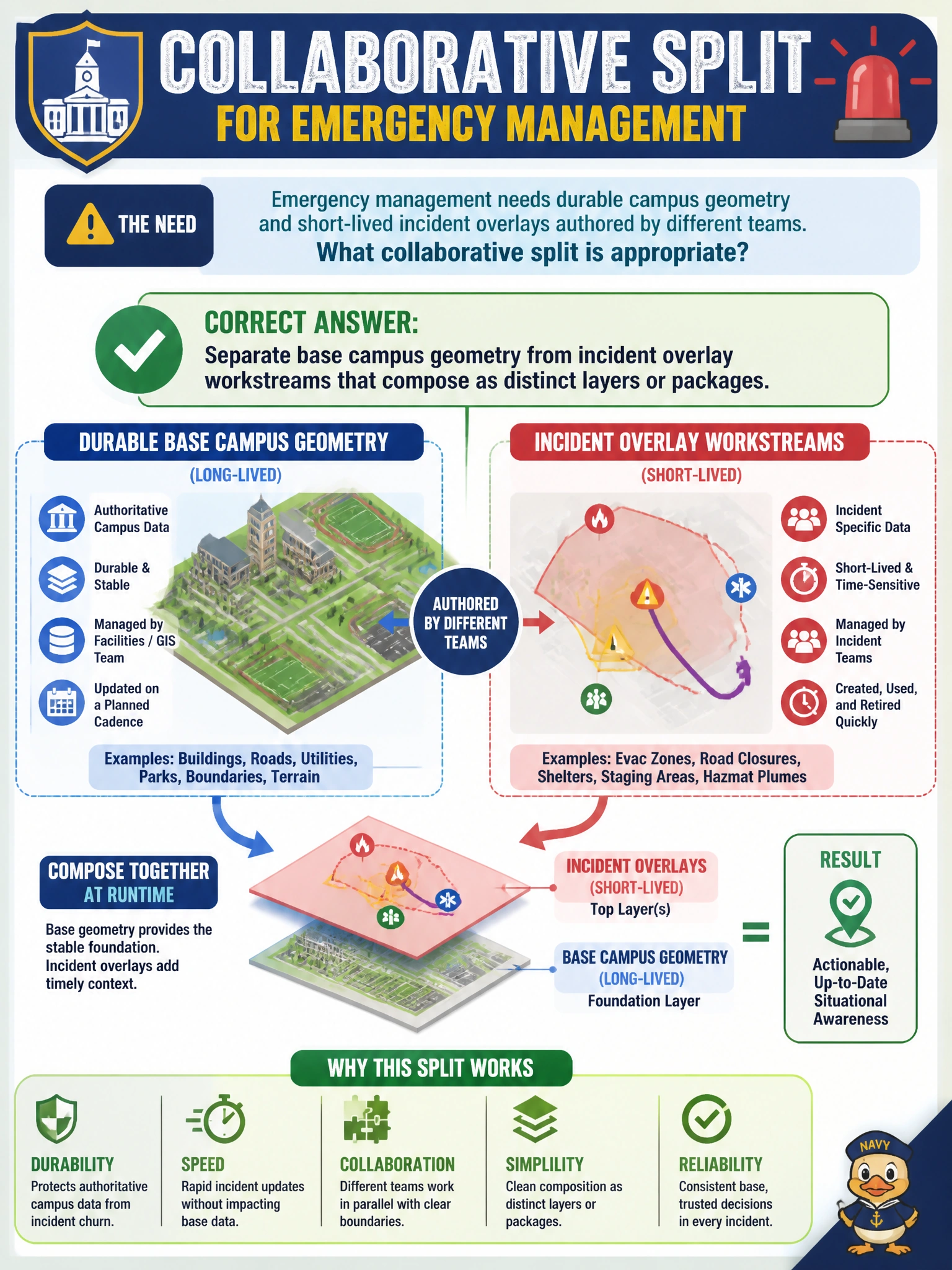
Emergency management needs durable campus geometry and short-lived incident overlays authored by different teams. What collaborative split is appropriate?
Select an answer to reveal the explanation.
Short Explanation
The campus bones stay put; the incident stickers come and go. Keep base geometry in one workstream and incident overlays in another that composes on top. That way ops can update emergencies without remodeling the school every time.
Full Explanation
Emergency management should separate durable campus geometry from short-lived incident overlay workstreams that compose as distinct layers or packages. Campus bones and incident stickers have different owners, update rates, and retention policies. Keeping them apart lets ops update emergencies without remodeling school walls each shift, while the composed stage still shows incidents in context for response planning.
Authoring incidents by permanently rewriting campus wall topology each shift pollutes durable assets with transient events. Merging incident overlays into the campus defaultPrim with no layer boundary destroys lifecycle separation. Disabling composition and emailing screenshots only abandons a queryable, updatable twin for coordination.
Exam caveat: incident overlays that must win over base attributes need sufficient strength (often local/layer opinions above referenced campus content)—separation without strength design can leave overlays invisible. Operational check: compose campus base with an incident overlay package; update the overlay without touching campus geometry; remove or mute the overlay and confirm campus remains intact. Verify time-bounded incidents can be archived by retiring overlay packages rather than rolling back campus topology.