
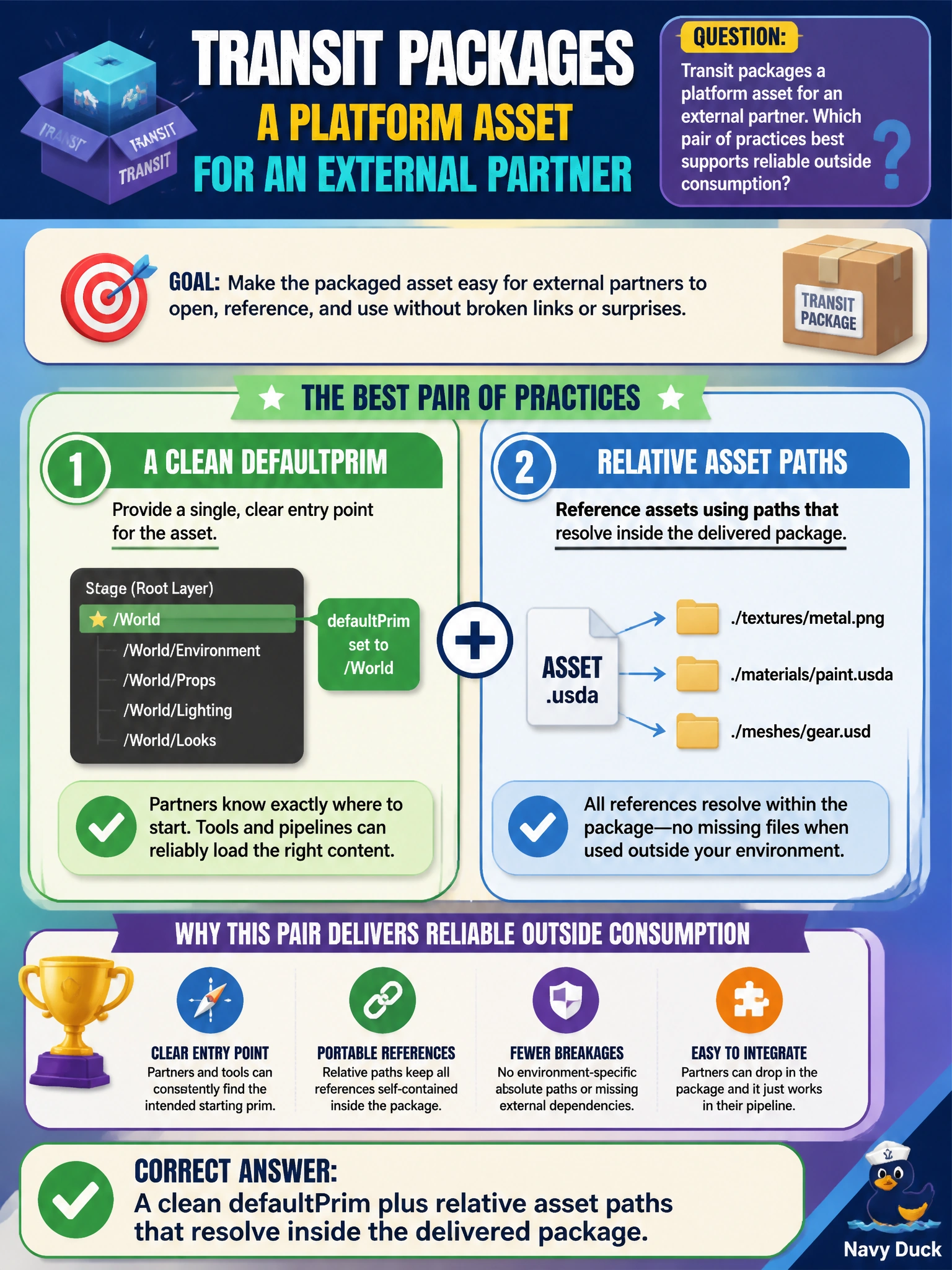
Transit packages a platform asset for an external partner. Which pair of practices best supports reliable outside consumption?
Select an answer to reveal the explanation.
Short Explanation
Give partners a front door and a map that travels with the box: defaultPrim is the door, relative paths are the map. Absolute paths to your NAS die the moment the package leaves the building. Clean entry plus portable paths keep the platform package usable outside transit HQ.
Full Explanation
Reliable external consumption of a transit platform asset rests on a clean defaultPrim plus relative asset paths that resolve inside the delivered package. Partners open the intended root and resolve textures, references, and related assets without city NAS mounts or machine-specific usernames. That pair of practices—entry prim clarity and portable pathing—supports outside review and integration far better than internal absolute layouts.
Absolute NAS paths with no defaultPrim fail off-network and force partners to guess the root. Hard-coded machine usernames in asset paths are non-portable by design. Omitting payloads documentation while keeping broken absolute texture paths combines unresolved media with unclear deferred content, guaranteeing incomplete opens.
Exam caveat: relative paths still require a correct search path or package-relative layout; shipping relatives that point outside the package is not enough. Operational check: copy the package to a clean directory on another machine, open via defaultPrim, and verify materials and references resolve without environment variables pointing at city servers. Fix any remaining absolute path, declare payload requirements explicitly, and confirm the partner’s viewer shows the complete platform assembly intended for delivery.