
A housing authority exports a unit assembly for a general contractor’s USD viewer. What payload-related delivery practice is appropriate?
Select an answer to reveal the explanation.
Short Explanation
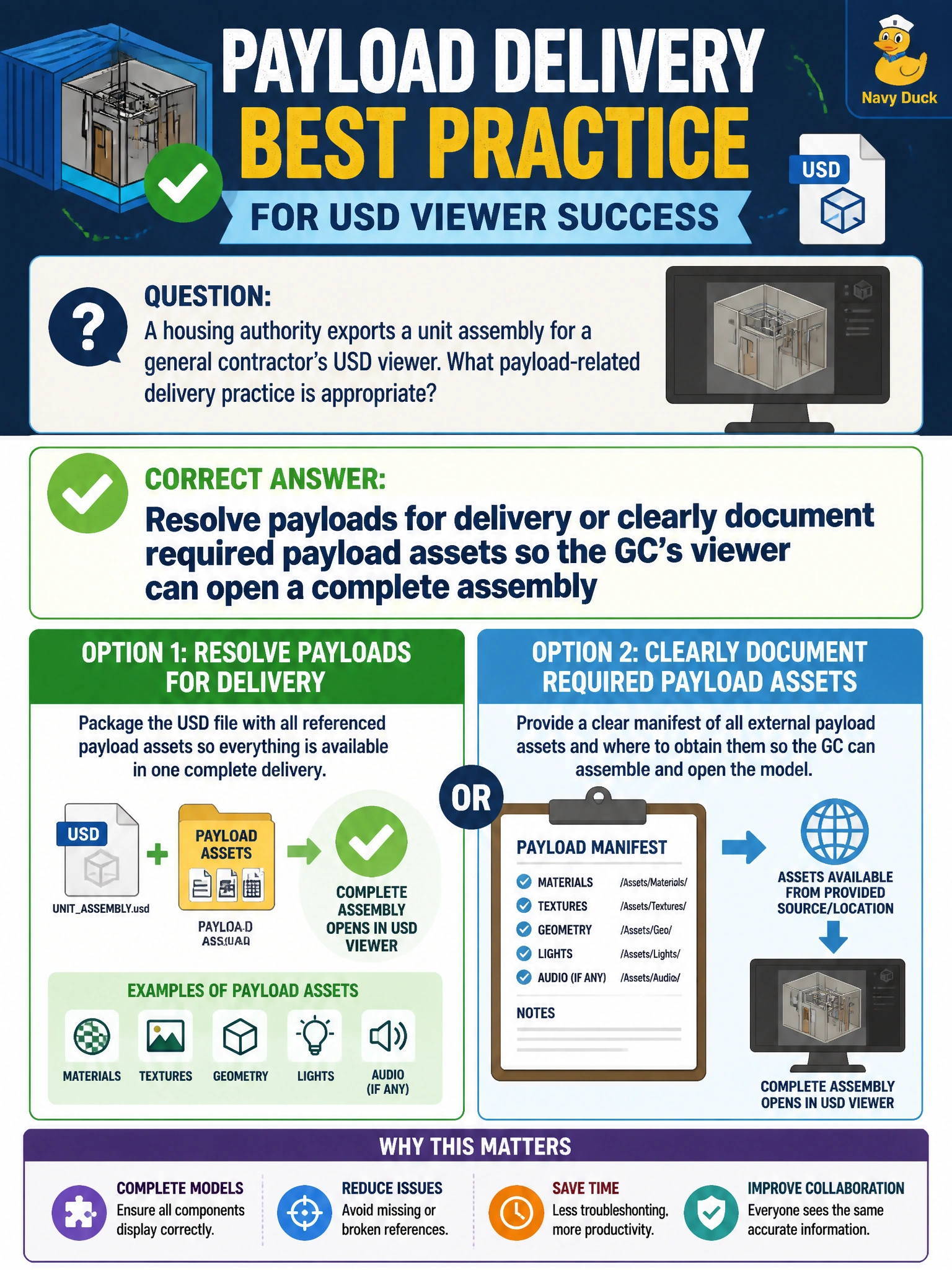
Payloads are the moving boxes in the unit assembly—great for deferred loading, terrible if the contractor gets an empty room and no packing list. Either resolve what’s needed for their viewer or document which payload assets must come along. Don’t ship a mystery box.
Full Explanation
Payloads defer loading; they do not invent missing content. When a GC’s viewer must open a complete housing-unit assembly, leads should resolve payloads needed for delivery or clearly document required payload assets so the recipient can obtain and load them. Shipping unresolved payloads without a packing list produces empty or incomplete assemblies that look like corruption when they are really deferred inclusions the GC was never told about.
Replacing all payloads with specializes arcs that hide missing assets confuses strength arcs with asset inclusion and does not deliver geometry. Muting every payload permanently so the export stays empty guarantees an incomplete handoff. Leaving payloads unresolved and undocumented fails the operational need for a complete assembly in the GC’s viewer.
Exam caveat: keeping payloads for internal iterative work is fine—delivery completeness is the requirement for the GC milestone, not a ban on payloads in authoring. Operational check: list payload arcs in the unit assembly, decide which must be present for GC review, either compose/resolve them into the delivery package or attach an explicit asset manifest, then open the package in a clean viewer and confirm expected rooms and finishes appear. Incomplete opens trace back to unresolved, undocumented payloads before chasing unrelated LIVERPS issues.