
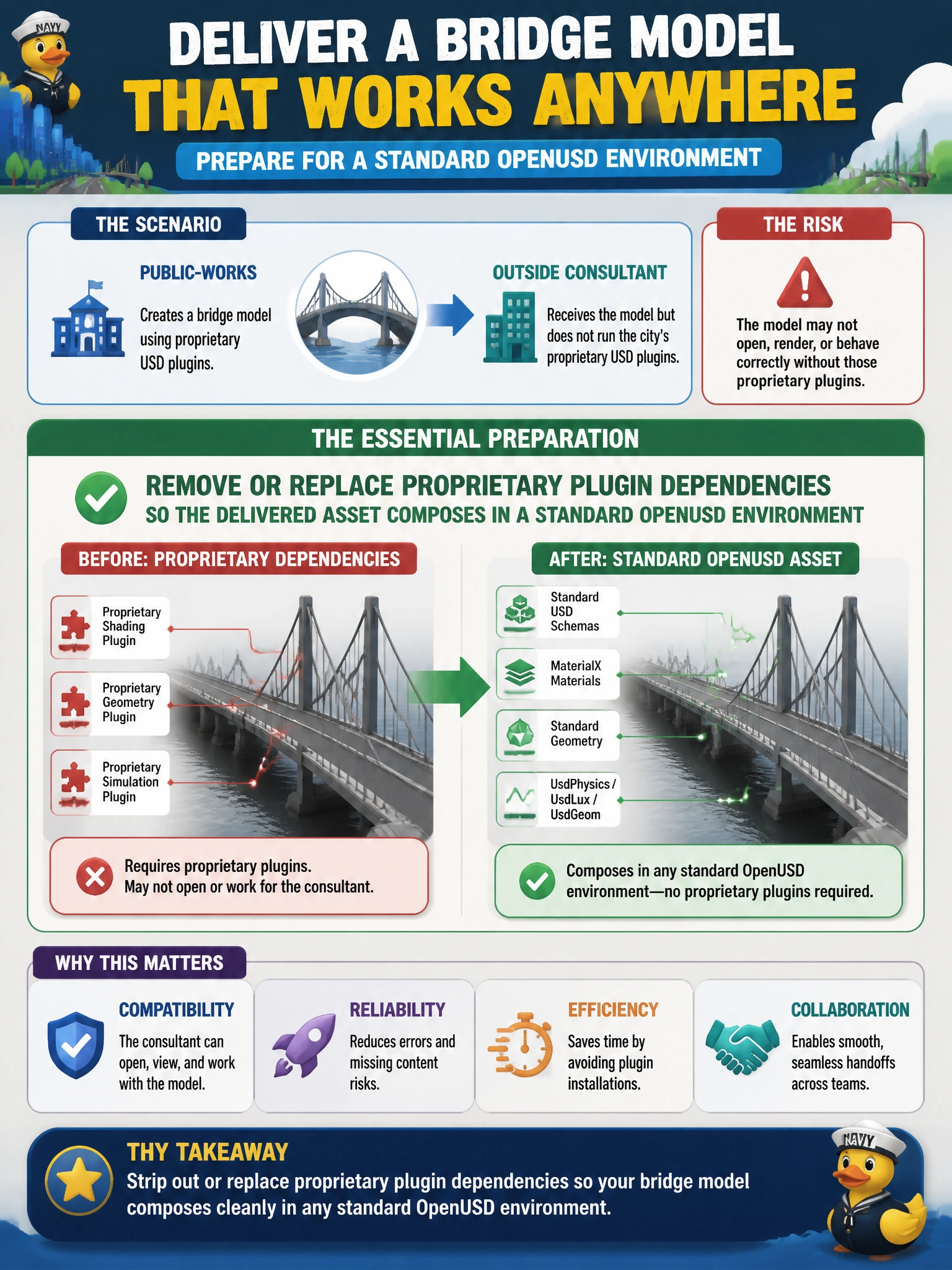
Public-works must hand a bridge model to an outside consultant who does not run the city’s proprietary USD plugins. What preparation is essential?
Select an answer to reveal the explanation.
Short Explanation
If the consultant doesn’t have your secret city plugins, a bridge that depends on them won’t open cleanly—like shipping a lock that needs a key you kept. Strip or replace those proprietary dependencies before handoff. Deliver something that composes with ordinary OpenUSD tooling.
Full Explanation
Public-works must remove or replace proprietary plugin dependencies before handing a bridge model to an outside consultant who does not run the city’s plugins. Delivered assets should compose in a standard OpenUSD environment. Plugin-locked schemas, file formats, or procedural nodes that only resolve inside the city toolchain will fail for the consultant even if the files look fine on municipal workstations. Strip, bake, or replace those dependencies with portable OpenUSD representations as part of handoff preparation.
Embedding plugin source code inside prim metadata fields does not make proprietary runtime dependencies portable and is not a supported delivery pattern. Converting the bridge exclusively to a muted sublayer that never loads ensures the consultant sees nothing. Deleting defaultPrim and all references so the consultant rebuilds from scratch destroys the asset contract and is not essential preparation—it is abandonment of composition.
Exam caveat: some domain schemas are standard; only proprietary, non-distributable dependencies need removal or replacement—do not strip legitimate OpenUSD structure. Operational check: open the handoff package on a machine without city plugins; run composition and note missing plugin errors, unresolved schemas, or empty prims. Replace those pieces with standard geometry, materials, and attributes, set a clear defaultPrim, and retest until the bridge opens cleanly for the consultant’s viewer.