
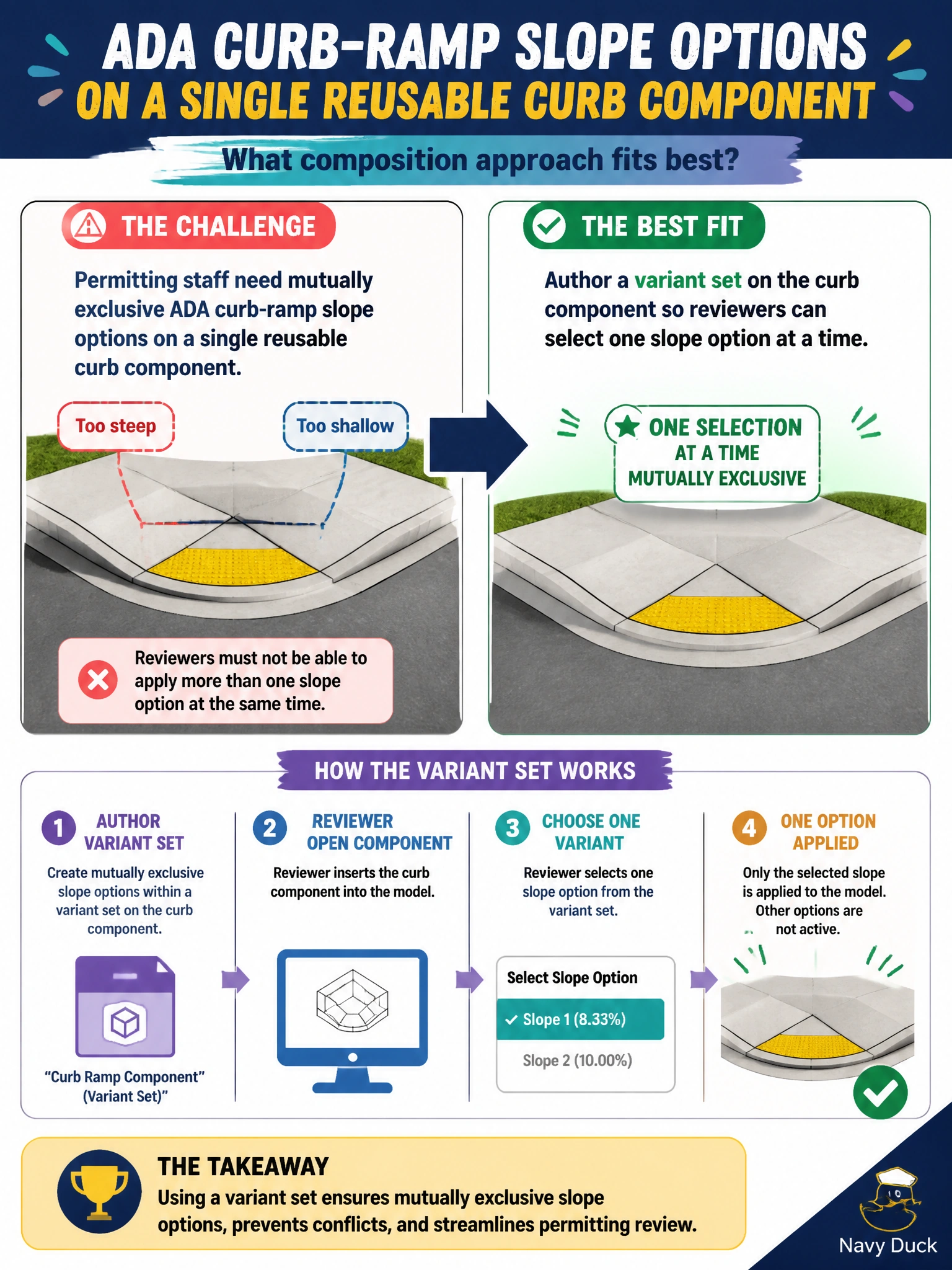
Permitting staff need mutually exclusive ADA curb-ramp slope options on a single reusable curb component. What composition approach fits best?
Select an answer to reveal the explanation.
Short Explanation
You can keep one reusable curb component and let reviewers choose among its mutually exclusive slope settings. A variant set makes that selection clear without duplicating the city twin, baking unselectable layers, or hiding the options in muted payloads.
Full Explanation
A variant set is the best fit because permitting staff need to choose one ADA curb-ramp slope at a time on a single reusable curb component. Authoring each slope as a variant preserves one component identity and lets reviewers select the configuration while keeping the stage’s composition clear. Baking every slope into separate anonymous layers that cannot be selected per instance fails because the options are not selectable configurations. Duplicating the entire city twin for each slope choice fails because it multiplies whole-scene copies instead of reusing the curb component. Storing slope options only as muted payloads that never compose into the stage fails because the options do not contribute to the stage for review. Exam caveat: variants fit when the slope choices belong to a coherent shared component; if they require incompatible topology or schemas, that assumption may not hold. Practical check: open the curb component, inspect its variant set and slope names, then select each option on a test instance and confirm the composed stage shows exactly one slope’s geometry and attributes while the component path remains stable. Document which variant encodes each ADA option for plan-check.