
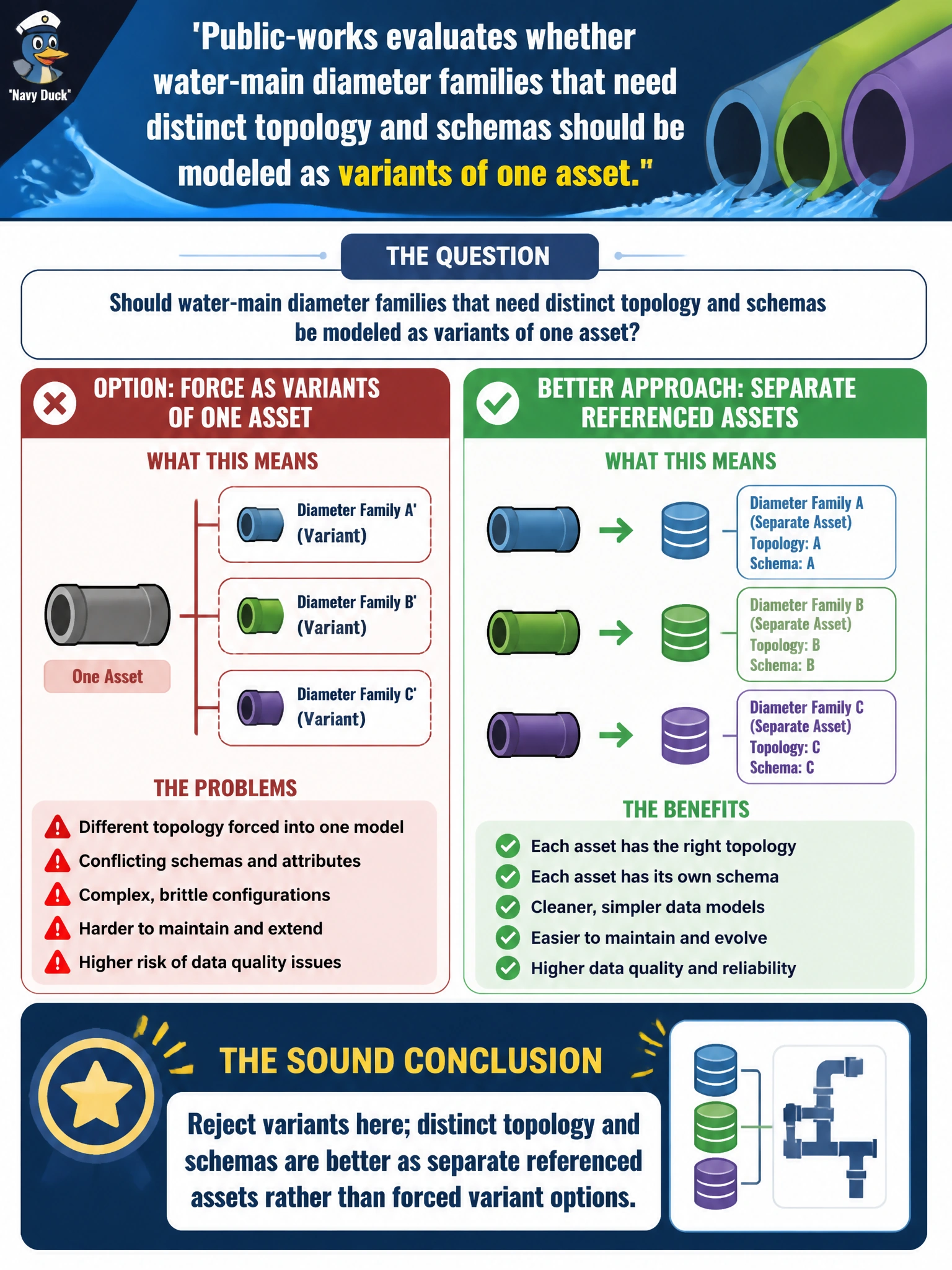
Public-works evaluates whether water-main diameter families that need distinct topology and schemas should be modeled as variants of one asset. What is the sound conclusion?
Select an answer to reveal the explanation.
Short Explanation
If the pipes don’t even share the same guts—different topology, different schemas—calling them “variants” is like labeling a fire hydrant and a water tower as paint colors of the same object. Separate referenced assets keep the truth honest. Variants are for interchangeable options on a shared structure, not forced sameness.
Full Explanation
Water-main diameter families that need distinct topology and schemas should not be forced into one variant set. Variants assume selectable alternatives within a coherent asset structure. When public-works diameters differ enough to require different meshes, relationships, or typed schemas, the honest model is separate referenced assets composed into the utility assembly. Rejecting variants here preserves clarity: each diameter family remains a truthful product with its own composition contract instead of a fake “option” that breaks shared prim assumptions.
Claiming variants are ideal because any mesh difference automatically belongs in one variant set is false—mesh difference alone does not prove shared structure or mutual exclusivity on one component. Using variants so LIVERPS can ignore schema mismatches misunderstands LIVERPS: strength order does not paper over incompatible schemas. Flattening all diameters into a single prim with no composition arcs discards reuse, parallel authorship, and clear asset boundaries that municipal pipelines need.
Exam caveat: small parametric diameter tweaks that keep the same schema and prim layout might still use variants; distinct families with divergent topology should not. Operational check: compare prim hierarchies and applied schemas across candidate diameters. If paths and types align and only selectable opinions differ, variants may work; if hierarchies diverge or schemas conflict, publish separate referenced assets and wire the correct diameter into the water-main assembly by reference rather than by variant selection.