
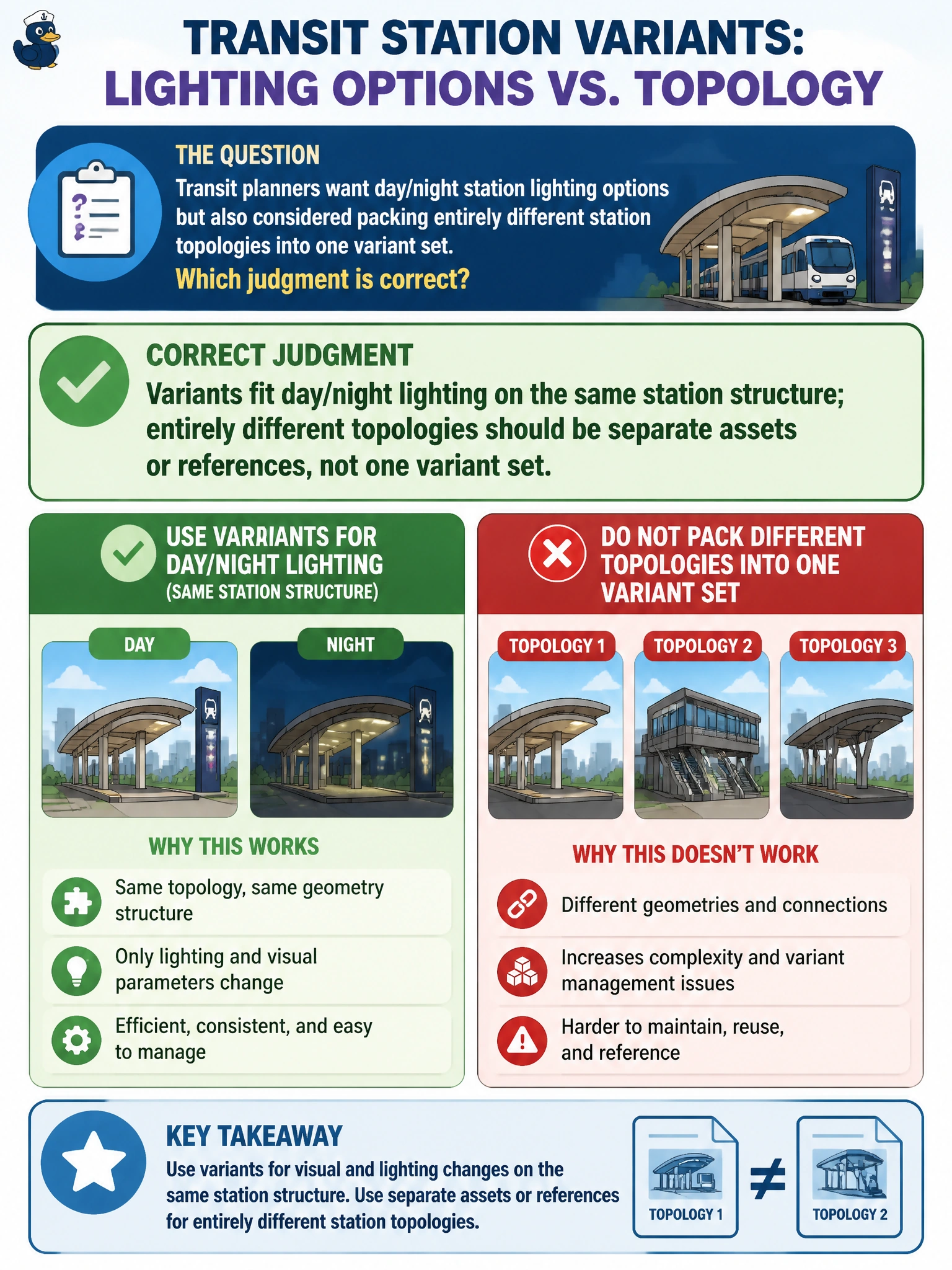
Transit planners want day/night station lighting options but also considered packing entirely different station topologies into one variant set. Which judgment is correct?
Select an answer to reveal the explanation.
Short Explanation
Day and night lights are two looks for the same station—that’s classic variant territory. Completely different station layouts are more like different buildings than different light switches. Don’t jam incompatible topologies into one variant dial just because both say “station.”
Full Explanation
Day/night station lighting on one shared station structure is a classic variant use case: mutually exclusive looks on the same topology. Transit planners can expose a lighting variant set so reviewers switch presentation without duplicating the station asset. Entirely different station topologies—different platform counts, circulation graphs, or structural shells—are not interchangeable configurations of one structure; they should be separate assets or references composed into the corridor, not jammed into one variant set merely because both are labeled “station.”
Requiring variants whenever any lighting attribute differs—even across unrelated station files—overuses variants and ignores ordinary attribute overrides and layer opinions. Packing incompatible topologies into one variant set so LIVERPS can “merge their meshes” misunderstands both variants and LIVERPS: variants select alternatives; they do not merge unrelated meshes via strength order. Claiming day/night lighting must never use variants because lighting only works through payloads confuses deferred loading with configuration selection; payloads control inclusion cost, not whether lighting looks can be variant-selected on a shared shell.
Exam caveat: a mild topology tweak that still shares the same component contract may still fit variants; wholesale layout replacement usually does not. Operational check: if switching the option would orphan prim paths, break relationships, or require different schemas, split assets. If only lights, materials, or visibility change on stable prims, keep a variant set and confirm each variant resolves cleanly in the station assembly.