
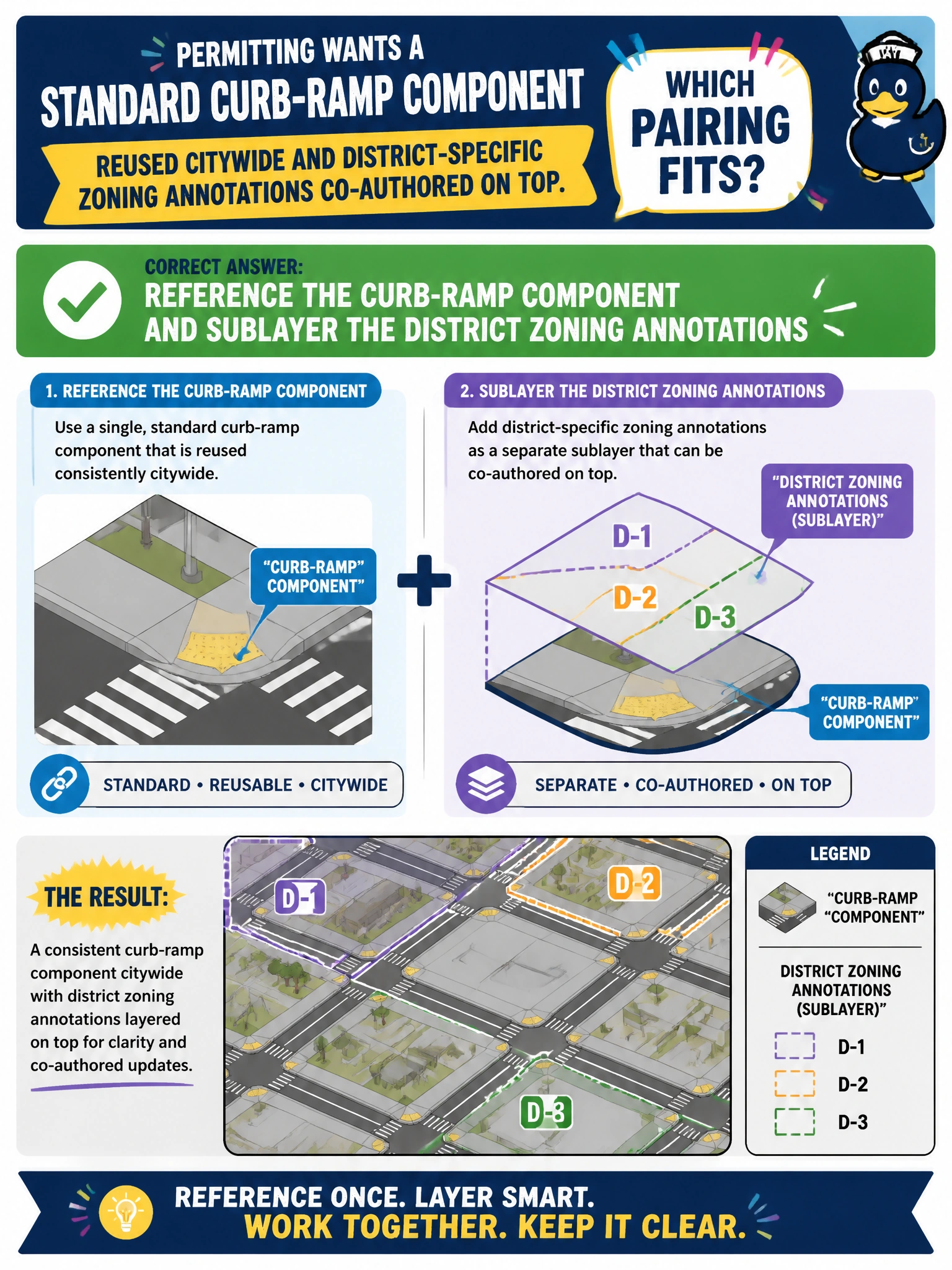
Permitting wants a standard curb-ramp component reused citywide and district-specific zoning annotations co-authored on top. Which pairing fits?
Select an answer to reveal the explanation.
Short Explanation
The curb ramp is a shared catalog part—reference it. District zoning notes are the sticky collaborative overlay—sublayer those. Flattening before review locks reviewers out of clean co-authoring.
Full Explanation
Reusable standards and collaborative overlays want different arcs. Permitting that needs a standard curb-ramp component reused citywide and district-specific zoning annotations co-authored on top should reference the curb-ramp component and sublayer the district zoning annotations. The curb ramp is a catalog-style reusable asset; district zoning notes are collaborative, place-specific contributions that fit sublayer co-authoring over shared structure.
Sublayering the curb-ramp mesh into every parcel and referencing zoning as textures only fails by concept: sublayering the reusable mesh everywhere duplicates contribution patterns poorly, and reducing zoning to textures alone loses structured annotation authorship. Payloading zoning annotations and never reusing the curb-ramp fails because zoning overlays are not primarily a deferral problem here, and abandoning curb-ramp reuse wastes the standard component library. Flattening curb ramps and zoning into one USDC before any review fails because flatten locks reviewers out of clean multi-layer co-authoring during the review cycle.
Exam caveat: reference = reusable component; sublayer = collaborative district overlay; flatten is for delivery, not mid-review. Operational check: reference one curb-ramp asset across parcels, author zoning on district sublayers, have two reviewers edit separate zoning sublayers without stomping the ramp reference, and only flatten if producing a sealed permitting package after review.