
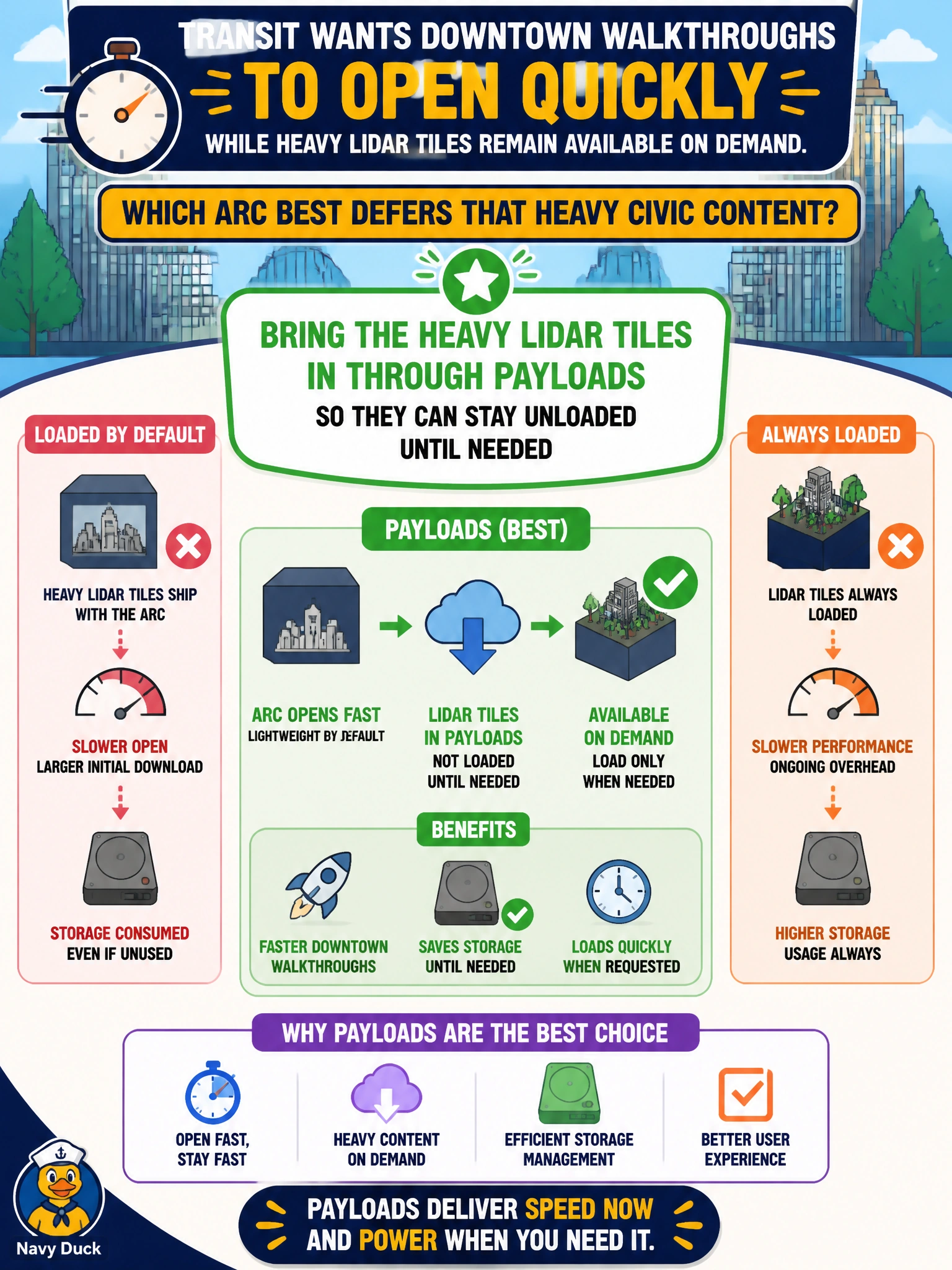
Transit wants downtown walkthroughs to open quickly while heavy LiDAR tiles remain available on demand. Which arc best defers that heavy civic content?
Select an answer to reveal the explanation.
Short Explanation
LiDAR tiles are the warehouse crates you don’t open until the field crew asks. Payloads keep them off the initial load so downtown walkthroughs stay snappy. Sublayering or inlining everything at open time is the opposite of deferred civic content.
Full Explanation
Deferred loading is the job of payloads. Transit wanting downtown walkthroughs to open quickly while heavy LiDAR tiles remain available on demand should bring those LiDAR tiles in through payloads so they can stay unloaded until needed. Payloads participate in composition with weaker strength than references but, critically here, support deferral so interactive downtown navigation is not blocked by full LiDAR I/O at stage open.
Always sublayering every LiDAR tile into the root so they load with the stage fails conceptually: sublayers contribute immediately to the working set and defeat the performance goal. Inlining all LiDAR points as root attributes for “fastest I/O” fails because stuffing massive point sets into root attributes is not a deferred composition strategy and can worsen open cost and authoring sanity. Referencing the LiDAR with no deferral so composition forces immediate full load fails because non-deferred references pull content into the composed working set more eagerly than payloads intended for heavy optional tiles.
Exam caveat: heavy optional civic data → payload deferral; do not confuse sublayer collaboration or references with deferral. Operational check: open the downtown walkthrough stage and confirm LiDAR payloads remain unloaded (or load only on demand); trigger load for a tile when a field review needs it; measure cold-open time against a forced-sublayer baseline to prove the deferral benefit.