
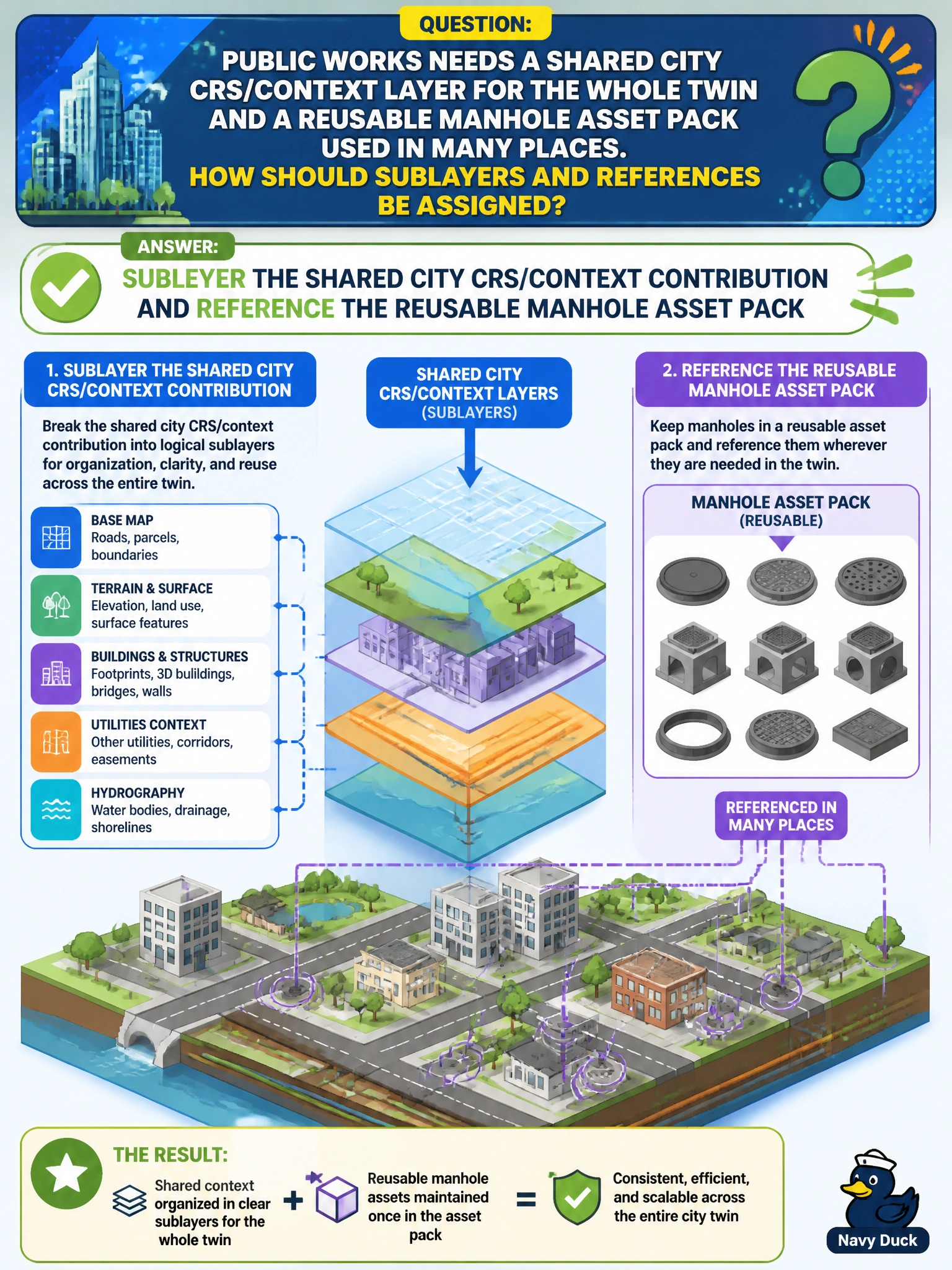
Public works needs a shared city CRS/context layer for the whole twin and a reusable manhole asset pack used in many places. How should sublayers and references be assigned?
Select an answer to reveal the explanation.
Short Explanation
Shared city context is like the base map sheet everyone draws on—that’s a sublayer. The manhole catalog is a reusable Lego brick—you reference it. Mixing those roles makes collaboration and reuse harder.
Full Explanation
Sublayers and references serve different municipal roles. Public works needing a shared city CRS/context layer for the whole twin and a reusable manhole asset pack used in many places should sublayer the shared city CRS/context contribution and reference the reusable manhole asset pack. Sublayers contribute collaborative shared context into the layer stack; references bring reusable component assets into the prim hierarchy without owning them as the city’s only base map sheet.
Referencing the CRS layer and sublayering every manhole copy as a unique file fails by reversing roles: CRS/context wants shared collaborative sublayer contribution, while manholes want reusable referenced components—not unique per-copy sublayers. Payloading both CRS and manholes so nothing opens until clicked fails because always-needed city context should not be deferred wholesale, and treating both the same ignores working-set vs reusable-component design. Baking CRS and manholes into one flattened delivery for all internal edits fails because premature flatten harms collaborative edits and reusable pack updates inside the organization.
Exam caveat: shared context → sublayer; reusable packs → reference; payload/flatten are not default substitutes. Operational check: open the twin with the CRS sublayer active and confirm spatial context aligns; reference manholes at multiple sites from one pack; update the pack once and confirm consuming sites pick up the change without rewriting CRS; avoid flatten until a true delivery milestone.