
An airport airside twin has unique jet-bridge configurations and hundreds of identical traffic cones. Which instancing split is most appropriate?
Select an answer to reveal the explanation.
Short Explanation
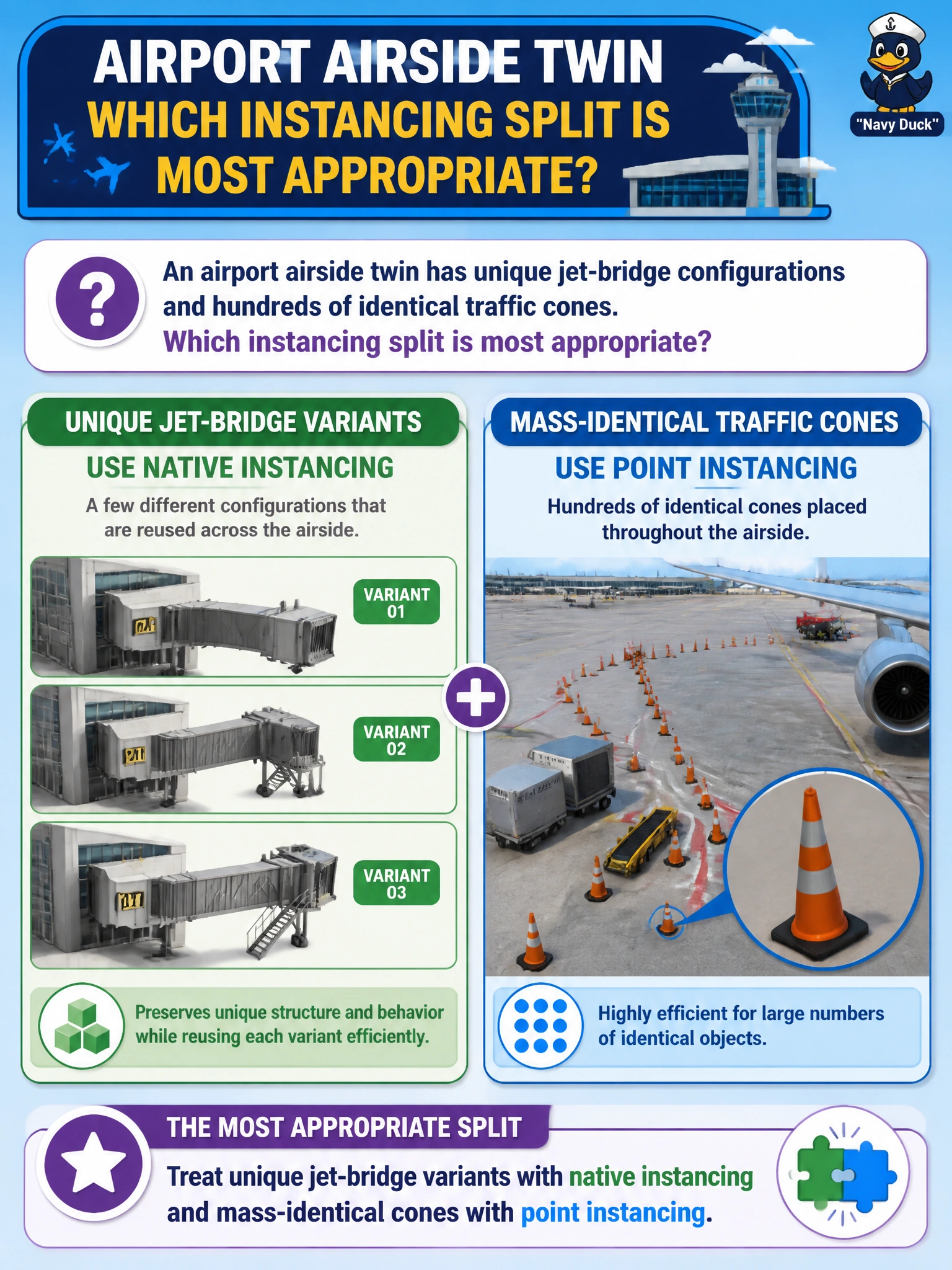
Jet bridges are one-off machines; cones are a pallet of the same orange marker. Native-style instancing for the unique bridges, point instancing for the cones. Flattening everything into one blob throws away that scale judgment.
Full Explanation
Airside twins mix unique configurable equipment with mass-identical clutter. The appropriate split is to treat unique jet-bridge variants with native instancing and mass-identical traffic cones with point instancing. Native scenegraph instancing better preserves per-variant jet-bridge structure for unique gate configurations, while point instancing handles hundreds of identical cones with one prototype and many instance transforms—matching airport operational scale.
Point-instancing jet bridges and native-instancing every cone as a unique sculpture fails by reversing the split: unique bridges lose needed structure under indiscriminate point instancing, and treating identical cones as unique sculptures wastes memory. Flattening jet bridges and cones into one monolithic mesh with no arcs fails because it destroys composition reuse, variant handling, and independent update of cones vs bridges. Using only sublayers for cones and only payloads for jet bridges regardless of scale fails because arc choice alone (sublayer vs payload) is not a substitute for the uniqueness-vs-density instancing judgment the question asks.
Exam caveat: pick instancing style from asset characteristics, not from a single arc habit. Operational check: author jet-bridge variants as native-style instances, author cones via pointInstancer, open the airside stage, confirm bridge variants remain distinct and editable, confirm cone prototype count stays low, and validate memory stays within twin budgets for a busy apron scene.